
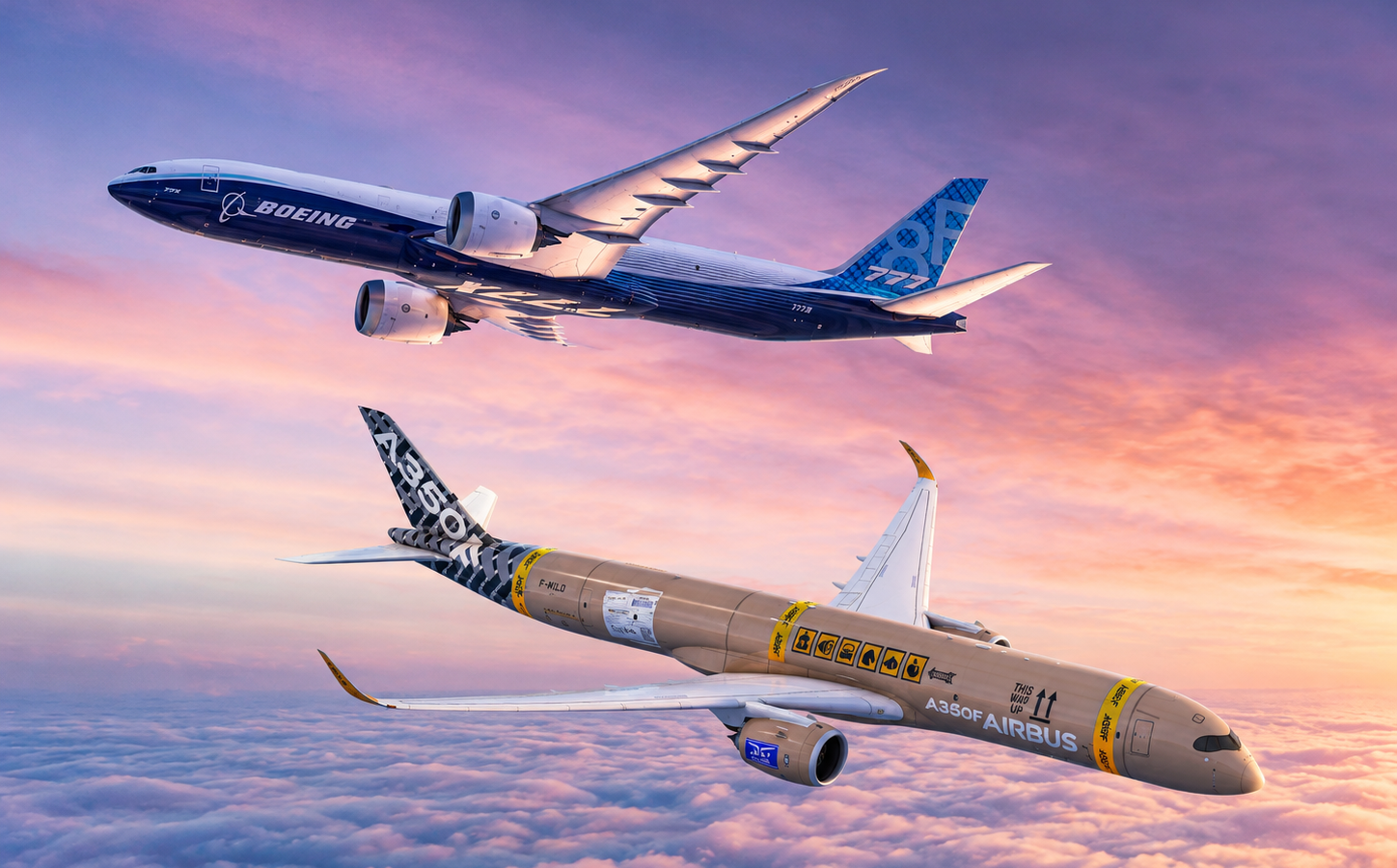
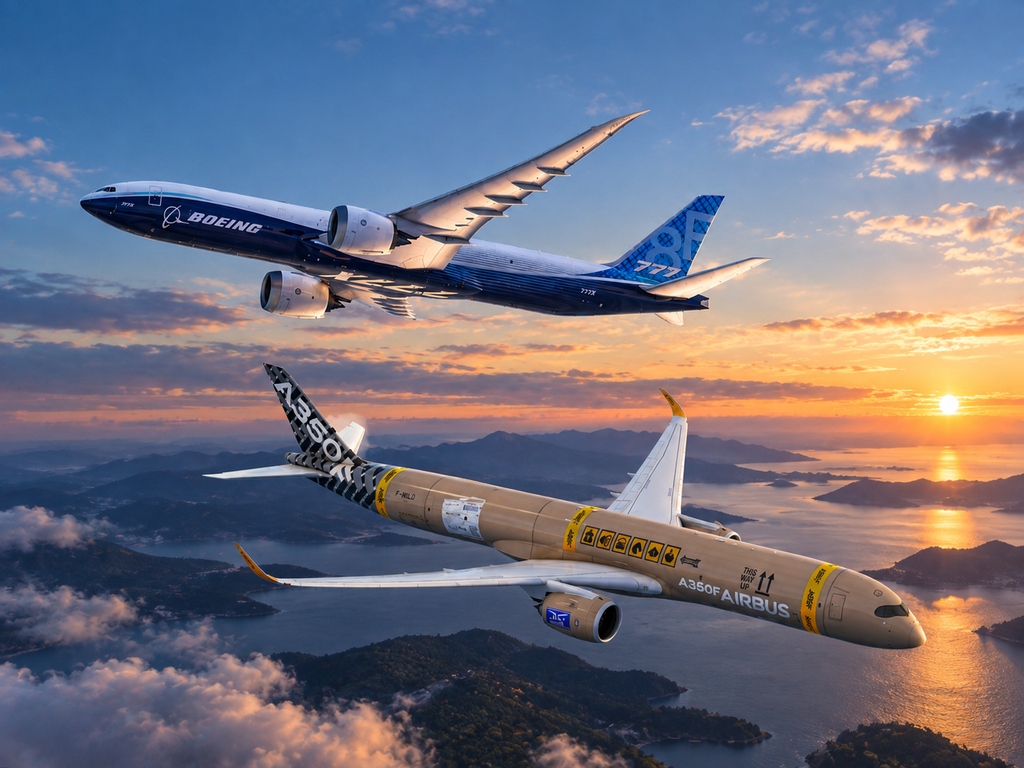
The next battle between Airbus & Boeing is heating up via the Boeing 777XF and the Airbus A350F. Which one will win the battle?
The next generation freighter war is already underway, and neither jet has carried a single revenue pallet yet. Boeing calls its entrant the 777-8 Freighter, commonly shortened to the 777-8F or referred to informally as the 777X Freighter.
Airbus calls its answer the A350F. Both are derivatives of existing widebody passenger platforms, both target the space vacated by ageing 747-400Fs and 767Fs, and both are chasing the same customer list of integrators, lessors and legacy cargo carriers.
With the A350F now weeks from its first flight and the 777-8F still years from delivery, the picture on which programme actually wins is starting to sharpen.
This analysis looks at three measures: who is winning the sales race, which aircraft holds the operational edge, and which programme is best placed for long term success.
The Sales Battle: Order Books Compared For Boeing & Airbus
Airbus currently holds the numerical lead.
Following an undisclosed customer’s order for eight more aircraft in late August, FlightGlobal reported the A350F backlog at 115 firm agreements as the first test aircraft neared its maiden flight.
That total has been built steadily through 2026, with Atlas Air Worldwide becoming the type’s largest single customer after ordering 20 aircraft in March, and Air China Cargo increasing its commitment to ten two months later.
Boeing is not far behind and its book has momentum of its own.
At Farnborough in July, Boeing and MSC Air Cargo announced an order for five 777-8 Freighters, a deal that took the programme past 80 total orders according to Boeing’s own release.
Qatar Airways remains the anchor customer, having launched the type in 2022 with a firm order for 34 aircraft plus options for 16 more, a package Boeing valued at more than twenty billion dollars at list prices.
Neither order book has been entirely clean.
The A350F lost its original launch customer when Air Lease withdrew seven aircraft in 2025, and Air France KLM later trimmed its own commitment.
Boeing, for its part, has had to defend the 777-8F’s timeline rather than its order intake, which is the more pressing issue below.
On raw numbers alone, Airbus is ahead by roughly 35 aircraft, though Boeing’s average deal size, anchored by Qatar’s fifty jet package, keeps the programme competitive in value terms.
The Operational Case: Range, Payload and Efficiency
Specification sheets tell two different stories depending on which manufacturer is doing the talking.
According to Boeing’s freighter family page, the 777-8F offers 5,000 nautical miles of range with a 110 tonne payload, a maximum structural payload of 118 tonnes, and 31 main deck pallet positions, which Boeing says is 17 per cent more volume than the current 777F.
It is powered by the GE9X engine and Boeing markets it as the largest twin engine freighter ever built, with the lowest operating cost per tonne in its class.
Airbus counters with efficiency rather than brute capacity.
The A350F’s official specification lists a range of 4,700 nautical miles with up to 111 tonnes of payload, powered by the Rolls Royce Trent XWB-97, currently the only new generation engine in service at this thrust level.
Airbus emphasises its main deck cargo door, which at 4.445 metres is around 15 per cent wider than the 777F’s, a genuine practical advantage for operators who regularly load oversized engines or vehicles.
Airbus also claims a fuel burn between 10 and 20 per cent lower than the 777-8F depending on mission length, and says the A350F is the only freighter that will fully meet ICAO’s tightened CO2 emissions standards coming into force in 2027.
Real world buyers are not always swayed by the numbers alone.
The Loadstar’s reporting on Atlas Air’s aircraft evaluation noted that Cargolux, weighing the same choice, found the emissions difference between the two jets “negligible” once real world routings were modelled, and opted for the 777-8F regardless.
Fleet commonality, pilot retraining costs and existing maintenance infrastructure often outweigh a few percentage points of fuel burn once an airline already operates a Boeing or Airbus widebody fleet.
In short, the 777-8F wins on sheer payload and volume, the A350F wins on door size and headline efficiency, and the deciding factor for most airlines has as much to do with their existing fleet as with either aircraft’s brochure.
Programme Timelines: Delays on Both Sides
Neither programme has kept to its original schedule, though Boeing’s slip has been the more serious.
When the 777-8F was launched in 2022, first delivery was pencilled in for 2027. That date has since moved twice.
Cargo Facts reported that Boeing pushed the freighter’s entry into service to 2029, roughly two years after the first delivery of the passenger 777-9, which has itself faced repeated certification delays.
For customers such as Qatar Airways, that means waiting the better part of a decade from order to delivery.
Airbus has faced its own supply chain problems, chiefly around structural components from Spirit AeroSystems, but has held its timeline together more successfully.
Air Cargo News reported the A350F on track for delivery in the second half of 2027, with the first flight expected imminently and certification testing running into early 2027.
That represents a lead of roughly eighteen months over the 777-8F’s revised target, a meaningful head start in a market where cargo operators are actively retiring 747-400Fs and older 767s and need replacement capacity now rather than later in the decade.
The Success Question: Who Wins Long Term – Boeing or Airbus?
Success in the freighter market is ultimately a function of demand, not just orders on paper.
Boeing’s own 2026 Commercial Market Outlook forecasts air cargo traffic growing around 3.7 per cent a year through 2045 and projects demand for more than 2,900 production and converted freighters over that period, of which roughly 930 would be new build deliveries.
That is a large enough pie that both manufacturers can plausibly find sustained demand, particularly as e commerce volumes and pharmaceutical and perishable shipping keep pushing airlines toward dedicated freighter capacity rather than belly hold space alone.
Where the two programmes diverge is exposure to risk.
Boeing’s repeated delays to the 777-9 and, by extension, the 777-8F, have already cost it goodwill with cargo customers who have alternatives.
Every month the 777-8F slips is a month in which Airbus can convert an undecided operator, and the growing A350F order book through 2026 suggests that dynamic is already playing out.
Conversely, Boeing’s advantage is structural rather than technical. The 777F, the aircraft the 777-8F replaces, has been the dominant large freighter for two decades, and many of today’s biggest cargo operators, Qatar Airways, Cargolux and Emirates SkyCargo among them, are deeply invested in Boeing widebody infrastructure, crews and spares.
That inertia is worth more to Boeing than any brochure figure.
The Verdict: Boeing & Airbus Both Have Their Benefits…
Neither aircraft has “won” anything yet.
Both remain years from carrying their first commercial shipment, and both are still gathering orders.
On the numbers available in September 2026, Airbus holds the sales lead and the schedule lead, and its cargo door and efficiency claims give it a genuine marketing edge with new entrants such as MSC Air Cargo’s Boeing order and Atlas Air’s Airbus order both prove.
But Boeing’s installed base, its payload advantage and the sheer scale of Qatar Airways’ commitment mean the 777-8F is far from beaten, even with entry into service now pushed out to 2029.
The honest answer is that this will not be settled by a single metric.
It will be settled route by route and operator by operator, as each airline weighs payload against door width, delivery slot against fleet commonality, and headline efficiency against the practical cost of retraining a workforce.
For now, Airbus has the early momentum.
Whether it can convert that into a lasting lead depends on getting the A350F through flight testing and into service without the kind of slippage that has dogged its rival.
Continue to follow The Aviation Hub for more analysis and insight!
Advertise with us Your brand, in front of an aviation audience Home page and in-article placements, sold directly, one advertiser per slot. From £250 a year. See the rates