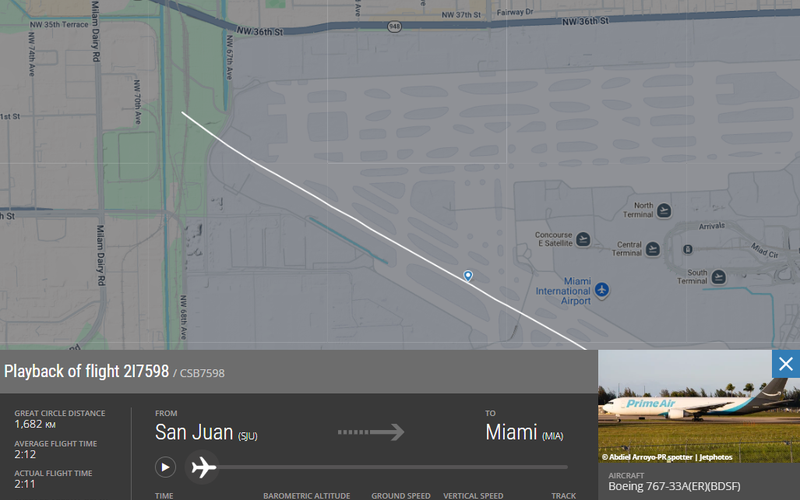

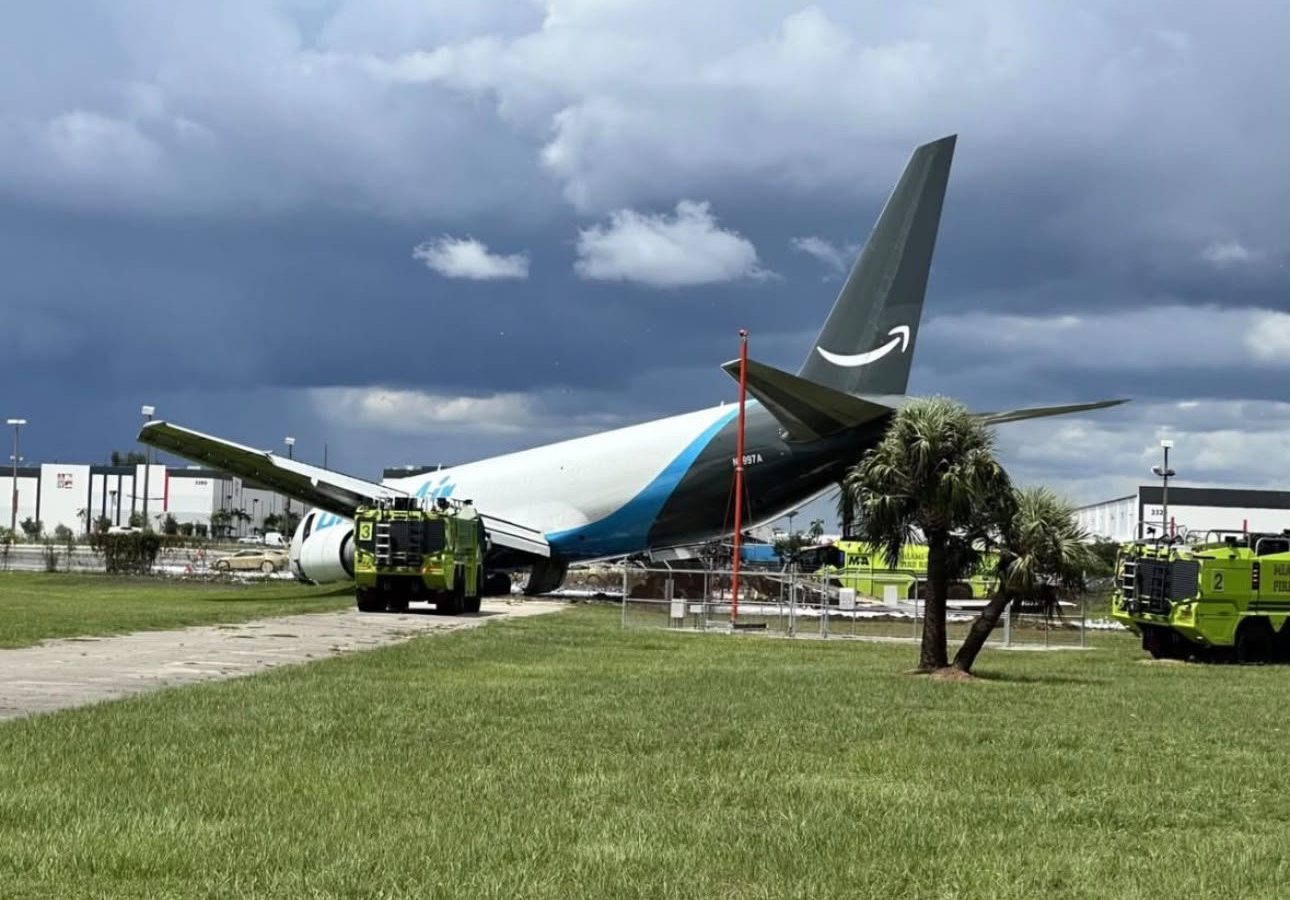
The National Transportation Safety Board has released a series of updates on the Prime Air Boeing 767 accident at Miami International Airport, building on the runway excursion The Aviation Hub first reported on September 6.
Briefings on September 7, September 8 and September 10 have added significant detail to the picture of what happened as flight 2I7598 approached Miami, culminating in the release of cockpit voice recorder and flight data recorder excerpts that show the final half minute of the flight in granular detail.
The Investigation Takes Shape in Miami
At a media briefing on September 7, the NTSB confirmed that both crew members were aboard the aircraft and that the freighter overran the runway before striking a van carrying seven people, which was torn apart in the impact, and a Toyota SUV travelling northbound.
The aircraft then broke through a second fence before coming to rest in a parking lot near the airport perimeter.
Investigators recovered both the flight data recorder and the cockpit voice recorder from the wreckage, and the NTSB confirmed a team of 32 people is now assigned to the Miami investigation.
The board declined to comment on the condition of the flight crew, and its chair told reporters that investigators would need to interview both pilots to establish why they did not execute a go around before the aircraft ran off the end of the runway.
At that stage, no interviews had taken place.
Pilot Interviews and Recorder Detail
By the following day the NTSB confirmed that interviews with the chief pilot of 21 Air, along with both pilots who operated the flight, were scheduled for the morning of September 9.
The captain, aged 55, held a type rating on the Boeing 767 since May 2026 and had accumulated 7,145 flight hours in total.
The first officer, aged 37, was rated on the aircraft since April 2025 and had logged 2,655 hours.
The cockpit voice recorder held more than two hours of usable audio, while the flight data recorder captured roughly 55 hours across more than 400 parameters, giving investigators a substantial dataset to work through.
The NTSB also disclosed weight figures for the flight.
The aircraft departed San Juan at a takeoff weight of 252,182 lbs, with a planned landing weight at Miami of 231,236 lbs.
The cargo load, made up mainly of contact lenses, weighed 32,222 lbs.
What the Flight Data Recorder Shows About The Miami Crash…

The flight data recorder timeline released by the NTSB paints a picture of an unstable and unusually long touchdown sequence in the final 30 seconds before the recording ended.
The nose and right main landing gear touched down first, at a groundspeed of 158 knots.
Brakes were applied seven seconds later at 146 knots, before the left main gear touched down at 134 knots.
Fifteen seconds before the end of the recording, the brakes were released at 120 knots and the throttles moved to a setting consistent with go around thrust, suggesting the crew attempted to abort the landing at that point.
That attempt was short lived.
Four seconds later the throttles were pulled back to idle again and the brakes were reapplied at 117 knots.
Seven seconds before the recording ended, the data shows a marked change in lateral, longitudinal and vertical acceleration, consistent with the aircraft leaving the paved surface, at a groundspeed of 96 knots.
The final recorded groundspeed was 65 knots.
Notably, the NTSB found no indication that speed brakes or thrust reversers were deployed at any point during the sequence.
The Cockpit Voice Recorder Excerpt
On September 10 the NTSB released a detailed CVR transcript covering the final six minutes of the flight, offering the clearest insight yet into the crew’s actions on approach into Miami.
Flap selections were called out routinely through the approach, with flaps 1 set six minutes before the recording ended, followed by the gear being lowered and further flap selections as the aircraft configured for landing.
At one minute and 42 seconds before the end of the recording, as flaps 20 was called, one pilot cautioned that the aircraft was too fast.
Further comments about excessive speed continued through the remainder of the recording, though the transcript notes there was not a consistent verbal response from the other pilot to those callouts.
The autopilot appears to have disconnected around 83 seconds before the end of the recording.
From that point, a sequence of electronic altitude callouts followed, along with two separate sink rate warnings and, at 48 seconds before the end, four consecutive too low terrain alerts.
Flaps 30 was called just seconds before touchdown, with sounds consistent with the aircraft touching down recorded 31 seconds before the end.
A go around was called 15 seconds before the recording ended, roughly matching the throttle movement captured on the flight data recorder, before sounds consistent with the aircraft departing the paved surface were recorded at the ten second mark.
What This Means for the Miami Crash Investigation
Taken together, the recorder data points to a landing that was fast, long and increasingly difficult to arrest, with repeated speed warnings from one pilot going unanswered in a consistent way.
The brief application of go around thrust after the aircraft was already on the ground, followed by a return to idle power and reapplied brakes, suggests the crew changed their mind on whether to continue the landing or abort it, a decision that appears to have cost critical seconds and runway distance.
The absence of speed brakes or thrust reversers in the data will likely draw particular attention from investigators, given both are standard tools for shedding speed and stopping distance on a heavy freighter landing fast.
The NTSB has not yet drawn conclusions from the material released so far, and the scheduled interviews with the flight crew and 21 Air’s chief pilot are expected to add crucial context to the sequence captured by the recorders.
The Aviation Hub will continue to follow the Miami investigation as further NTSB updates are released.