More Aircraft From Seattle to Seoul: Growth Ahead for Korean Air?
 By The Aviation Hub
8 min read
By The Aviation Hub
8 min read
Seoul-based Korean Air has closed the books on the largest aircraft order in its history.
On September 15, the airline signed a firm agreement worth USD 44.8 billion, or KRW 60 trillion, for 103 Boeing aircraft, 21 spare engines and a fifteen year engine maintenance programme.
The signing, held at the Conrad Seoul, turned last year’s Washington handshake into a binding contract and gave Korean Air a fleet plan that will carry it through the next decade of growth from Seoul.
The scale of the number invites an obvious question.
Is this simply Korean Air catching up on deferred fleet renewal, or is it the clearest signal yet that Seoul intends to become one of the dominant long haul hubs in North Asia?
The answer, on the evidence available, is a bit of both.
A Deal Finalized, Not Announced

It is worth being precise about what happened this week, because the headline figure has understandably overshadowed the sequencing.
Korean Air did not announce a new order. It finalized one.
The 103 aircraft commitment was first revealed in Washington D.C. in August 2025, signed during a period of intense diplomatic activity around the Trump and Lee summit and witnessed by senior figures from both governments, including then Commerce Secretary Howard Lutnick.
That original memorandum of understanding gave Korean Air and Boeing thirteen months to work through the contractual detail before converting intent into a firm order.
This week’s ceremony was the conversion. Chairman and CEO Walter Cho called it “the finish line” on the Washington agreements, and the language matters.
A fleet plan of this size does not happen in a single afternoon.
It is built on a year of engineering reviews, financing arrangements and delivery slot negotiations, much of it involving South Korea’s Export Import Bank, which was represented at the signing by its President, Ki yeon Hwang.
The Aircraft Behind the Headline Number
Strip away the dollar figure and the order is a fairly conventional widebody and narrowbody refresh, just executed at an unusually large scale.
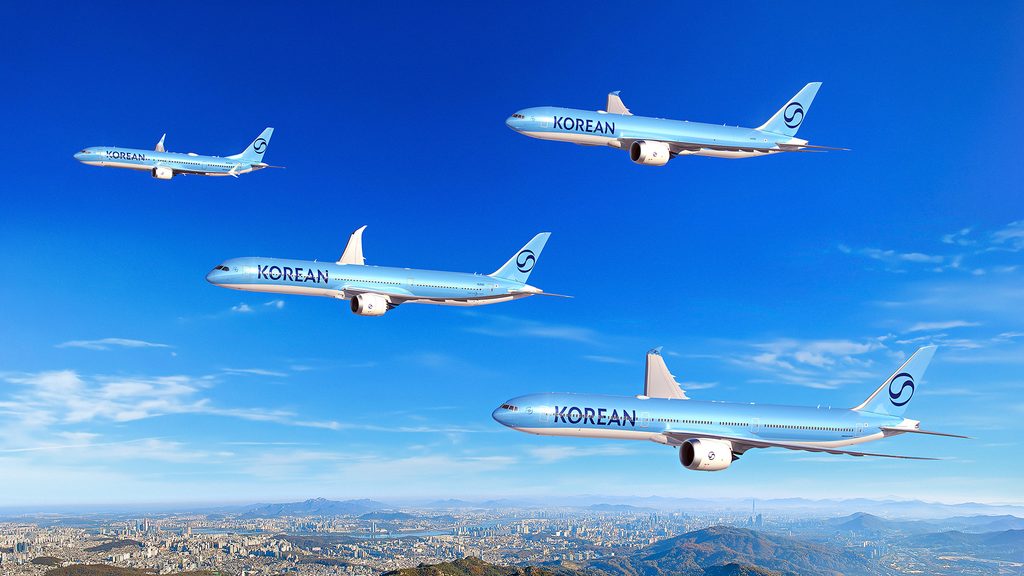
Korean Air has committed to 20 Boeing 777-9s, 25 Boeing 787-10s, 50 Boeing 737-10s and eight Boeing 777-8 Freighters, according to Boeing’s own release.
Each type has a clear job inside the network.
The 777-9 becomes the new long haul flagship, eventually replacing the airline’s aging 747 and older 777-300ER frames on marquee routes to North America and Europe.
The 787-10 fills the medium and long haul gap and will carry Korean Air’s established Prestige Suites 2.0 business class product, a 36 suite cabin in a one two one layout that Business Traveller describes as offering fully enclosed suites with lie flat beds well over six feet in length.
The 737-10 is the volume order, 50 aircraft destined for regional and short haul routes across Northeast Asia, a segment where Korean Air’s fleet has aged noticeably compared with budget rivals.
The eight 777-8 Freighters, meanwhile, point to a cargo business Korean Air has no intention of shrinking, even as passenger growth dominates the conversation.
Set against the airline’s existing fleet, the order is genuinely transformative rather than incremental.
Seoul-based Korean Air entered this process operating around 108 Boeing aircraft, with 72 more already on order.
Finalizing the 103 aircraft deal takes the Boeing order book alone past 175 units, before accounting for the Airbus aircraft, including A350 freighters, that Korean Air has also been adding to diversify its supplier base.
Engines, Spares and Fifteen Years of Support For The Seoul-based Airline…
The aircraft order is only part of the announcement.
Seoul-based Korean Air also finalized agreements worth approximately USD 8.6 billion with GE Aerospace and CFM International covering 21 spare engines and a maintenance contract spanning fifteen years across 28 aircraft.
This detail tends to get lost beneath the aircraft numbers, but it is arguably the more telling commercial decision.
A spare engine pool of this size, combined with a long term maintenance agreement, is not something an airline commits to unless it expects sustained utilization across the fleet for years to come.
It also locks Korean Air into GE and CFM as engine partners for a generation of aircraft, reducing the operational complexity that comes with running a mixed engine fleet across dozens of frames.
Youngje Kim, President of GE Aerospace Korea, and Gaël Méheust of CFM International both attended the Seoul signing, underlining how central the engine relationship is to the wider deal rather than a footnote to the airframe order with the Seoul-based carrier.
Why Now: The Asiana Integration
None of this fleet planning makes sense without reference to what is happening elsewhere in Korean Air’s business out of Seoul.
The airline is in the final stages of absorbing Asiana Airlines, a process that began with Korean Air’s acquisition of a controlling stake in December 2024 and is scheduled to reach full corporate integration by the end of 2026.
Asiana currently operates a fleet of around 67 aircraft, weighted toward Airbus types including the A330, A350 and a small A380 fleet due for retirement before the end of the decade.
Merging two airlines with different fleet philosophies is never simple, and Korean Air has been explicit that this Boeing order exists partly to smooth that transition.
The company’s own statement framed the investment as securing “a predictable long term fleet introduction schedule to support capacity growth following the Asiana Airlines integration.”
Read plainly, that means Korean Air wants new, standardized Boeing aircraft arriving on a known Seoul schedule while it works through the harder problem of consolidating Asiana’s operating certificate, crew training and route authorities into a single carrier.
Executive Traveller has reported that Asiana as a distinct brand will be wound down entirely once integration completes in December, which only increases the pressure on Korean Air to have its own fleet renewal running smoothly in parallel.
The 777X Question Hanging Over Seoul
Any article about a 777-9 order has to address the aircraft’s troubled path to service, because it directly affects how quickly Korean Air can realize the benefits of this deal.
The 777-9 was originally due to enter service in 2020.
Repeated delays, driven initially by regulatory scrutiny following the 737 MAX accidents and subsequently by additional design and certification reviews, have pushed the timeline back repeatedly.
As of mid 2026, the test programme has logged more than 1,700 flights and over 4,800 flight hours, and Boeing has moved into the ETOPS certification phase required before the aircraft can fly extended twin engine routes over water, a prerequisite for the long haul missions Korean Air has in mind for it.
Boeing continues to target 2027 for entry into service, though Emirates, the largest 777X customer, has already signaled it will not accept some of the earliest production aircraft without significant rework.
None of this changes Korean Air’s order and it’s operations out of Seoul, but it does mean the airline’s flagship replacement plan carries a certification risk that sits largely outside its own control.
A cautious reading of the fleet plan would note that the 787-10 and 737-10 deliveries, on more mature production lines, are likely to arrive and enter revenue service well ahead of the 777-9s.
Seoul & It’s Bid to Become a Dominant Hub
The most interesting part of this story may not be the aircraft at all. It is what Korean Air is trying to build around them out of Seoul.
The airline has been investing heavily in ground infrastructure at Seoul Incheon International Airport ahead of the Asiana integration, including renovations to its operations control centre, an expanded cabin crew training facility, and additional engine maintenance hangar capacity.
Korean Air has stated its ambition plainly: to use the combined airline and its modernized fleet to establish Incheon as what it calls a dominant global hub through improved network connectivity and transit efficiency.
That is a meaningful claim in a region where Seoul already competes with Tokyo Narita and Haneda, Singapore Changi and increasingly the major Gulf hubs for long haul connecting traffic between North America and Asia.
A larger, younger, more fuel efficient widebody fleet, feeding a single integrated network out of one Korean hub, being Seoul, rather than two competing ones, is precisely the kind of structural change that could shift transit traffic in Korean Air’s direction, provided the aircraft arrive on schedule and the merger integration proceeds without major disruption to schedules or codeshare agreements.
Growth Ahead for Korean Air?
Taken together, the numbers point toward expansion rather than simple replacement.
Korean Air is not swapping out 103 aircraft for 103 aircraft already flying out of Seoul.
It is adding meaningfully to total fleet capacity at the same moment it absorbs a second full service carrier’s network, routes and passenger base.
The airline’s own language, about supporting capacity growth and strengthening competitive edge, suggests Seoul is being positioned for a larger role in long haul connecting traffic rather than a defensive fleet renewal.
The risks are real and mostly familiar to anyone who has followed Boeing’s recent widebody programmes.
The 777-9 remains unproven in commercial service, and its 2027 target has already slipped more than once industry wide.
Integrating Asiana’s people, aircraft and systems into Korean Air by the end of this year is a substantial undertaking in its own right, and doing so while simultaneously onboarding new aircraft types adds operational complexity that will need careful management.
Even so, the direction of travel from Seattle to Seoul is unambiguous.
Korean Air has committed tens of billions of dollars on the belief that Seoul’s future is bigger than its past, and the aviation industry will be watching Incheon closely over the next several years to see whether that bet pays off.
Continue to follow The Aviation Hub for more analysis and insight!