
Tokyo Haneda Airport Guide: Four Runways on Tokyo Bay
Tokyo Haneda Airport is the domestic heart of Japanese aviation and a fast growing international gateway. Runways, terminals, access and spotting explained.
 By The Aviation Hub
6 min read
Updated October 20, 2026
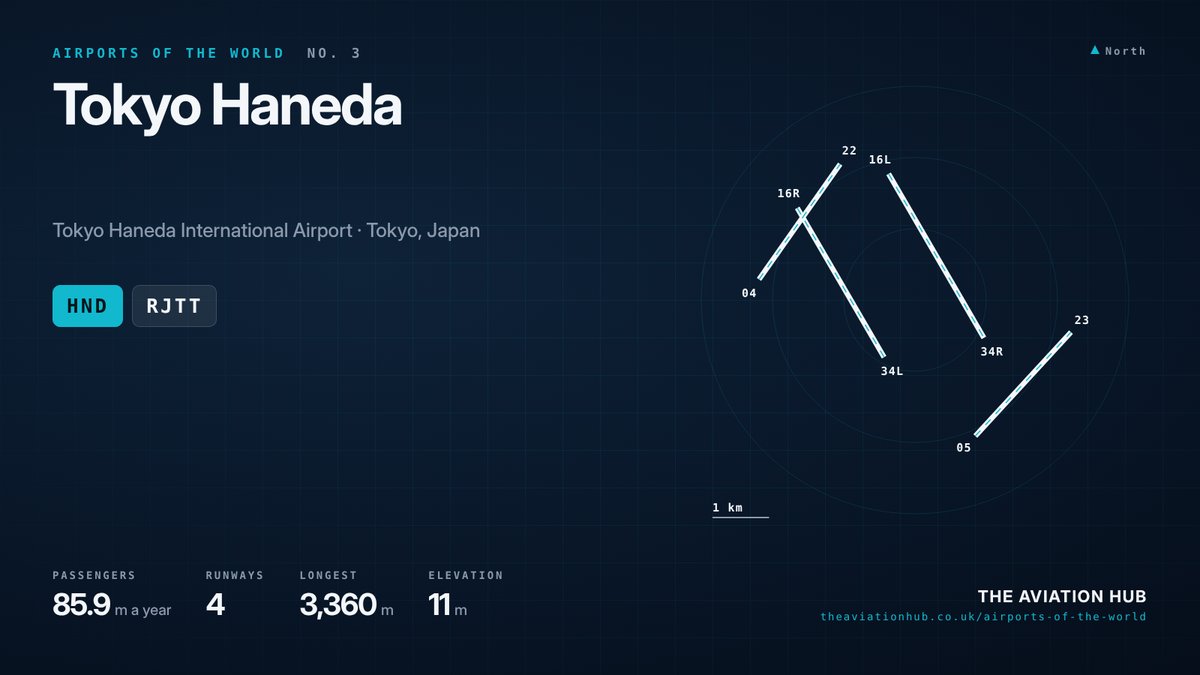
Haneda sits on reclaimed land at the mouth of the Tama River in Ota ward, around nine miles (15 km) south of central Tokyo. Officially named Tokyo International Airport, it is the domestic base of Japan Airlines and All Nippon Airways and the closer of the capital’s two airports to the city. Tokyo Haneda Airport handled around 86 million passengers in its latest reported year and ranks among the five busiest airports on the planet. Its four runways on Tokyo Bay make it one of the great spectacles of Asian aviation.
Tokyo Haneda Airport at a Glance
The IATA code is HND and the ICAO code is RJTT. The field lies about nine miles (15 km) from Tokyo Station and roughly 11 miles (18 km) from Shinjuku. Elevation is 35 feet (11 m), with the whole site built on landfill pushed out into the bay over nine decades.
Haneda has four runways and three terminals, with around 70 jet bridge gates between them. Annual traffic is roughly 86 million passengers, and capacity is rated at around 90 million following the 2018 slot expansion. JAL, ANA, Skymark, StarFlyer, Air Do and Solaseed Air are all based here. The runways and aprons belong to the Ministry of Land, Infrastructure, Transport and Tourism, while Japan Airport Terminal Co runs Terminals 1 and 2 and Tokyo International Air Terminal Corporation runs Terminal 3. Flight information and terminal maps are on the airport’s official website.
A Short History of Haneda
Haneda Airfield opened in 1931 on a small strip of reclaimed land at the western end of today’s complex. After the Second World War the American occupation forces took it over, expanded it, and evicted the Anamori Inari shrine and more than 3,000 residents to do so. Part of the base returned to Japanese control in 1952, when the name Tokyo International Airport was adopted.
The airport was Tokyo’s sole gateway until Narita opened in 1978 and took almost all international flights. Haneda then spent three decades as a purely domestic giant. A new 3,000 metre runway on reclaimed land opened in 1988, Terminal 1 followed in 1993, and Terminal 2 arrived in 2004.
The turning point came in 2010. The offshore D Runway and a new international terminal opened together, and long haul flights returned in earnest. Terminal 2 gained its own international wing in 2020, and the old terminal site became Haneda Innovation City in 2023. The ground collision of 2 January 2024, in which a JAL Airbus A350-900 struck a Japan Coast Guard DHC-8 on runway 34R, killed five of the six coast guard crew. All 379 on the A350 escaped.
Runways at Tokyo Haneda Airport
Tokyo Haneda Airport has four asphalt runways arranged in two pairs. Runway 16L/34R, known locally as the C Runway, is the longest at 3,360 metres (11,024 feet) and takes most of the heavy departures. Its parallel 16R/34L, the A Runway, is 3,000 metres (9,843 feet) long and handles much of the domestic arrival flow. Both are 61 metres wide.
The two cross runways sit at angles to the parallel pair. Runway 04/22, the B Runway, is 2,500 metres (8,202 feet) and lies between the terminals. Runway 05/23, the D Runway, is also 2,500 metres (8,202 feet) and was completed in 2010 on a part piled, part reclaimed platform in the bay so that the Tama River channel stayed open. Operating patterns shift with the wind, and since 2020 some arrivals have routed directly over central Tokyo on southerly flow, a decision that remains contested with residents.
Terminals and Airlines
Terminal 1, nicknamed Big Bird when it opened in 1993, is the domestic home of Japan Airlines, alongside Skymark and StarFlyer. Its 23 gates stretch along a long central spine with a rooftop observation deck at the top. Terminal 2 across the central apron belongs to ANA and its partners Air Do and Solaseed Air, with 27 gates and a small international pier that reopened in July 2023.
Terminal 3 handles most international flights at Tokyo Haneda Airport and sits on the western side of the field beside the Keikyu and monorail stations. Twenty gates serve the oneworld carriers around JAL, the Star Alliance partners of ANA, and SkyTeam members led by Delta. Lounges are run by JAL, ANA, Cathay Pacific and Delta. A tunnel linking Terminal 3 with Terminals 1 and 2 was completed in 2020, though a free shuttle bus remains the easiest transfer.
Routes and Destinations
Domestic flying dominates. Tokyo to Sapporo and Tokyo to Fukuoka rank among the busiest air routes in the world, each with dozens of daily departures operated by Boeing 777, 787 and Airbus A350 aircraft in dense domestic configurations. Osaka Itami, Okinawa Naha and Kagoshima follow close behind. Domestic slots at Tokyo Haneda Airport are reallocated by the ministry every five years.
International service has grown steadily since 2010. Seoul, Taipei and Shanghai are the busiest short haul markets, while London Heathrow, Los Angeles, Seattle, Detroit, Minneapolis and Vancouver anchor the long haul schedule. Late evening departures to Europe and North America are a Haneda speciality because Narita closes at night. Cargo is modest compared with Narita, which keeps most of the freighter traffic.
Getting to and from Tokyo Haneda Airport
Two railways reach the terminals. The Keikyu Airport Line runs to Shinagawa in about 15 minutes for roughly 330 yen (about £1.70) and continues through to the Toei Asakusa subway line. The Tokyo Monorail runs to Hamamatsucho in around 20 minutes for about 520 yen, with a direct JR connection onwards. Both are the cheapest sensible options and both stop at all three terminals.
Airport Limousine buses serve hotels across the city and reach Tokyo Station in under an hour depending on traffic. Taxis cost around 7,000 yen (£37) to central Tokyo and more at night. A JR East link, the Haneda Airport Access Line, is under construction and should bring direct trains from Tokyo Station by around 2031. Road access is via the Shuto Expressway Bayshore Route and National Route 357, which pass straight through the site.
Spotting and Photography
Tokyo Haneda Airport is one of the friendliest major airports in the world for enthusiasts. Each terminal has a free rooftop observation deck, with Terminal 1 offering a long open air gallery and a cafe, Terminal 2 facing the C Runway and the bay, and Terminal 3 looking across the international apron.
Outside the fence, Jonanjima Seaside Park on the northern shore sits under the final approach to runway 22 and gives low passes against the bay with Tokyo in the background. The Tamagawa Sky Bridge to the southwest looks down on the Terminal 3 apron. Arrivals on the 34s are typical in winter and the 22 approach is common in summer. Decks close in the evening and during strong winds, and staff will ask you to move if you block walkways or use step ladders, so keep it civil.
What Comes Next
Haneda’s airfield has reached its practical limit, so growth now comes from efficiency and ground access. The JR Access Line will cut journey times to the Marunouchi business district. Terminal 2’s international pier is being used more heavily as ANA shifts flights from Narita.
The 2024 collision has pushed the ministry towards better runway status lights and tighter procedures for aircraft holding short, and the results will shape safety practice across Japan. With domestic demand steady and international traffic still climbing, Tokyo Haneda Airport is heading for the 90 million mark and will stay the capital’s preferred gateway. Browse more hubs on our Airports of the World map.
Continue to follow The Aviation Hub for more analysis and insight.
Advertise with us Your brand, in front of an aviation audience Home page and in-article placements, sold directly, one advertiser per slot. From £250 a year. See the rates

