Shanghai Pudong Airport sits on the East China Sea coast, about 19 miles (30 km) east of the Bund and the city centre. It opened in 1999 to take over international flying from the cramped Hongqiao field on the other side of the city and has grown into the busiest airport in China. Around 85 million passengers passed through in 2025, more than 35 million of them on international flights, and cargo volumes rank second in the world. For most visitors to Shanghai, this is where China begins.
Shanghai Pudong Airport at a Glance
The IATA code is PVG and the ICAO code is ZSPD, and the terminals lie roughly 19 miles (30 km) east of People’s Square across the flat reclaimed farmland of the Pudong New Area. Elevation is only 13 feet (4 m), and the eastern boundary runs along the sea wall.
Five runways serve two main terminals and two satellite concourses, S1 and S2, which opened in September 2019 and are linked to the terminals by an underground people mover. Passenger traffic reached about 85 million in 2025, with cargo at roughly 4.1 million tonnes. China Eastern and its subsidiary Shanghai Airlines use the field as their main hub, Air China runs a major international hub, and Juneyao Air and Spring Airlines are based here. The operator is the Shanghai Airport Authority, which also runs Hongqiao. Terminal maps and transit information are published on the airport’s official website.
How Shanghai’s Second Airport Came to Be
By the mid 1990s Hongqiao, Shanghai’s airport since the 1920s, was boxed in by the expanding city and could not grow. The municipal government chose a greenfield site on the Pudong coast, where land reclaimed from the sea offered almost unlimited room. Construction began in October 1997 and took just two years at a cost of around 12 billion yuan. The airport opened on 16 September 1999, and Terminal 1 followed on 1 October with a single 4,000 metre runway.
Almost all international flights moved across from Hongqiao immediately, setting the pattern that still applies: Hongqiao for domestic and short regional flights, Pudong for everything else. A second runway arrived in 2005, and Terminal 2 opened on 26 March 2008 ahead of the Beijing Olympics, doubling capacity. The Shanghai maglev, opened in 2004, gave the airport the fastest airport rail link in the world at 268 mph (431 km/h), until top speed was cut to 186 mph (300 km/h) in 2021.
The satellite concourses of 2019 added 83 gates in a single step and pushed design capacity to 80 million. Two accidents stand out in its record. An Avient MD-11F overran the runway on takeoff in November 2009, killing three crew, and an Ethiopian Boeing 777F burned out on the ground in July 2020 after chlorine dioxide tablets in its hold ignited.
Runways at Shanghai Pudong Airport
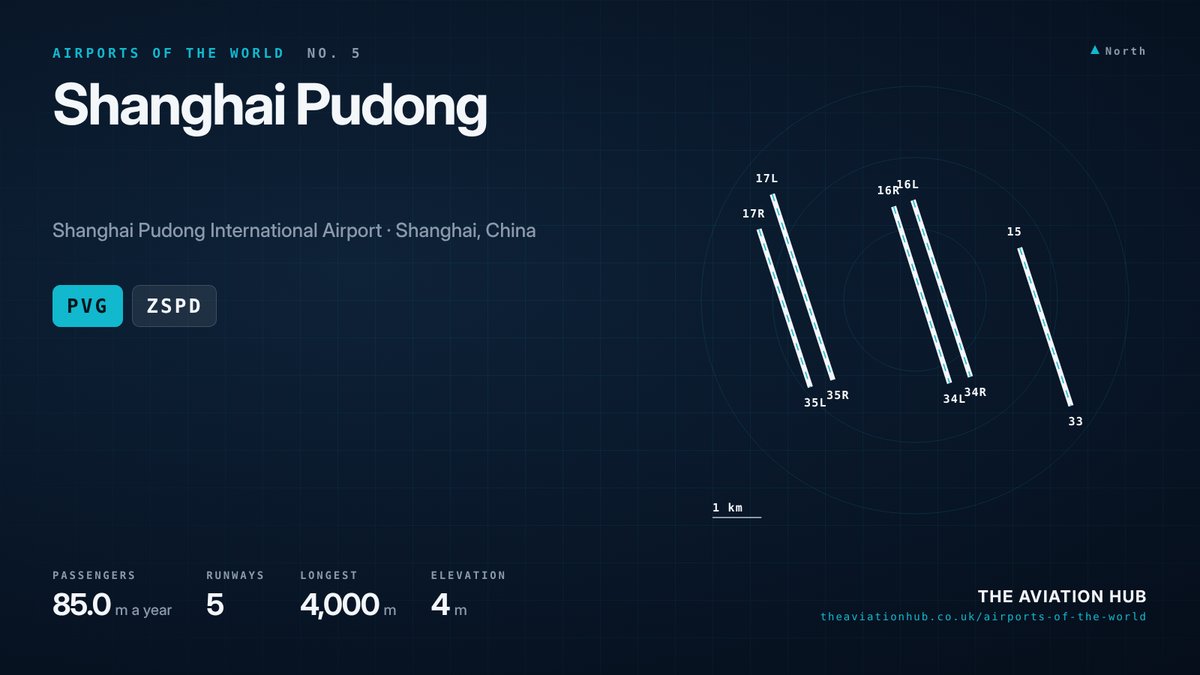
Shanghai Pudong Airport has five concrete runways, all broadly aligned north to south. The original 17L/35R is the longest at 4,000 metres (13,123 feet). Runways 16L/34R and 16R/34L each measure 3,800 metres (12,467 feet), while 15/33 and 17R/35L are 3,400 metres (11,155 feet) each. Every runway is 60 metres wide, which suits the Airbus A380 and the Boeing 747-8 freighters that visit daily.
Four of the runways flank the terminal complex in two pairs and run as independent parallel operations, giving the airport a theoretical capacity well beyond its current slot allocation. Runway 15/33, the fifth, sits on the eastern side of the field and is reserved for test flights by COMAC, whose C919 and ARJ21 programmes are based in Shanghai. Northerly winds dominate in winter and bring arrivals in from the south. Summer southerlies reverse the flow.
Terminals and Airlines
Terminal 1 at Shanghai Pudong Airport is the China Eastern and SkyTeam building. China Eastern, Shanghai Airlines, Delta, Air France, KLM and Korean Air operate from here, with many flights now boarding from Satellite S1 after a short ride on the people mover.
Terminal 2 serves Air China and the Star Alliance partners, including Lufthansa, United, ANA, Singapore Airlines and Thai Airways. The oneworld carriers, among them Cathay Pacific, Japan Airlines and British Airways, share Terminal 2 as well, alongside the local carriers Juneyao Air and Spring Airlines, with Satellite S2 handling the overflow. The two terminals sit either side of the central rail station and are linked landside by a long walkway. Transit between them takes around 15 minutes on foot.
Routes and Destinations
Domestic trunk routes to Beijing, Guangzhou, Shenzhen and Chengdu carry enormous volumes, often with wide body aircraft such as the Airbus A330-300 and Boeing 787-9 on what are barely two hour flights. Tokyo, Seoul, Hong Kong, Taipei and Singapore are the leading international markets, with departures throughout the day on China Eastern alone.
Long haul flying has rebuilt strongly since 2023. China Eastern serves Los Angeles, New York, London, Paris, Sydney and Auckland. The longest nonstop routes run to the eastern seaboard of the United States at over 7,000 miles (11,300 km), and China Eastern also reaches Buenos Aires with a stop in Auckland. Cargo is a huge part of daily life at Shanghai Pudong Airport, with FedEx, UPS and DHL all running regional hubs on the field and a constant flow of freighters from Cathay, Cargolux and China Cargo Airlines.
Getting to and from Shanghai Pudong Airport
Three rail lines serve the airport. Metro Line 2 runs from the airport station beneath the terminals right across the city to People’s Square in about 60 minutes for roughly 8 yuan (under £1), the cheapest sensible choice. The maglev reaches Longyang Road in eight minutes for 50 yuan (£5.50), where you change to the metro. The Airport Link Line, which opened in December 2024, connects Pudong with Hongqiao Airport in around 40 minutes, and a spur to the new Shanghai East railway station is due in 2027.
Airport buses run to hotels, railway stations and nearby cities such as Suzhou and Hangzhou. Taxis to the city centre cost around 200 yuan (£22) and take 45 to 60 minutes outside the rush hour. Road access is via the S1 Yingbin Expressway and the S2 Hulu Expressway. Multi storey car parks sit in front of both terminals. Allow extra time at immigration, which can be slow at peak periods despite recent visa free entry for many nationalities.
Spotting and Photography
Shanghai Pudong Airport offers no official viewing deck. Airside, the large glass panels at the Terminal 2 gates give clear views of the apron, and the Terminal 2 driveways overlook taxiing aircraft from landside. Afternoon light generally suits the terminal spots.
The most productive outdoor spot is near the southern end of the field on arrivals days with northerly winds, when aircraft pass low over the farmland. Freighter traffic is the draw here, with Boeing 747-8F and 777F aircraft from a dozen operators alongside the COMAC test fleet on runway 15/33. Chinese law treats airport perimeters as sensitive, so photograph only from hotels and public roads, keep well away from fences and military areas, and accept that security staff may ask you to stop.
What Comes Next
Terminal 3 is under construction on the southern side of the site. Work began in 2021 as part of a fourth phase of expansion aimed at raising capacity from 80 million to around 130 million passengers and handling six million tonnes of freight a year. The new terminal will link to the metro and to the Shanghai East station development.
With China’s outbound travel recovering and cargo already at record levels, Shanghai Pudong Airport is well placed to stay at the top of the Chinese rankings and to push towards the 100 million mark before the end of the decade. Find its neighbours on our Airports of the World map.
Continue to follow The Aviation Hub for more analysis and insight.
Advertise with us Your brand, in front of an aviation audience Home page and in-article placements, sold directly, one advertiser per slot. From £250 a year. See the rates