Heathrow lies in the London Borough of Hillingdon, about 14 miles (23 km) west of central London, hemmed in by the M25, the M4 and the suburbs of Hounslow. London Heathrow Airport is the home of British Airways and Virgin Atlantic, the busiest airport in Europe, and the most intensively used two runway airport in the world. Around 83.9 million passengers used it in 2024, a record, and the figure climbed again in 2025. For a UK reader it needs no introduction, but the detail still rewards a closer look.
London Heathrow Airport at a Glance
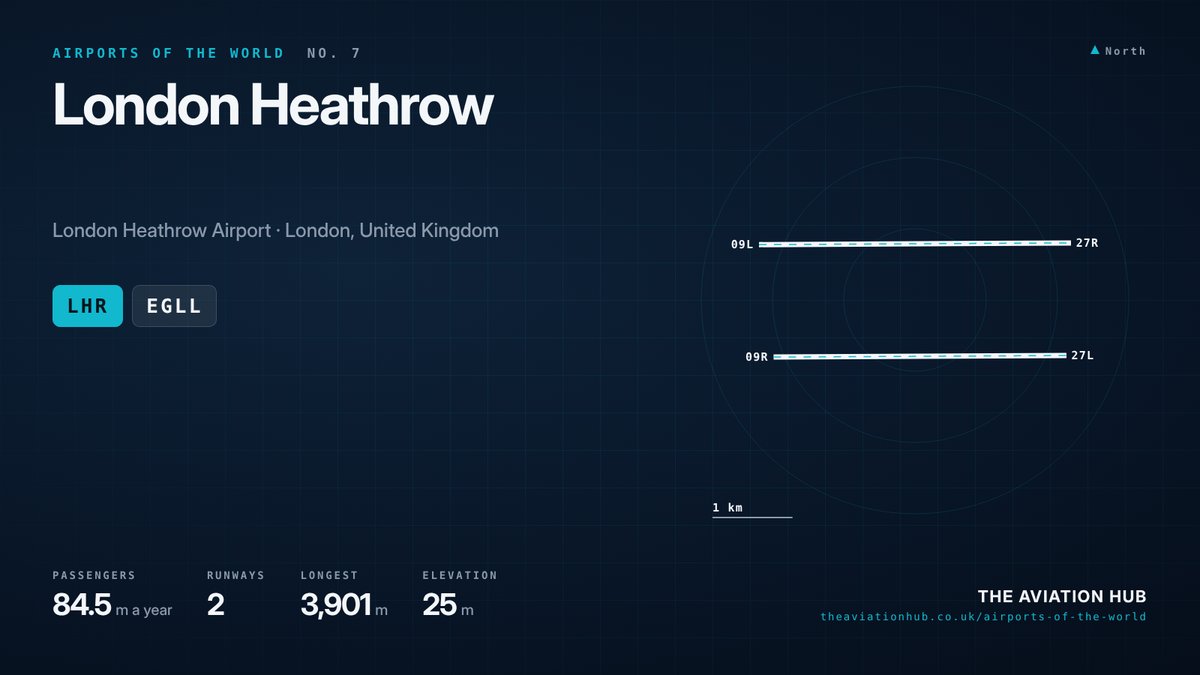
The IATA code is LHR and the ICAO code is EGLL. The central terminal area sits 14 miles (23 km) west of Charing Cross and the field stands at 83 feet (25 m) above sea level on the flat gravel plain between the River Crane and the Colne. Two parallel runways serve four terminals, numbered 2 to 5, after the original Terminal 1 closed in 2015.
Passenger traffic was roughly 83.9 million in 2024 and a little higher in 2025, across more than 89 airlines and around 214 destinations in 84 countries. British Airways is by far the largest operator, with Virgin Atlantic the second home carrier. The owner and operator is Heathrow Airport Holdings, whose shareholders include the French investor Ardian, the Qatar Investment Authority and Canadian pension fund CDPQ. Flight status and terminal maps are on the airport’s official website.
How London’s Airport Came to Be
A small private airfield called the Great West Aerodrome operated here from 1929, run by the Fairey Aviation Company. The government requisitioned the land during the Second World War, ostensibly for a long range bomber base, but the real intention was always a civil airport. London Airport formally opened on 25 March 1946 with tents for terminals, although a Lancastrian had already left for Buenos Aires on 1 January.
The original layout was a Star of David pattern of six runways, with the terminal area in the middle reached by a tunnel from the Bath Road. The Europa Building, later Terminal 2, opened in 1955, followed by the Oceanic Terminal, later Terminal 3, in 1961. The name Heathrow, taken from the hamlet flattened to build it, became official in September 1966. Terminal 4 opened in 1986 and Terminal 5 in 2008, with a new Terminal 2, the Queen’s Terminal, replacing the old one in 2014.
Two modern events stand out. The old Terminal 1 closed in 2015 as BA consolidated into Terminal 5. On 21 March 2025 a fire at the North Hyde electrical substation cut power to the whole site and closed it until midnight, cancelling more than 1,000 flights and costing BA an estimated £40 million.
Runways at London Heathrow Airport
London Heathrow Airport runs on two parallel asphalt runways aligned east west. The northern runway, 09L/27R, is 3,901 metres (12,799 feet) long, and the southern runway, 09R/27L, is 3,658 metres (12,001 feet). Both are 50 metres wide. They are the survivors of the original six, the others having been swallowed by taxiways, aprons and terminals.
Prevailing westerly winds mean aircraft land from the east over central London on the 27s for around 70 per cent of the year, giving the famous approach over Windsor Great Park in the other direction on easterlies. On westerly operations the two runways alternate between landing and departing at 15:00 each day to share noise across the communities under the approach. Night flights are capped by quota, and the whole field is slot controlled at close to 480,000 movements a year, which is why a Heathrow slot pair changes hands for tens of millions of pounds.
Terminals and Airlines
Terminal 5 at London Heathrow Airport is the British Airways building, with its satellite piers B and C reached by an underground transit. Iberia shares it. Almost all BA long haul and the bulk of its short haul schedule leaves from here, and the sheer scale of the main building, designed by Richard Rogers, still impresses. Terminal 3 handles most of the other oneworld carriers, including American, Cathay Pacific, Qantas and Japan Airlines, plus Emirates, Virgin Atlantic and Delta.
Terminal 2, the Queen’s Terminal, is the Star Alliance home, with Lufthansa, United, Air Canada and Singapore Airlines, along with Aer Lingus and other domestic and Irish flights. Terminal 4, on the southern edge of the field, is used by most SkyTeam carriers such as Air France, KLM and Korean Air, and by Qatar Airways, Malaysia Airlines, Etihad and a cluster of Asian and African airlines. Free trains and buses connect the terminals, but allow at least 90 minutes for a change between 4 and 5.
Routes and Destinations
New York JFK is the busiest route from London Heathrow Airport by a distance, with around 3.2 million passengers in 2025 on BA, Virgin, American, Delta and JetBlue. Dubai and Doha follow at roughly 2.5 million and 2.15 million, reflecting the Gulf carriers’ heavy presence with Airbus A380 and Boeing 777-300ER services. Dublin, New Delhi, Madrid and Amsterdam fill out the leading international markets.
Domestic flying is thin by the standards of other hubs but still significant. Edinburgh, Glasgow and Belfast City are the busiest UK routes, mostly on BA Airbus A320neo aircraft feeding the long haul banks. The longest scheduled flights are the Qantas Boeing 787-9 nonstop to Perth and its A380 to Sydney via Singapore. Traffic peaks in July and August and again in the Christmas fortnight. Cargo moves mainly in passenger bellies, with the cargo area on the south side handling around 1.5 million tonnes a year.
Getting to and from London Heathrow Airport
Rail gives the best options. The Elizabeth line runs from all terminals to Paddington in around 35 minutes and continues through central London to Canary Wharf and Abbey Wood, with fares of about £13 at peak times. The Piccadilly line serves Terminals 2 and 3, 4 and 5 directly and reaches the West End in 45 to 50 minutes for roughly £5.80 with contactless, the cheapest sensible choice. Heathrow Express runs nonstop to Paddington in 15 minutes but costs £25 or more for a walk up ticket.
Heathrow Central bus station between Terminals 2 and 3 is a major National Express hub with coaches to Oxford, Reading, Bristol and the Midlands. By road the airport is served by the M4 and the M25, with the Terminal 5 spur off junction 14. A black cab to central London costs around £60 to £100 and takes 40 to 60 minutes. Dropping off at the terminal forecourts carries a charge, so most drivers use the long stay and Pod parking at Terminal 5 or the business car parks on the Bath Road.
Spotting and Photography
Myrtle Avenue in Hatton Cross is the classic spot, a small green under the final approach to 27L where aircraft pass a few hundred feet overhead. Afternoon light is ideal there. On easterlies, the Northern Perimeter Road and the layby near the Renaissance Hotel on the Bath Road give close views of landings on 09L. The Renaissance and the Thistle at Terminal 5 both offer rooms with runway views, and the Thistle’s upper floors look across the western end of the airfield.
Heathrow Academy on the Northern Perimeter Road used to host an unofficial viewing area, and the mounds by the Terminal 5 Pod car park remain popular. Variety at London Heathrow Airport is enormous: every Airbus and Boeing type in production, A380s from six operators, and a steady flow of Gulf, Asian and North American wide bodies. The Metropolitan Police and airport security patrol regularly and are generally relaxed, provided you stay off private land, keep clear of fence lines marked as restricted, and move on when asked.
The Third Runway Question
The Airports Commission backed a third runway to the northwest in 2015 and Parliament approved the policy in 2018. The Court of Appeal struck it down on climate grounds in 2020, the Supreme Court restored it later that year, and the government signalled fresh support in 2025. Heathrow submitted a revised scheme to ministers in 2025, while Hillingdon Council and local groups continue to fight it.
Whatever happens to the runway, the near term work is about terminals, with a new baggage system and the long planned expansion of Terminal 2 to replace the Terminal 1 site. London Heathrow Airport will stay full, expensive and essential for the foreseeable future, and the question is only how much bigger it is allowed to get. See how it compares on our Airports of the World map.
Continue to follow The Aviation Hub for more analysis and insight.
Advertise with us Your brand, in front of an aviation audience Home page and in-article placements, sold directly, one advertiser per slot. From £250 a year. See the rates