
Singapore Changi Airport Guide: Jewel of Southeast Asia
Singapore Changi Airport is the home of Singapore Airlines and a serial winner of world's best airport. Runways, terminals, routes and spotting.
 By The Aviation Hub
7 min read
Updated October 20, 2026
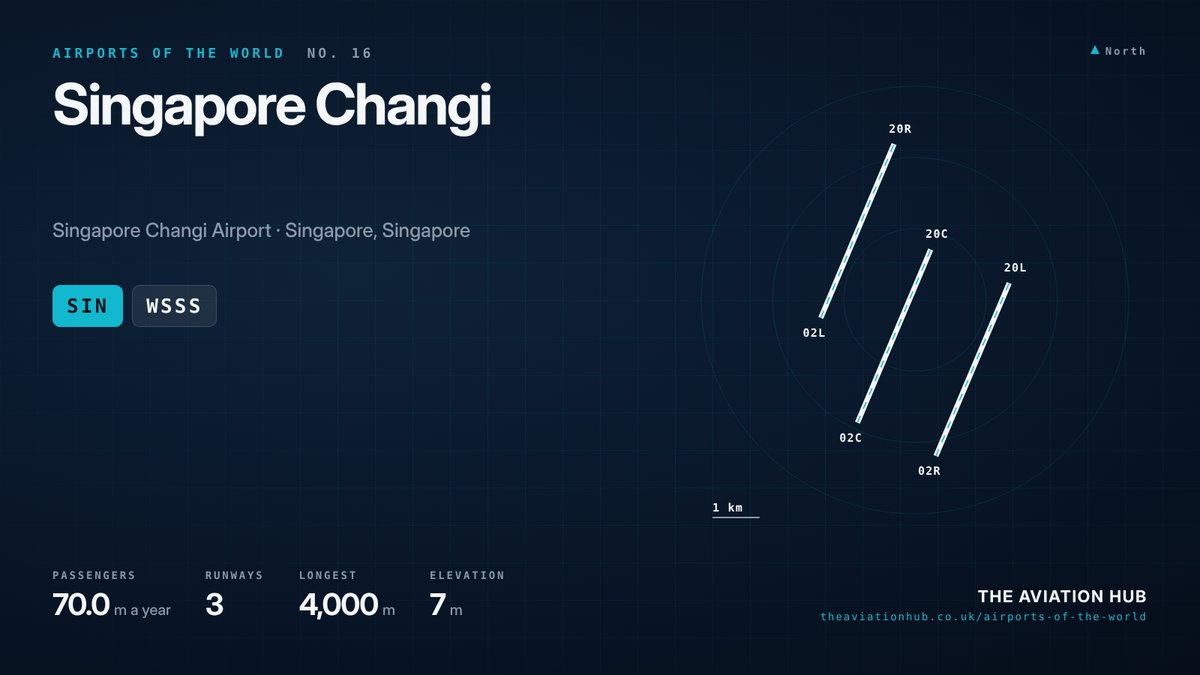
Singapore Changi Airport occupies the eastern tip of the island, about 11 miles (17 km) from the Downtown Core, on land reclaimed from the sea beside a former RAF station. It is the home of Singapore Airlines and Scoot and the transfer point between Europe, Australia and the whole of Southeast Asia. A record 70 million passengers passed through in 2025. Three runways, four terminals and the Jewel complex with its indoor waterfall make it a destination in its own right, and Skytrax has named it the best airport in the world 13 times.
Singapore Changi Airport at a Glance
The IATA code is SIN and the ICAO code is WSSS. The terminals lie about 11 miles (17 km) northeast of the city centre in the Changi planning area. Elevation is 22 feet (7 m), with the Singapore Strait on three sides.
Three parallel runways serve four passenger terminals, linked by the Skytrain and by Jewel, the glass domed retail and garden complex that opened in 2019. Traffic in 2025 reached about 70 million passengers and roughly 2.08 million tonnes of cargo. Singapore Airlines, its cargo arm and Scoot are based here, and Jetstar Asia flew from the airport until its closure. Changi Airport Group, owned by the Singapore government, operates the field. Flight information and terminal maps are kept on the airport’s official website.
How Singapore Moved to Changi
Paya Lebar had served as the international airport since 1955 but sat in the middle of the island with no room to grow and aircraft noise spreading over housing. In 1975 the government chose Changi, the site of a British air base, where runways could point out to sea and land could be reclaimed. Construction took six years and involved large scale reclamation of swamp and seabed. Commercial flights began on 1 July 1981 and the airport opened officially on 29 December that year.
Terminal 2 followed in 1990, the Skytrain linked the buildings, and Terminal 3 opened in 2008 with Airbus A380 gates built in from the start. Terminal 4, a smaller automated building on the site of the old Budget Terminal, arrived in 2017. Jewel in 2019 wrapped Terminal 1 in a ten storey garden and gave the airport its signature Rain Vortex waterfall. The third runway, formerly military, is being brought into civil use as part of the Terminal 5 project.
The airport’s history includes the 1991 hijack of Singapore Airlines Flight 117, ended by commandos on the apron, and the 2010 Qantas Flight 32 engine failure, when an A380 returned safely after a Rolls Royce Trent 900 disintegrated over Batam. A 777 caught fire on landing in 2016 and another was destroyed by a tow tug fire in 2017.
Runways at Singapore Changi Airport
Singapore Changi Airport has three parallel asphalt runways, each 4,000 metres (13,123 feet) long and 60 metres wide. Runway 02L/20R lies on the western side of the terminals and 02C/20C on the eastern side. The third strip, 02R/20L, sits on the former Changi Air Base (East) and was used by the Republic of Singapore Air Force before being extended for the three runway system.
Winds follow the monsoon. The northeast monsoon from December to March puts aircraft on the 02s, approaching over the sea from the south. During the southwest monsoon from June to September operations switch to the 20s and arrivals come over the island from the north. The three runway system is designed for the Terminal 5 era, when the airport expects to handle around 140 million passengers a year. Night operations run without restriction, which is one reason the overnight European departure bank is so dense.
Terminals and Airlines
Singapore Airlines splits its operation between Terminals 2 and 3, with Terminal 3 taking the A380 and most long haul flights and Terminal 2, rebuilt and reopened in 2023, handling regional services and partners such as Air India, Malaysia Airlines and Lufthansa. Terminal 1 houses British Airways, Qantas, Emirates, Turkish Airlines, Scoot and Jetstar, and is the building most directly connected to Jewel. Terminal 4 is the automated one, with Cathay Pacific, Korean Air, Vietnam Airlines, Cebu Pacific and the AirAsia group among its users.
Transfers are simple because every terminal is airside connected by the Skytrain or a walkway, and Terminal 4 by a shuttle bus. The Singapore Airlines Private Room in Terminal 3 is among the most exclusive lounges anywhere, and the airport itself offers a rooftop pool, a butterfly garden and free city tours for long layovers. The Crowne Plaza inside Terminal 3 has won the world’s best airport hotel award many times.
Routes and Destinations
With no domestic market, every flight from Singapore Changi Airport is international. Kuala Lumpur, Bangkok, Jakarta, Denpasar and Hong Kong were the busiest routes in 2025, and China overtook Indonesia as the largest country market after mutual visa free travel began. Malaysia, Australia and India complete the top five. More than 100 airlines serve the airport, and the short haul schedule is a battle between Scoot, AirAsia, Jetstar and the full service carriers.
Long haul is Singapore Airlines’ core. The nonstop Airbus A350-900ULR flights to New York JFK and Newark cover around 9,500 miles (15,300 km) and rank among the longest in the world. London Heathrow sees several daily SIA flights plus British Airways and Qantas, and the airport is the main waypoint on the Kangaroo Route between Europe and Australia. Cargo is growing fast on demand for semiconductors and electronics, with SIA Cargo, FedEx, DHL and Cargolux all prominent.
Getting to and from Singapore Changi Airport
The MRT is the cheapest sensible option. Changi Airport station sits between Terminals 2 and 3 on a branch of the East West line, and a change at Tanah Merah puts passengers in the city centre in about 40 minutes for around S$2 (£1.20). Trains run until just before midnight. A direct link via the Thomson East Coast line and the Cross Island line is planned alongside Terminal 5.
Eight public bus routes pass through the terminal basements, with bus 36 running to Orchard Road in about an hour. Taxis queue at every terminal and charge S$25 to S$40 (£15 to £24) to downtown, including an airport surcharge, with journeys of 20 to 30 minutes on the East Coast Parkway. Ride hailing is well established. Multi storey car parks serve each terminal, and the Changi Airport Connector cycle path links the airport with East Coast Park for anyone arriving on two wheels.
Spotting and Photography
Changi has long welcomed spotters. The Terminal 1 viewing mall and the Terminal 3 viewing gallery look over the apron and the 02L/20R runway from inside the building, and Jewel’s Canopy Park gives elevated views of Terminal 1 movements. Outside the fence, Changi Beach Park at the northern end lines up with approaches to runway 20R during the southwest monsoon, and the coastal path near Changi Village catches departures off 02L in the opposite season.
Morning light favours the beach park on the eastern side, afternoons suit the terminal galleries. Singapore Changi Airport offers A380s from Singapore Airlines, Emirates and Qantas, SIA 777-300ERs, 787-10s and A350s, and freighters from across Asia. Security is strict and the Changi Air Base perimeter is off limits, so stay on public paths, never use ladders and do not photograph military aircraft.
What Comes Next
Terminal 5 is the defining project. Ground was broken on 14 May 2025 on a site east of the existing terminals, and the building will handle around 50 million passengers a year when it opens in the mid 2030s. It brings the third runway into full use, adds direct MRT access and will take Singapore Changi Airport past the 140 million mark in total capacity. Terminal 2’s expansion and Terminal 4’s automation have already lifted the current site to around 90 million.
Environmental constraints are modest for a reclaimed site with sea approaches, and the main competition comes from hubs in the Gulf and from Kuala Lumpur. Singapore Changi Airport is heading for a position as the undisputed gateway between Asia and the southern hemisphere. Compare its three runway layout with other hubs on the Airports of the World map.
Continue to follow The Aviation Hub for more analysis and insight.
Advertise with us Your brand, in front of an aviation audience Home page and in-article placements, sold directly, one advertiser per slot. From £250 a year. See the rates

