
Madrid Barajas Airport Guide: Europe’s Bridge to Latin America
Madrid Barajas Airport is the Iberia hub and Europe's main gateway to Latin America. Four runways, Terminal 4, routes, metro access and spotting.
 By The Aviation Hub
7 min read
Updated October 20, 2026
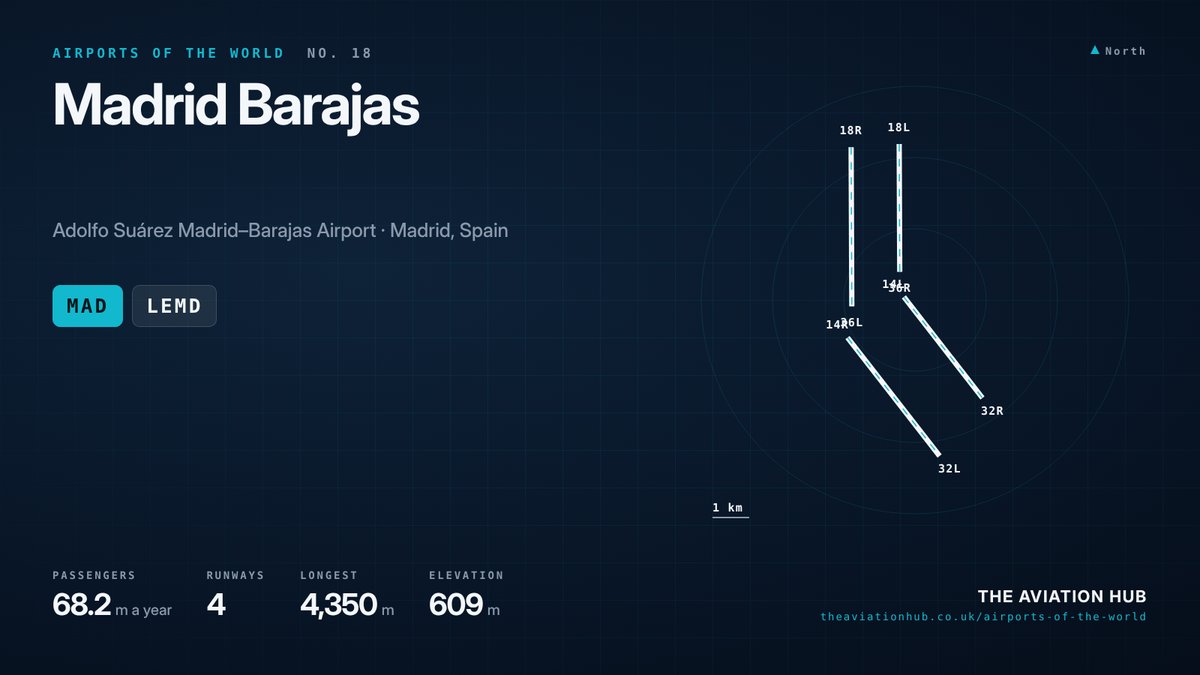
Madrid Barajas Airport lies about 8 miles (13 km) northeast of the Puerta del Sol, on the high plateau of central Spain at nearly 2,000 feet. It is the hub of Iberia and Air Europa and the point where Europe’s airline networks meet those of South America. Around 68 million passengers used it in 2025, the fifth highest total in Europe. Four long runways, the undulating bamboo ceilings of Terminal 4 and a growing Ryanair base make it an airport of two very different halves.
Madrid Barajas Airport at a Glance
The IATA code is MAD and the ICAO code is LEMD. The terminals sit roughly 8 miles (13 km) from the city centre in the Barajas district, inside the municipality of Madrid. Elevation is 1,998 feet (609 m), which lengthens take off runs on hot summer afternoons and explains why the runways are so long.
Four runways serve two terminal complexes, the older T1, T2 and T3 cluster and the newer T4 with its satellite T4S. Traffic in 2025 reached about 68.2 million passengers, 430,000 aircraft movements and 840,000 tonnes of cargo. Iberia, Iberia Express, Air Europa, Plus Ultra and World2Fly call it home, Ryanair, Iberojet and Wamos Air keep bases, and Wizz Air adds one from 3 November 2026. Aena, the part state owned Spanish airport operator, runs the field. Terminal maps and flight status live on the airport’s official website.
How Barajas Became Spain’s Gateway
The airport opened on 22 April 1931 on farmland beside the village of Barajas, and scheduled flights began two years later. Iberia’s early DC-3s and Junkers used a grass field that grew paved runways in the 1940s. The first proper terminal, today’s T2, dates from 1954, and the jet age brought T1 in the 1970s and an extended north runway for Boeing 747s to Buenos Aires and Mexico City.
The transformation came with the Barajas Plan of the 1990s and 2000s. New runways opened in 1998 and 2006, and on 5 February 2006 Terminal 4, designed by Richard Rogers and Antonio Lamela, opened with its satellite, doubling capacity to 70 million. The name changed in 2014 to honour Adolfo Suárez, the prime minister who steered Spain to democracy after Franco.
Tragedy struck on 20 August 2008 when Spanair Flight 5022, a McDonnell Douglas MD-82 bound for Gran Canaria, crashed on take off from runway 36L with the loss of 154 lives. Two years earlier an ETA car bomb destroyed part of the T4 car park and killed two people. The Madrid to Barcelona air shuttle, once the busiest route in the world with nearly 1,000 flights a week, shrank sharply after high speed rail arrived in 2008.
Runways at Madrid Barajas Airport
Madrid Barajas Airport has four asphalt runways in two parallel pairs set at an angle to each other. The north south pair is the longer: 18R/36L stretches 4,350 metres (14,271 feet) and 18L/36R measures 3,500 metres (11,483 feet). The northwest to southeast pair consists of 14R/32L at 4,100 metres (13,451 feet) and 14L/32R at 3,500 metres (11,483 feet). All are 60 metres wide.
The field runs in two fixed configurations. In the northerly pattern used for most of the year, aircraft land on 32L and 32R from the southeast and depart on 36L and 36R to the north, giving four runway operations with no crossings. In the southerly pattern arrivals come down 18L and 18R and departures head out on 14L and 14R. The altitude and summer heat mean fully loaded Airbus A350-900s to Santiago or Lima need long take off runs on 36L.
Terminals and Airlines
Terminal 4 and its satellite T4S at Madrid Barajas Airport belong to Iberia and the oneworld alliance. Iberia, Iberia Express, Air Nostrum, British Airways, American Airlines, Qatar Airways and Finnair all use it, with Schengen flights from the main building and long haul and non Schengen flights from T4S, reached by a driverless people mover under the apron. The bamboo lined roof and the colour coded steel columns make it one of Europe’s most photographed terminals. The Iberia Velázquez lounge in T4S handles the premium long haul traffic.
Terminals 1, 2 and 3 form a single linked building on the original site. Air Europa and its SkyTeam partners Air France, KLM and Delta use T1 and T2, as do Star Alliance members such as Lufthansa and Turkish Airlines, while T1 is the base for Ryanair, Vueling and easyJet. T3 is the smallest and handles some regional flights. Moving between the two complexes means a free bus and at least 20 minutes, so check the terminal before heading out.
Routes and Destinations
Palma de Mallorca was the busiest route in 2025 with about 2.2 million passengers, followed by Gran Canaria, Tenerife North and Barcelona. The Canary Islands keep a year round flow of Airbus A320s and A321neos on Iberia Express, Vueling, Ryanair and Binter. Rome Fiumicino, Lisbon, Paris Orly and London Heathrow lead the European list, and Ryanair’s base has made the airport a major leisure point for the first time.
Latin America is the specialism of Madrid Barajas Airport. Bogotá, Buenos Aires, Mexico City, Lima and Sao Paulo were the busiest intercontinental routes in 2025, and Iberia’s A350s and A330s serve almost every capital in the region, with Air Europa’s Boeing 787s competing on the main trunks. Among the longest flights are those to Santiago de Chile and Buenos Aires, at well over 6,000 miles (9,700 km). Cargo is modest for a hub of this size, led by Emirates SkyCargo, FedEx, Air China Cargo and the Spanish freight carrier Swiftair.
Getting to and from Madrid Barajas Airport
Metro Line 8 is the cheapest sensible route into town, with stations at T2 and T4 and a ride to Nuevos Ministerios in 15 to 20 minutes for a regular fare plus a €3 airport supplement, around €5 (£4.30) in total. Trains run from about 06:00 to 01:30. The Cercanías C-1 suburban line from T4 reaches Chamartín in 12 minutes and Atocha in about 25 for a similar price, and connects directly with the high speed network.
The yellow Exprés Aeropuerto bus runs round the clock between all terminals and Atocha for €5, taking around 40 minutes. Taxis are the white cars with a red stripe and charge a flat €33 (£28) to anywhere inside the M30 ring road, with journeys of 20 to 35 minutes on the A2 or M12. Ride hailing has official pickup points since 2024. Car parks face every terminal, and the long stay lot is served by a shuttle.
Spotting and Photography
The best known location is the old bunker viewpoint near Paracuellos de Jarama, which overlooks arrivals on 32R in the standard northerly configuration. A second spot on a hill at Barajas gives departures off 36L and 36R. Aena opened an official viewing terrace in 2022, entered with an escort, that looks over Terminals 1 to 3, and the hotels along the A2 sit within walking distance of spots by the 32L approach.
The Castilian light is harsh at midday, so mornings on the eastern side and late afternoons from the west are best. Madrid Barajas Airport offers Iberia A350s and A330s, Air Europa 787s, Latin American visitors from LATAM, Avianca and Aeroméxico, and Emirates and Qatar wide bodies. Guardia Civil patrols are routine and generally friendly to spotters who stay on public roads, so carry identification, avoid the fence and do not block farm tracks.
What Comes Next
Aena has committed around €750 million in the period to 2026 to lift capacity from 70 to 80 million passengers, renewing the T1 to T3 complex and closing the gap in quality between the two halves of the airport. A larger scheme for the 2027 to 2031 period would expand T4 further and add new aprons. The Ryanair base, the Wizz Air arrival and Iberia’s A321XLR fleet all point to continued growth.
The constraint is capacity on the ground rather than in the air, since four runways give Madrid Barajas Airport room for well over 500,000 movements. It is heading for 80 million passengers and a stronger grip on the Europe to Latin America market. See how it compares with other hubs on the Airports of the World map.
Continue to follow The Aviation Hub for more analysis and insight.
Advertise with us Your brand, in front of an aviation audience Home page and in-article placements, sold directly, one advertiser per slot. From £250 a year. See the rates

