
Kuala Lumpur Airport Guide: Malaysia’s Airport in the Forest
Kuala Lumpur Airport at Sepang is the home of Malaysia Airlines and the main AirAsia base. Three runways, two terminals, routes, rail access and spotting.
 By The Aviation Hub
7 min read
Updated October 20, 2026
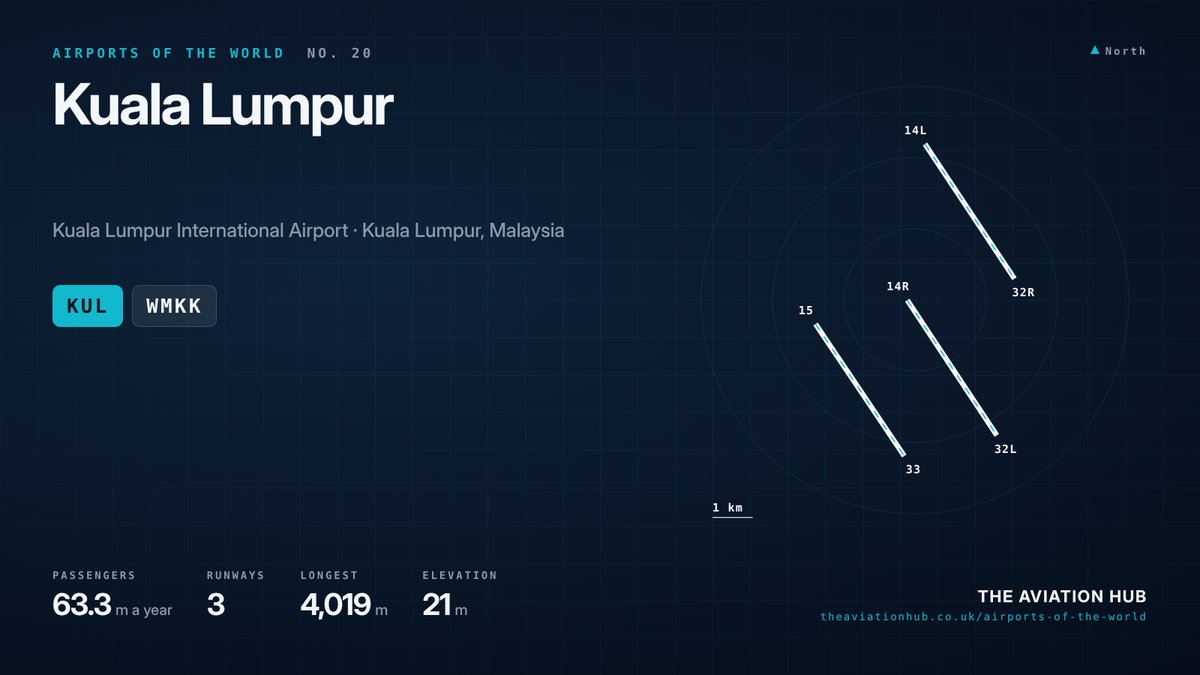
Kuala Lumpur Airport lies at Sepang in the state of Selangor, around 28 miles (45 km) south of the Malaysian capital, on a site carved from oil palm plantations in the 1990s. It is the hub of Malaysia Airlines and the home base of AirAsia, the largest low cost carrier in Asia. About 63 million passengers used it in 2025. Three parallel runways, a terminal built around a patch of rainforest and a separate budget terminal with its own railway station make it one of the more unusual hubs in the region.
Kuala Lumpur Airport at a Glance
The IATA code is KUL, inherited from the old Subang airport, and the ICAO code is WMKK. The terminals lie roughly 28 miles (45 km) from KL Sentral in the Sepang district, close to the Formula One circuit. Elevation is 69 feet (21 m) on gently rolling plantation land.
Three asphalt runways serve two terminals: Terminal 1, the original Kisho Kurokawa building with its Satellite A, and Terminal 2, the former klia2 that opened for low cost carriers in 2014. Traffic in 2025 reached about 63 million passengers, with cargo around 640,000 tonnes. Malaysia Airlines, Batik Air Malaysia, MASkargo and Raya Airways run hubs here, and AirAsia and AirAsia X keep their main bases. Malaysia Airports Holdings, now majority owned by a consortium including the sovereign fund Khazanah, operates the field. Flight status and terminal maps sit on the airport’s official website.
How Kuala Lumpur Moved South to Sepang
Subang, just west of the city, served Kuala Lumpur from 1965 but had a single runway and no room to grow. In 1993 the government of Mahathir Mohamad chose a 100 square kilometre site at Sepang and commissioned the Japanese architect Kisho Kurokawa to design a terminal on the theme of an airport in the forest. A section of real rainforest was transplanted into the centre of the satellite building. The airport opened on 27 June 1998, though baggage system failures and computer crashes marred the first weeks.
A Low Cost Carrier Terminal opened in 2006 as a bare bones base for the fast growing AirAsia and quickly overflowed. Its replacement, klia2, opened on 1 May 2014 with 68 gates, a skybridge and a shopping mall, and was renamed Terminal 2 in 2023. The Aerotrain linking Terminal 1 with its satellite broke down in March 2023 and stayed out of service until new trains entered service on 1 July 2025.
The airport is forever linked with Malaysia Airlines Flight 370, the Boeing 777-200ER that vanished about 40 minutes after departing for Beijing on 8 March 2014. Three years later, in February 2017, Kim Jong Nam, the half brother of North Korea’s leader, was murdered with a nerve agent in the Terminal 2 departures hall.
Runways at Kuala Lumpur Airport
Kuala Lumpur Airport has three parallel asphalt runways, each 60 metres wide. The longest is 14L/32R at 4,019 metres (13,186 feet), on the eastern side beside Terminal 1. Runway 14R/32L measures 4,000 metres (13,123 feet) and serves the western side of the field. The third runway, 15/33, opened with Terminal 2 and is 3,960 metres (12,993 feet) long. It takes the next number along, rather than a letter, because it is the third parallel strip.
Winds are light and variable in the tropics, so the airport switches direction with the monsoons rather than daily. Afternoon thunderstorms are the main operational hazard and can halt departures for an hour at a time. The long runways let Malaysia Airlines Airbus A350-900s and AirAsia X A330s depart at full weight in 35 degree heat.
Terminals and Airlines
Terminal 1 is the full service building at Kuala Lumpur Airport. Malaysia Airlines uses the contact pier for domestic and regional flights and Satellite A for long haul, with the oneworld partners British Airways, Qatar Airways, Cathay Pacific and Japan Airlines alongside. Star Alliance members such as Singapore Airlines, Turkish Airlines, Thai and ANA, and SkyTeam carriers including KLM, Saudia and China Eastern, share the satellite. Emirates, Etihad and Batik Air Malaysia are also here. The Malaysia Airlines Golden Lounge in the satellite is the best in the building.
Terminal 2 belongs to the AirAsia group, with AirAsia, AirAsia X and the Thai, Indonesian and Philippine affiliates filling most of its gates. Scoot, Cebu Pacific and other budget carriers use it too. The two terminals are 2 km apart and connected only by road or by the KLIA Transit train, a two minute ride that costs a couple of ringgit. An airside link has been proposed but passengers connecting between a Malaysia Airlines and an AirAsia flight must still clear immigration and transfer landside.
Routes and Destinations
Singapore is the busiest route by a wide margin, with around 3.6 million passengers in 2023 spread across Malaysia Airlines, Singapore Airlines, AirAsia, Scoot and Batik. Jakarta and Denpasar follow, and Bangkok, Hong Kong, Ho Chi Minh City and Manila complete the regional picture. Domestically, the East Malaysian cities of Kota Kinabalu and Kuching lead, followed by Langkawi and Penang, with AirAsia and Malaysia Airlines competing on every trunk.
Long haul from Kuala Lumpur Airport is thinner than at Singapore but still broad. Malaysia Airlines flies A350s to London Heathrow and Boeing 737 MAX 8s and A330s across Asia and Australia, AirAsia X reaches Sydney, Tokyo, Osaka, Seoul and Auckland, and Qatar, Emirates, Turkish and Saudia serve the Gulf and Europe via their hubs. The London flight is the longest at about 6,590 miles (10,600 km). Cargo has fallen sharply, but MASkargo, Raya Airways and UPS keep the Advanced Cargo Centre busy.
Getting to and from Kuala Lumpur Airport
The KLIA Ekspres is the fastest way into town, running nonstop from Terminal 1 to KL Sentral in 28 minutes for 55 ringgit (£10), with trains every 15 to 20 minutes and a stop at Terminal 2. The KLIA Transit uses the same line but calls at Putrajaya and two other stations, taking about 35 minutes for the same fare. From KL Sentral the metro, monorail and commuter trains cover the city.
Buses are the cheapest sensible option. Several operators run coaches from both terminals to KL Sentral for 12 to 15 ringgit in about an hour, and intercity coaches continue to Malacca, Ipoh, Penang and Johor Bahru. Taxis use a coupon system from the arrivals hall and cost 75 to 100 ringgit (£13 to £18) to the city centre, with journeys of 50 to 70 minutes on the toll free KLIA Expressway. Ride hailing is well established. Multi storey car parks face each terminal and long term lots are served by shuttles.
Spotting and Photography
Terminal 1 has a public observation deck on the top floor of the main building, landside and free, overlooking the taxiways and apron through glass. The Sama Sama Hotel next to Terminal 1 has a ninth floor terrace looking towards runway 32R. Outside the fence, a dirt road beside runway 33 suits afternoon arrivals, and the village of Labu Lanjut sits under the approach to 14L.
Tropical light is best before 10:00 and after 16:00, when the haze lifts and the sun drops. Kuala Lumpur Airport offers Malaysia Airlines A350s and A330neos, dozens of AirAsia A320s and A321neos in special liveries, AirAsia X A330s, and Gulf and Asian wide bodies. Malaysian police tolerate photography from the terminal and hotels but often move people on from roadside spots, so stay off plantation estate roads marked as private and keep away from the fence.
What Comes Next
The government wants to raise Terminal 1’s capacity from 30 to around 59 million passengers and Terminal 2’s from 45 to 67 million through a rolling programme of refurbishment, including the replaced Aerotrain and a new baggage system. A fourth runway and a Terminal 3 are under study for the 2030s, and the airside link between the two terminals is the next practical step.
Competition from Singapore Changi and Bangkok is the strategic challenge, and Malaysia Airlines must grow its long haul network to justify the investment. Kuala Lumpur Airport has the space and the runways to double in size, and it is heading for a stronger position as the low cost capital of Southeast Asia. Compare its layout with other hubs on the Airports of the World map.
Continue to follow The Aviation Hub for more analysis and insight.
Advertise with us Your brand, in front of an aviation audience Home page and in-article placements, sold directly, one advertiser per slot. From £250 a year. See the rates

