
Frankfurt Airport Guide: Germany’s Four Runway Gateway
Frankfurt Airport explained: four runways, Lufthansa's main hub, the new Terminal 3, rail links and the best places to watch aircraft.
 By The Aviation Hub
7 min read
Updated October 20, 2026
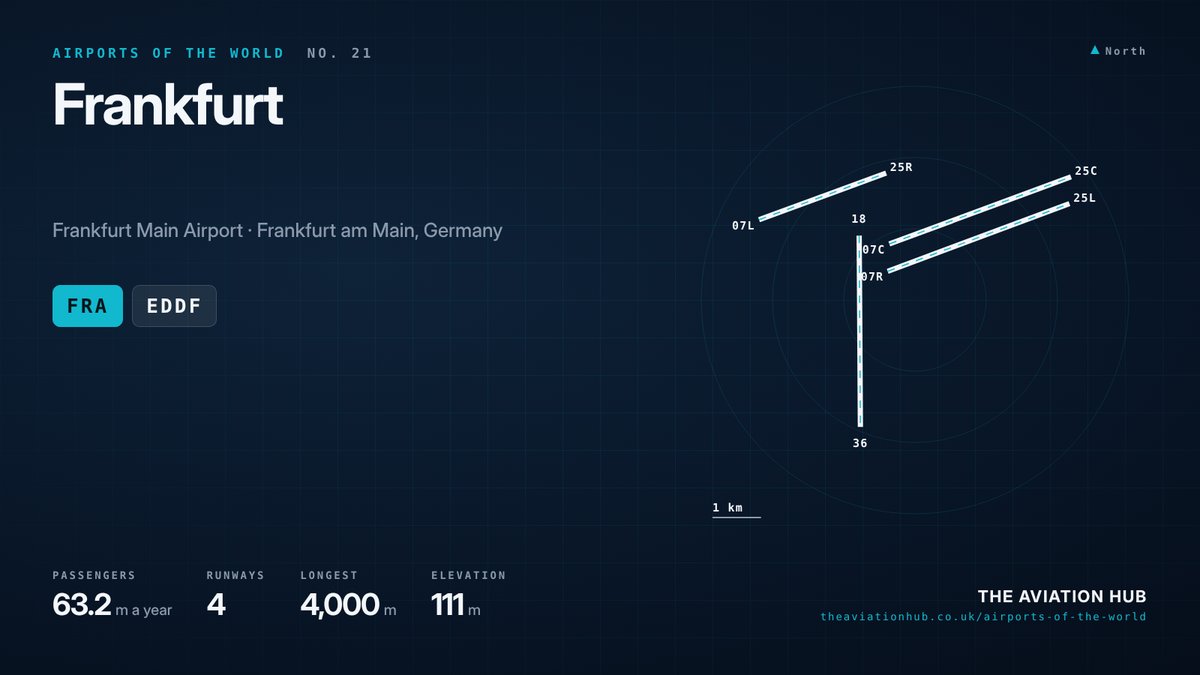
Frankfurt Airport sits on the southwestern edge of Germany’s financial capital, wedged between the A3 and A5 motorways and the forest of the Frankfurt City Forest. It is the busiest airport in Germany by passengers, the home hub of Lufthansa, and one of the largest cargo gateways in Europe. Around 63 million passengers passed through in 2025. For enthusiasts, it offers four runways, a constant flow of wide body traffic and some of the best public viewing on the continent.
Frankfurt Airport at a Glance
The airport uses the IATA code FRA and the ICAO code EDDF. Its official name in the German aeronautical publications is Frankfurt Main Airport, which gives the code its logic. The field lies about 7 miles (12 km) southwest of the city centre at an elevation of 111 m (364 ft). Fraport, a part publicly owned company, operates the site and also runs airports around the world.
Three passenger terminals serve the airport, although only two are open at any one time during the current rebuilding programme. Four runways handle the traffic. Lufthansa, Lufthansa CityLine, Lufthansa City Airlines, Discover Airlines, Lufthansa Cargo and AeroLogic all call Frankfurt Airport home. Condor, SunExpress and TUI fly Deutschland run bases here too. Up to date flight and parking information is available on the airport’s official website.
How Frankfurt’s Airport Came to Be
The airport opened on 8 July 1936, replacing an older airfield at Rebstock that could not cope with larger aircraft or airships. The new site in the forest south of the city had room to grow, and it needed it. After the Second World War the Americans took over part of the field as Rhein Main Air Base, which served as a major transport hub for the US Air Force until 2005. The Berlin Airlift of 1948 and 1949 flew largely from here.
Civil traffic recovered through the 1950s, and in 1972 the vast Terminal Mitte opened, now known as Terminal 1. The 1984 arrival of Runway 18, a departures only strip pointing due south, followed years of protest and court action over the loss of forest. Terminal 2 opened in 1994 with concourses D and E. The long distance rail station followed in 1999, and the high speed line to Cologne opened through it in 2002.
The most recent turning points are the Northwest Runway, opened in October 2011 after another long planning fight, and Terminal 3, which finally opened on 23 April 2026 after pandemic delays. A night flight ban between 11pm and 5am came into force with the new runway, and it still shapes the schedule.
Runways at Frankfurt Airport
Frankfurt Airport has four runways, more than any other German airport. Three of them run roughly east to west and one points north to south. Runway 07C/25C is the original 1936 strip, 4,000 m (13,123 ft) long and 60 m wide with an asphalt surface. Runway 07R/25L, the southern parallel, also measures 4,000 m (13,123 ft) and dates from 1949. Both handle departures and arrivals.
Runway 18/36 is the oddity. It is 4,000 m (13,123 ft) of concrete, yet it is used only for southbound departures as Runway 18. Aircraft taxi across the two main runways to reach it, which keeps controllers busy. The fourth strip, Runway 07L/25R, is the 2,800 m (9,186 ft) Northwest Runway opened in 2011. It is used for landings only, and it is not approved for the Airbus A380, the Boeing 747 or the MD-11 because of its narrower safety margins.
The usual pattern sees arrivals on 25L and 25R or 07L and 07R, departures on 25C or 07C, and heavy southbound departures on 18. Westerly operations on the 25s dominate for much of the year. The layout gives Frankfurt Airport a theoretical capacity of more than 100 movements an hour, although the night ban limits total throughput.
Terminals and Airlines
Terminal 1 is the heart of the operation. Its concourses A, B, C and Z handle Lufthansa and its Star Alliance partners, which include United, Air Canada, Singapore Airlines, Thai Airways and Turkish Airlines. The A Plus pier, opened in 2012, was built for the A380 and now handles Lufthansa’s 747-8 and Boeing 787-9 fleets. Condor and El Al also use Terminal 1. Lufthansa runs a separate First Class Terminal for its top tier passengers, complete with its own security and chauffeur driven transfers to the aircraft.
Terminal 3 opened in April 2026 on the former air base site south of the runways. Its first wave of airlines included Cathay Pacific, Emirates and Qatar Airways, and Condor plans to move across in summer 2027. Terminal 2, home to the SkyTeam and Oneworld carriers for three decades, closed on 9 June 2026 for a full refurbishment expected to last into the mid 2030s. The driverless SkyLine people mover links Terminals 1 and 2, and a new line now serves Terminal 3.
Routes and Destinations
Around 330 destinations across five continents appear on the departure boards, one of the largest direct route networks of any airport. London Heathrow was the busiest international route in 2023 with roughly 664,000 departing passengers. Vienna, Madrid, Palma de Mallorca and Istanbul follow. Domestically, Berlin Brandenburg, Hamburg and Munich lead, although high speed rail has eaten into those flows.
Long haul traffic is where Frankfurt Airport earns its keep. Dubai, Toronto, New York JFK and Antalya were the busiest intercontinental routes. Lufthansa’s wide body fleets fan out to North America, Asia and Africa every evening. Summer brings a wave of leisure capacity from Condor and Discover to the Mediterranean, Caribbean and Indian Ocean.
Cargo is an enormous part of the business. Lufthansa Cargo bases its Boeing 777F fleet here and AeroLogic flies 777Fs for DHL. CargoCity South and CargoCity North handle more than two million tonnes in a normal year, and the field regularly ranks as the busiest cargo airport in Europe.
Getting to and from Frankfurt Airport
Rail is the obvious choice. The regional station beneath Terminal 1 has the S8 and S9 suburban lines to Frankfurt Hauptbahnhof in about 11 minutes, with trains roughly every 15 minutes. A single ticket costs around €6. The long distance station next door puts Cologne within an hour, and ICE trains reach Munich, Hamburg and Basel without a change. Deutsche Bahn even sells joint rail and air tickets with Lufthansa.
By road, the Frankfurter Kreuz interchange of the A3 and A5 sits at the airport gate. The drive to the city centre takes 10 to 15 minutes outside rush hour. Taxis charge roughly €35 to €40 to the centre. Coaches run to cities across Germany and neighbouring countries from the Terminal 1 bus station. Long stay parking is cheapest when pre booked online, and multi storey car parks sit directly outside each terminal.
Spotting and Photography
Frankfurt Airport is a spotter’s airport. The viewing terrace on Terminal 2 overlooks the apron and Runway 25C/07C, but the terminal closed for refurbishment in June 2026, so check before visiting. The best free location is the elevated platform beside the A5 near Zeppelinheim, at the eastern end of the field, where heavy arrivals on 25L and 25C pass on short final. A second platform sits beside the Northwest Runway near Kelsterbach and covers arrivals on 25R.
Light at both platforms is good for most of the day outside high summer. The West Runway platform, reached by walking under the runway from the Airportring, gives a view of Runway 18 departures from the side, best after 1pm. Stay on the public side of all fences, do not block service roads, and expect police checks if you park in the forest tracks.
What Comes Next
The opening of Terminal 3 is the biggest change in decades. Its first phase has two piers and room for about 19 million passengers a year, with capacity for 25 million once Pier G and the remaining sections are complete. Terminal 2’s long closure will push more airlines into Terminal 3 and reshape the alliance groupings that have held since the 1990s.
Capacity on the runways is capped by the night ban and by German environmental politics, so Fraport is chasing yield rather than slots. Lufthansa continues to renew its long haul fleet with the Boeing 787-9 and Airbus A350-900, and the first Boeing 777-9 deliveries will land here. Frankfurt Airport is heading towards 70 million passengers with the same four runways it has today. You can compare its layout with other major hubs on the Airports of the World map.
Continue to follow The Aviation Hub for more analysis and insight.
Advertise with us Your brand, in front of an aviation audience Home page and in-article placements, sold directly, one advertiser per slot. From £250 a year. See the rates

