Chengdu Tianfu Airport is the newest of China’s great hubs, opened in 2021 on farmland southeast of the Sichuan capital. It gave Chengdu a second international airport and made it one of only a handful of Chinese cities with two. Around 56.7 million passengers used it in 2025, which puts it in the top five in China. Three runways and two terminals were built in the first phase, and the master plan runs to six runways and 90 million passengers a year.
Chengdu Tianfu Airport at a Glance
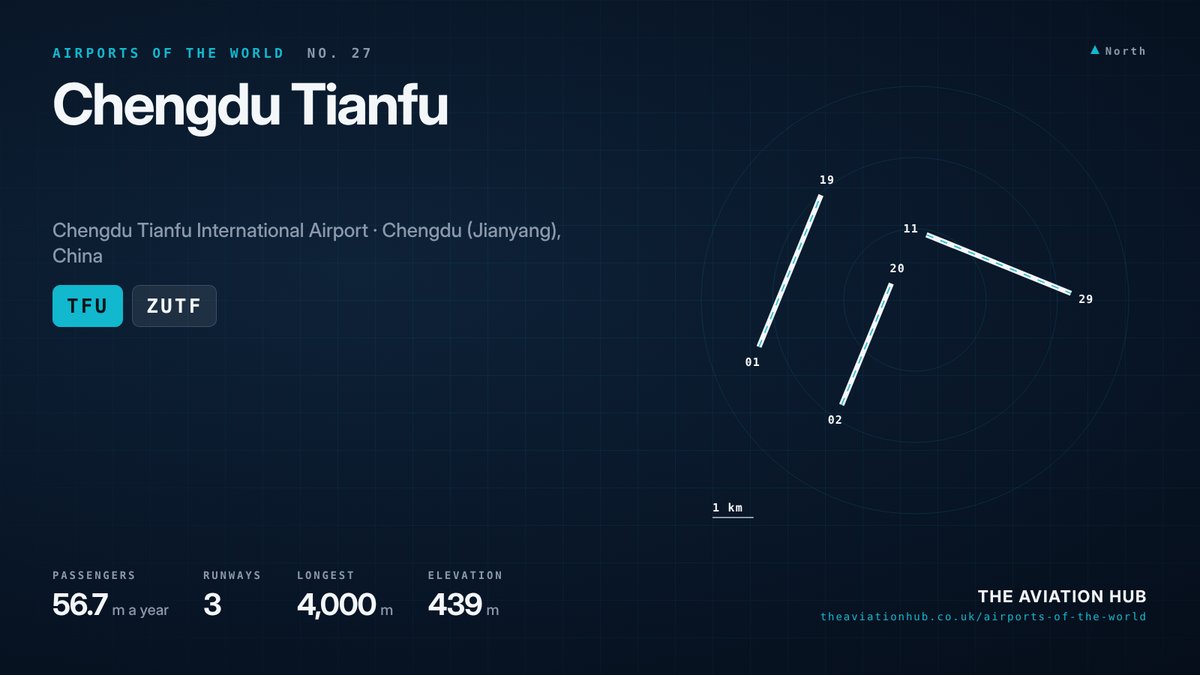
The IATA code is TFU and the ICAO code is ZUTF. The airport lies in Lujia Town in Jianyang, about 32 miles (51 km) southeast of central Chengdu, on the far side of the Longquan mountains from the old Shuangliu airport. The elevation is 439 m (1,440 ft). Sichuan Province Airport Group, a state owned company, operates both Chengdu airports.
Three runways are in service, and a third terminal joins the first two from 28 October 2026. Air China runs a major base at Chengdu Tianfu Airport with its own maintenance hangars and crew facilities. Sichuan Airlines, China Eastern and Chengdu Airlines call it a hub, and China Southern and Lucky Air treat it as a focus city. Information on flights, transit visas and transport is published on the airport’s official website.
How Chengdu’s Second Airport Came to Be
Shuangliu, Chengdu’s original airport, passed its design capacity years before anyone expected and had no room to add a third runway. Planning for a replacement began in 2007, the site at Lujia was approved in 2013, and the State Council and the Central Military Commission approved the project in 2015. The name Tianfu borrows the ancient title for the Sichuan basin, the land of heavenly abundance.
Construction started in May 2016 on a greenfield site chosen for its space rather than its convenience. The two terminals were designed in the shape of the golden Sunbird, the ancient emblem of Chengdu found at the Jinsha archaeological site. The airport opened on 27 June 2021 with a Sichuan Airlines Airbus A350-900 to Beijing as the first departure.
The pandemic kept international flights away for almost two years. Tianfu took over most international and cargo routes from Shuangliu in March 2023, and the division of labour between the two fields has been adjusted several times since. In the summer of 2026 some Hong Kong and Taipei flights moved back to Shuangliu.
Runways at Chengdu Tianfu Airport
Chengdu Tianfu Airport opened with three concrete runways, which is unusual for a brand new field. Runway 01/19 is the longest at 4,000 m (13,123 ft) and 60 m wide, built to handle fully loaded wide bodies departing in the humid summer heat of the basin. Runway 02/20 runs roughly parallel to it at 3,200 m (10,499 ft) and 45 m wide.
The third strip, Runway 11/29, is 3,800 m (12,467 ft) long and sits at an angle to the parallel pair, which gives controllers a crosswind option and a separate departure stream. In practice the two parallels take the bulk of arrivals and departures.
The site is 439 m above sea level, high enough to trim performance on hot days, but the long runways remove any practical limits. Fog in the basin during the winter months is the main operational headache, and the airport has invested in low visibility procedures to keep the schedule moving.
Terminals and Airlines
Terminal 1 handles most international flights plus some domestic services, and Terminal 2 handles mainly domestic traffic. An automated people mover links the two, with a domestic section that lets international arrivals transfer to domestic departures in Terminal 2. Both terminals are vast, with wide corridors, long walks and a design that spreads the gates along the Sunbird’s wings.
Air China is the largest tenant at Chengdu Tianfu Airport, with a 1,500 bed staff hostel beside the airport, its own maintenance base and a lounge of nearly 3,000 square metres. Sichuan Airlines, the hometown carrier, flies its Airbus A350-900 and A330 fleets from here on the long haul routes. China Eastern, Chengdu Airlines and Lucky Air add domestic frequency. Foreign carriers include Qatar Airways, with Turkish Airlines, S7 and Etihad joining between October 2026 and March 2027, while Cathay Pacific and EVA Air moved their flights back to Shuangliu in the summer of 2026.
Routes and Destinations
Domestic flying dominates at Chengdu Tianfu Airport. Beijing, Shanghai, Guangzhou, Shenzhen, Hangzhou and Kunming are the trunk routes, each with many departures a day across several airlines. The network reaches every province and dozens of smaller cities across western China. Air China and Sichuan Airlines have the longest route lists, and the two together provide most of the regional feed into the long haul flights.
International service spans Asia, Europe and North America. Sichuan Airlines flies the A350-900 to Los Angeles, Sydney and Auckland, and also serves Madrid and Athens. Air China links Tianfu with Paris, Milan, Brussels and Tokyo, plus London in summer. The Gulf and Southeast Asian carriers connect Chengdu to Doha, Singapore, Bangkok and Kuala Lumpur. Cargo matters here too, with around 435,000 tonnes handled in 2025 and the main freight apron laid out for Boeing 747 and 777 freighters. The transit visa scheme allows 240 hour stays for more than 50 nationalities and short stopovers for everyone else.
Getting to and from Chengdu Tianfu Airport
Metro Line 18 is the main link, running from the airport to Chengdu South railway station in 30 to 40 minutes with express services, and an extension towards the main Chengdu railway station is under construction. A single fare is cheap, which makes it the obvious choice for most passengers. Metro Line 19 provides an express link between Tianfu and Shuangliu for passengers connecting between the two airports.
The Chengdu to Yibin high speed railway stops at Tianfu Airport station beneath the terminals, which puts the field within reach of cities across Sichuan without a transfer. Five bus routes run around the clock to the city centre and surrounding towns. Taxis and ride hailing apps are plentiful, and the drive to the centre takes about an hour on the airport expressway, costing roughly 150 to 200 yuan (around £16 to £22). Large multi storey car parks surround the terminals.
Spotting and Photography
Chengdu Tianfu Airport has no official viewing deck, and the open countryside around it is still being developed. The hills and farm roads around the field can give views of the approaches, though access changes as the area is built up. The terminal windows on the departures level overlook the aprons and the people mover line.
Light is the challenge. The basin is often hazy, and the best conditions come after rain in spring and autumn when the air clears. Morning light suits the eastern side, and afternoons favour the hills to the west. Chinese airports are sensitive about photography near the fence, so stay on public roads, keep cameras away from military or security areas and be ready to show identification if asked.
What Comes Next
Terminal 3 opens at midnight on 28 October 2026, pushing the field towards its phase one design capacity. The master plan calls for six runways, four terminals and 90 million passengers a year, which would make Tianfu one of the largest airports in the world by capacity. A personal rapid transit system for the car parks has been planned but had not opened by 2025.
New international routes keep arriving, with S7 to Novosibirsk in October 2026, Turkish Airlines to Istanbul in November 2026 and Etihad to Abu Dhabi in March 2027. The balance between Tianfu and Shuangliu will keep shifting as the airlines settle. Chengdu Tianfu Airport is set to stay among the busiest airports in China through the decade. See how it sits against the rest of the country on the Airports of the World map.
Continue to follow The Aviation Hub for more analysis and insight.
Advertise with us Your brand, in front of an aviation audience Home page and in-article placements, sold directly, one advertiser per slot. From £250 a year. See the rates