
Beijing Daxing Airport Guide: Inside the Starfish Terminal
Beijing Daxing Airport explained: the starfish terminal, four runways, the SkyTeam hub for Beijing, metro and rail links, and what comes next.
 By The Aviation Hub
7 min read
Updated October 20, 2026
Beijing Daxing Airport sits on the southern edge of the capital, straddling the border between Beijing and Hebei province. It opened in September 2019 as the city’s second major gateway and has grown faster than almost any new airport of its generation. More than 53 million passengers passed through in 2025, and the single starfish shaped terminal is already one of the most recognisable buildings in Chinese aviation. For enthusiasts it offers a rare chance to watch a hub being built from a blank sheet of paper.
Beijing Daxing Airport at a Glance
Beijing Daxing Airport carries the IATA code PKX and the ICAO code ZBAD. It lies about 29 miles (46 km) south of Tiananmen Square and some 40 miles (65 km) from Beijing Capital, which sits on the opposite side of the city. The site is low and flat at 98 ft (30 m) above sea level. There are four civil runways and one passenger terminal of roughly 700,000 square metres, billed as the largest single building airport terminal in the world.
Traffic reached around 53.6 million passengers in 2025, up more than 8 per cent on the previous year, with close to 346,000 aircraft movements. China Southern, China Eastern, Air China, XiamenAir, Beijing Capital Airlines and China United all run hubs here. Capital Airports Holding, the state owned group behind Beijing Capital, operates the field. Flight and facility details are on the airport’s official website.
How Beijing’s Second Hub Came to Be
By 2012 Beijing Capital was running close to its design limit, and the city’s third airport, Nanyuan, was a cramped military field with a small civil terminal. Planners had floated a new southern airport as early as 2008. The National Development and Reform Commission approved the project in December 2014, and construction started within days of the decision.
The design came from Zaha Hadid Architects working with the French planners ADPi, and the Beijing Institute of Architectural Design executed it. Arup was among the engineering consultants. The terminal takes its nickname from the plan view, a central hub with six curved piers that keep walking distances short despite the building’s size. Construction finished on 30 June 2019 after four and a half years of work.
President Xi Jinping opened the airport on 25 September 2019, six days before the 70th anniversary of the People’s Republic. The first commercial arrival came the next day, and China Southern flew the first official departure with an Airbus A380. Nanyuan, which had been China’s oldest airport, closed on the same day. Beijing Daxing Airport was built to handle 72 million passengers a year in its first phase.
Runways at Beijing Daxing Airport
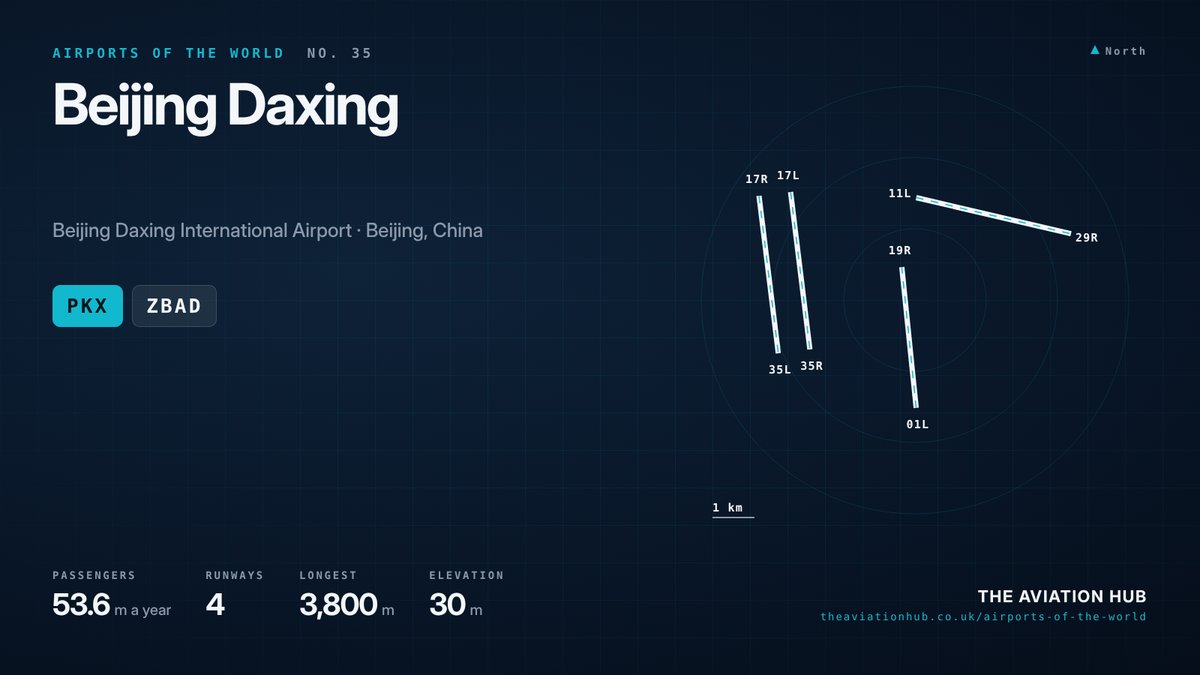
Four concrete runways serve the civil airport. Three of them measure 3,800 m (12,467 ft). Runways 17L/35R and 17R/35L form a parallel pair aligned roughly north to south, and 11L/29R runs east to west on the opposite side of the terminal. The fourth, 01L/19R, is 3,400 m (11,155 ft) long and lies east of the terminal, roughly parallel to the western pair.
The layout is unusual. Most large hubs settle on a single set of parallels, but Beijing Daxing Airport spreads its runways around the terminal so that aircraft can taxi short distances from any pier. The east to west runway, 11L/29R, does not cross any of the others. A separate military airfield shares the site, as one did at Nanyuan, and the master plan allows for further runways. The long term layout calls for seven, six of them civil.
Terminals and Airlines
Everything happens in one building. The terminal’s central hall holds check in, security and a large landside commercial area, and the six piers radiate from it so that no gate is more than a few minutes’ walk from the core. Passengers clear facial recognition checkpoints, and bags move on a radio tracked system.
The airline split follows alliance lines, which was the plan from the start. The 2016 allocation sent the SkyTeam carriers south. China Southern moved every Beijing flight to Daxing in October 2020, and China Eastern and XiamenAir followed the same logic, although China Eastern keeps a presence at Capital for its Beijing to Shanghai shuttle. Star Alliance stayed at Capital, where Air China dominates, though Air China also runs a secondary hub at Daxing.
Foreign carriers were allowed to choose. British Airways and Malaysia Airlines moved to Beijing Daxing Airport, although British Airways paused its Beijing flights in October 2024, while Cathay Pacific stayed north. Lufthansa and Swiss planned moves that the pandemic delayed, and Finnair dropped its services after the Russian airspace closure lengthened the route. Beijing Capital Airlines, China United and Hebei Airlines complete the domestic line up.
Routes and Destinations
Domestic flying dominates. The densest routes link Daxing with Guangzhou, Shanghai, Shenzhen, Chengdu, Chongqing, Hangzhou, Xi’an and the big cities of the northeast, with China Southern and China Eastern running shuttle style frequencies on the trunk routes. China United’s network of smaller provincial cities adds breadth that Capital does not have.
International services are growing but remain a minority of the schedule. London Heathrow, Amsterdam, Moscow Sheremetyevo, Doha, Seoul Incheon, Tokyo Haneda, Bangkok, Singapore and Sydney all feature. China Southern flies to London, and the longest services are Royal Air Maroc’s flights to Casablanca and the seasonal Beijing Capital Airlines link to Lisbon. Cargo passed 369,000 tonnes in 2025, up 13 per cent, and the airport has a large dedicated freight zone that is still filling up.
Getting to and from Beijing Daxing Airport
The Daxing Airport Express metro line runs from Caoqiao on Line 10 straight to the terminal, with trains running at up to 160 km/h. The ride takes about 20 minutes, and a northern extension to Lize business district is due to open in 2027. Fares are a fraction of a taxi. Intercity trains on the Beijing to Xiong’an railway stop beneath the terminal, and the run from Beijing West takes 28 minutes.
The Daxing Airport Expressway and its northern link road take cars and airport coaches into the city. Allow an hour or more to the centre by road and considerably longer in the evening peak. Coaches serve several points in Beijing and the Hebei cities of Langfang and Baoding. Taxis queue at ground level and cost roughly 150 to 200 yuan to central Beijing. For most visitors the metro is the cheapest and most reliable way to reach Beijing Daxing Airport.
Spotting and Photography
Beijing Daxing Airport is spotter friendly by Chinese standards. The piers have long runs of glass, and the upper levels of the terminal look out across the aprons to the runways. The east and west piers give the best views of movements on the parallel runways, and the central hall’s roof lights the building beautifully in the late afternoon.
Outside the fence, the farmland and new roads around the perimeter give views of approaches to the 35s and 17s. The light favours the eastern side in the morning and the western side later in the day. Security is strict in China, so stay on public roads, do not linger close to the fence, keep well away from the military side of the airport and be ready to show identification if asked.
What Comes Next
The first phase was built for 72 million passengers, and traffic is already about three quarters of the way there. The master plan adds more terminal space and the remaining runways in later phases. Rail is the next big change, with the Airport Express reaching Lize in 2027, the Xiong’an line extending south and a connector planned towards Langfang, Tongzhou and Beijing Capital.
The open question is international growth. China’s outbound market has recovered slowly, and Capital still holds the stronger long haul schedule. Beijing Daxing Airport is heading for the 70 million mark by the end of the decade as the SkyTeam hub for northern China, with plenty of concrete still to lay. See how it compares with Capital and the rest of the top 50 on the Airports of the World map.
Continue to follow The Aviation Hub for more analysis and insight.
Advertise with us Your brand, in front of an aviation audience Home page and in-article placements, sold directly, one advertiser per slot. From £250 a year. See the rates

