
Manila Airport Guide: Crossing Runways in a Crowded City
Manila Airport explained: two crossing runways, three terminals and their airlines, the busiest routes, how to reach the city and what the new operator plans.
 By The Aviation Hub
6 min read
Updated October 20, 2026
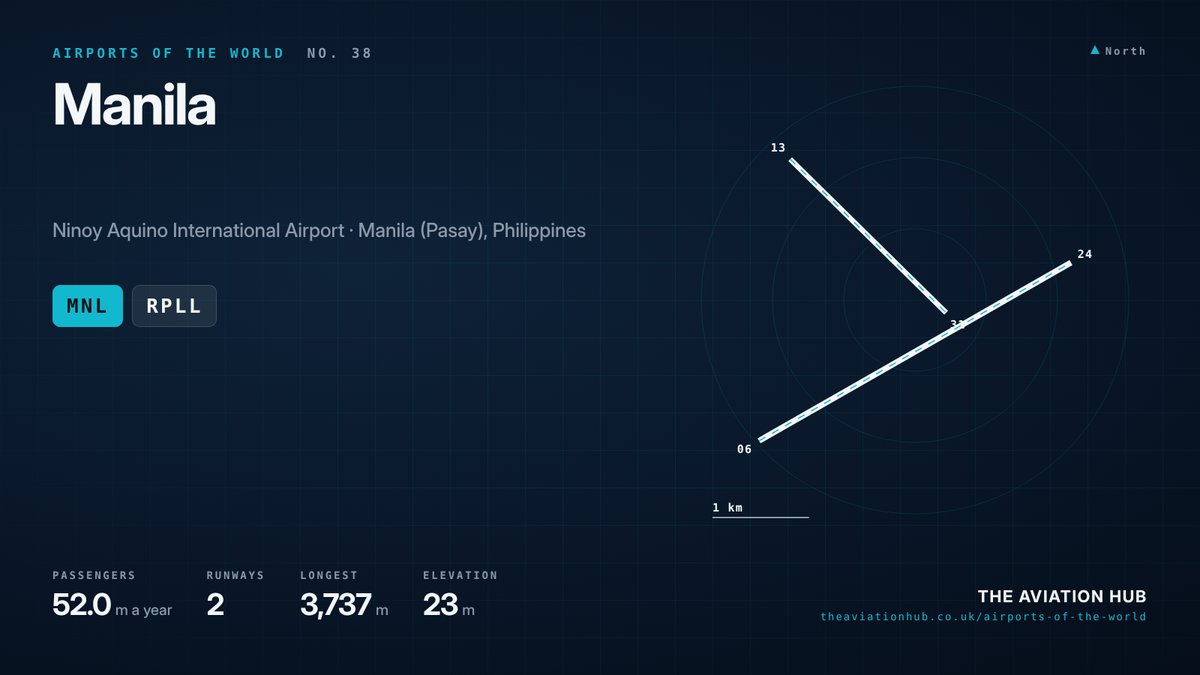
Manila Airport, officially Ninoy Aquino International, is the main gateway to the Philippines and one of the most congested airports in Asia. It sits inside the built up sprawl of Metro Manila, barely 4 miles (7 km) south of the old city and a short drive from the business district of Makati. The airport handled more than 50 million passengers in 2024 on an airfield designed for 35 million, with two crossing runways and no room to grow. A private operator took over in 2024 with a brief to fix it, and a replacement airport is rising to the north.
Manila Airport at a Glance
Manila Airport uses the IATA code MNL and the ICAO code RPLL. It lies on the boundary of Pasay and Paranaque, south west of Makati, at an elevation of 75 ft (23 m). Two runways cross near the terminals, and three passenger terminals remain in use after the demolition of the original Terminal 4 in 2025. Philippine Airlines and its regional arm PAL Express run their hub here, and Cebu Pacific and Philippines AirAsia base most of their fleets at the airport.
Traffic reached around 50.4 million passengers in 2024, a record and an increase of about 11 per cent on the year before. New NAIA Infrastructure Corporation, a consortium led by San Miguel Corporation with Incheon International Airport Corporation, has operated the airport since September 2024 under a long term concession. Flight status and terminal assignments are on the airport’s official website.
How the Philippine Capital’s Airport Came to Be
Manila’s first commercial airfield opened at Grace Park in 1935, and Nielson Airport in Makati followed in 1937. After the war the government chose Nichols Field, an American air base with an existing runway and flat open land, and civil flights moved there in 1948. The airport was known as Manila International Airport for four decades.
On 21 August 1983 the opposition leader Benigno “Ninoy” Aquino Jr was shot dead on the apron moments after stepping off a China Airlines flight from Taipei. His killing fed the People Power Revolution of 1986, and in 1987 Congress renamed the airport in his honour. Several later attempts to restore the old name or to honour Ferdinand Marcos have failed.
Terminal 2 opened in 1999 as the Centennial Terminal for Philippine Airlines. Terminal 3 took far longer. Construction began in 1997, then legal disputes, a ceiling collapse and arbitration stalled it for years. It opened in part in 2008 and became fully operational only in 2014. The airport was repeatedly ranked among the worst in the world during those years, a label the new operator is working hard to shed.
Runways at Manila Airport
The primary runway, 06/24, is 3,737 m (12,261 ft) long and 60 m wide with a concrete surface. It is aligned to take advantage of the north east and south west monsoon winds, and it handles the great majority of the roughly 550 daily movements, including every wide body. The secondary runway, 13/31, measures 2,258 m (7,408 ft) and is 45 m wide. It meets the main runway east of its midpoint.
The crossing layout is the fundamental constraint at Manila Airport. Runway 13/31 takes around 100 flights a day, mostly ATR 72 turboprops, Airbus A320s and A321s and business jets, and every movement on it has to be threaded between arrivals and departures on 06/24. Capacity is capped at about 40 movements an hour as a result. The short runway closed for a full rehabilitation in 2020 and reopened in February 2021. Slot limits and frequent delays follow directly from this geometry.
Terminals and Airlines
Terminal 1, the building where Aquino died, is international only. Philippine Airlines moved its international hub here in June 2023, and the AirAsia group’s international flights followed in March 2026. Korean Air, Asiana, EVA Air and Malaysia Airlines also use it. Terminal 2 is now domestic only and houses PAL’s domestic network, PAL Express, Philippines AirAsia’s domestic flights and Royal Air Philippines.
Terminal 3 is the largest and busiest building at Manila Airport. Cebu Pacific flies its entire operation from here, and most foreign airlines, including Emirates, Singapore Airlines, Cathay Pacific, Qatar Airways and Japan Airlines, use it too. Terminal 4, the modest 1948 domestic terminal used by turboprop operators, closed in 2024 and was demolished in 2025 to make room for a taxiway. A free landside shuttle links the terminals, though traffic on the airport roads makes transfers slow.
Routes and Destinations
Manila to Cebu is the busiest route from the airport and ranks among the busiest domestic routes in the world, with PAL, Cebu Pacific and AirAsia all flying it many times a day. Caticlan for Boracay, Iloilo, Davao, Cagayan de Oro, Bacolod and Puerto Princesa follow. Domestic flying fills the schedule from dawn, with A320 and A321 shuttles turning around in under an hour.
Internationally, Hong Kong has the most flights and Singapore is the busiest route, with Taipei, Seoul, Tokyo and Kuala Lumpur also major markets. Philippine Airlines flies long haul to Los Angeles, San Francisco, Seattle, Chicago, New York JFK, Toronto, Vancouver and Australia with Boeing 777-300ERs and Airbus A350-900s. The JFK service is the longest at around 8,500 miles (13,700 km). Gulf and Middle East routes serve the huge community of overseas Filipino workers. Seasonal peaks come at Christmas and during the Holy Week holidays.
Getting to and from Manila Airport
There is no direct rail link, because aviation clearance rules keep stations away from the airfield. The nearest is Ninoy Aquino Avenue on LRT Line 1, opened in November 2024 about 1.5 km from Terminal 1, and a station on the Metro Manila Subway at Terminal 3 is expected to open in partial service by 2032. Most passengers therefore reach Manila Airport by road.
The elevated NAIA Expressway connects the terminals to the Skyway and to the Manila to Cavite Expressway, and NAIA Road links to Roxas Boulevard. Makati is 20 minutes away in light traffic and over an hour in the evening rush. Ride hailing apps are the practical choice and cost around 300 to 500 pesos (roughly 4 to 7 pounds) to Makati. UBE Express runs a paid loop bus between the terminals, its Route 43 links Terminal 3 with the PITX bus terminal, and coaches run north to Clark. Parking is limited and prices rose after the concession started.
Spotting and Photography
The spotters’ classic location is the end of runway 24, where aircraft pass low over the housing and roads of Paranaque on short final. The roads along C5 at the eastern end catch arrivals on 24 and departures off 06. Inside, Terminal 3’s departure area has broad windows over the apron and Runway 13/31, and the Runway Manila elevated walkway to Newport City offers glimpses of movements.
Manila Airport is at its best in the dry season from December to April, when the light is sharp and the north east monsoon keeps Runway 06 in use for most of the day. The wet season brings heavy showers and typhoons that disrupt schedules. Military areas surround parts of the field, so keep cameras away from the air base fence, avoid blocking the narrow roads near the threshold and expect polite questions from security staff.
What Comes Next
The new operator has promised to raise capacity to 62 million passengers through better taxiways, a 2,500 space car park, the removal of Terminal 4 and a link between Terminals 1 and 2. Terminal 5 is planned for 2029. Fees have already risen, and the airline shuffle between terminals continues. The runways cannot change, so every gain has to come from the ground.
The real answer lies 22 miles (35 km) north at the New Manila International Airport in Bulacan, which San Miguel is building with four runways, and at a possible airport on Sangley Point in Cavite. Until they open, Manila Airport is heading for a decade of careful patching rather than transformation. See where it sits among the world’s top 50 on the Airports of the World map.
Continue to follow The Aviation Hub for more analysis and insight.
Advertise with us Your brand, in front of an aviation audience Home page and in-article placements, sold directly, one advertiser per slot. From £250 a year. See the rates

