
Xian Airport Guide: Northwest China’s Growing Hub
Xian Airport is the gateway to the Terracotta Army and northwest China, with three runways and a vast new Terminal 5. Routes, access and spotting.
 By The Aviation Hub
6 min read
Updated October 20, 2026
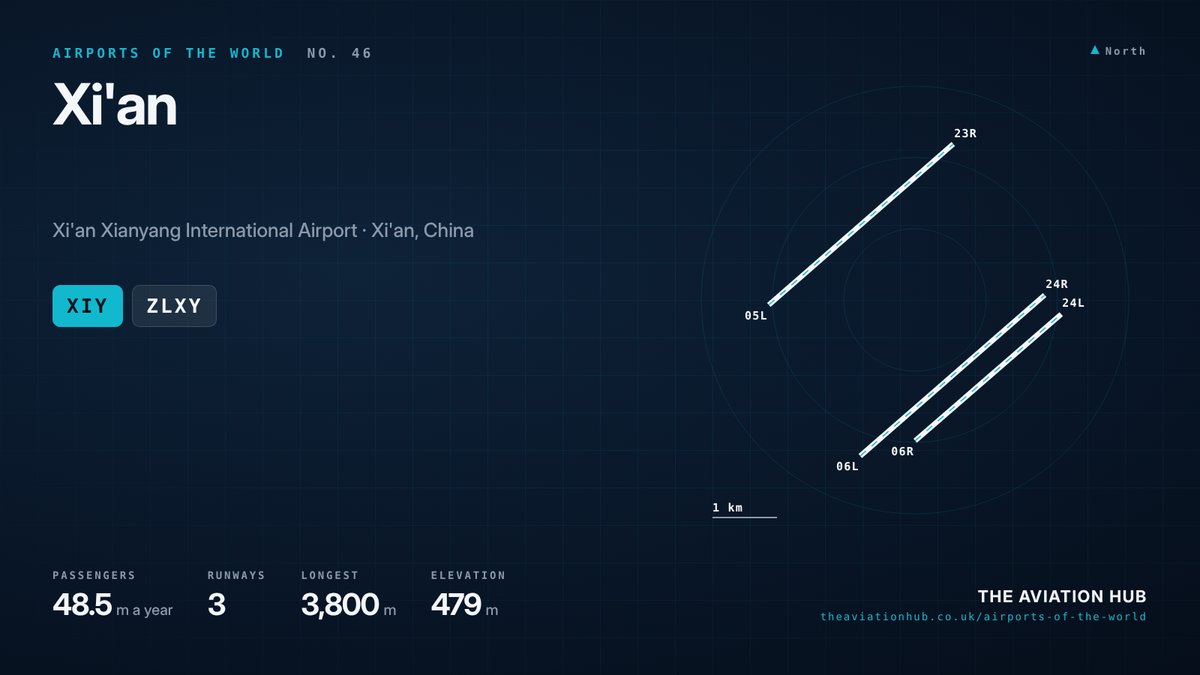
Xi’an Xianyang International Airport serves the ancient capital of Xi’an and the wider Shaanxi Province in northwest China. It sits roughly 16 miles (25 km) northwest of the city centre, within the neighbouring city of Xianyang, which gives the field its name. Xian Airport handled around 48.5 million passengers in 2025, which makes it the largest airport in the northwest of the country. New runways and the vast Terminal 5, opened in 2025, have turned it into one of China’s biggest airfields by infrastructure.
Xian Airport at a Glance
The IATA code is XIY and the ICAO code is ZLXY. The field lies at 479 metres (1,572 feet) above sea level on the loess plateau north of the Wei River, around 8 miles (13 km) from central Xianyang. Three runways are in service, with a fourth to come, alongside three active passenger terminals and the enormous Terminal 5 complex. Xi’an Xianyang International Airport Co., part of the Western Airport Group, operates the site.
Annual traffic sits just under 50 million passengers and continues to grow at mid single digit rates. China Eastern runs a major hub here through its Xi’an branch, the successor to China Northwest Airlines. Hainan Airlines, Okay Airways and Tianjin Airlines also run hubs here, and Air Chang’an keeps a base at the field. Air China, China Southern and most other mainland carriers maintain a strong presence. Transfer guides and live flight boards are on the airport’s official website.
How Xi’an’s Airport Came to Be
Xi’an’s older airfield at Xiguan, inside the city, could not grow with the booming economy of the 1980s. In 1984 the State Council and Central Military Commission approved a new civil airport on the site of a military airfield at Xianyang. Phase 1 opened on 1 September 1991 and Xiguan closed the same day. The field quickly became the home base of China Northwest Airlines.
That carrier merged into China Eastern in 2002, which explains the Shanghai based airline’s unusually strong position in Shaanxi. Phase 2 expansion ran from 2000 to 2003 and delivered Terminal 2. The 1994 loss of China Northwest Flight 2303, a Tupolev Tu-154 that broke up in flight after a maintenance error with 160 people aboard, remains the worst accident associated with the airport.
Terminal 3 and the second runway opened on 3 May 2012, lifting capacity beyond 33 million passengers and allowing Airbus A380 operations. The Phase 3 project that followed was the largest of all. Archaeologists uncovered thousands of ancient tombs on the construction site, a reminder that this plain was the heartland of the Qin and Han dynasties. Terminal 5 opened in 2025, and a new south runway followed on 25 December 2025, transforming Xian Airport.
Runways at Xian Airport
Three runways are in service. On the north western side, Runway 05L/23R is a new 3,800 metre (12,467 feet) runway built under Phase 3, and the original 3,000 metre north strip beside it is being turned into a taxiway. On the south eastern side, Runway 06L/24R, opened in 2012, measures 3,800 metres (12,467 feet) by 60 metres, and Runway 06R/24L, opened on 25 December 2025, is 3,000 metres (9,843 feet) by 45 metres. A fourth runway is due when the Phase 3 works are complete.
The two pairs are parallel, so the 05 and 06 designations are simply a device to avoid duplicate identifiers. Winds across the Guanzhong plain favour northeasterly operations for much of the year, so arrivals usually approach from the southwest over Xianyang. Southwesterly flow on the 23s and 24s takes over during summer monsoon months.
With runways on both sides of the field the airport can separate arrivals and departures. Winter smog and spring dust storms are the main weather hazards. Xian Airport sits far from the sea, so fog is less of a problem than at coastal hubs, but visibility can still fall sharply on still winter mornings.
Terminals and Airlines
Terminal 1 is the 1991 original, renovated but small, and now hosts a limited schedule, mainly 9 Air and Spring Airlines. Terminal 2 handles Air China, Hainan Airlines, Beijing Capital Airlines and several smaller carriers. Terminal 3, the 2012 building, was home to China Eastern, Shanghai Airlines and China United Airlines, and it handled international flights until the newest complex opened.
Terminal 5 is the centrepiece of Phase 3. The building covers roughly 700,000 square metres. It now handles the international schedule together with the domestic flying of China Eastern and other large carriers. Its scale rivals the new terminals at Beijing Daxing and Chengdu Tianfu.
Foreign carriers at Xian Airport include Asiana, Korean Air, Cathay Pacific, Turkish Airlines, Scoot, AirAsia X and Thai AirAsia. SkyTeam, through China Eastern and XiamenAir, is the dominant alliance. Star Alliance members Air China and Asiana cluster in Terminal 2 and Terminal 5.
Routes and Destinations
Domestic trunk routes to Beijing, Shanghai, Guangzhou, Shenzhen, Chengdu and Hangzhou carry the most passengers, with departures throughout the day. Xian Airport also acts as the connecting point for the sparsely populated northwest, with dense services to Lanzhou, Yinchuan, Xining, Urumqi and the oilfield towns of Shaanxi and Gansu.
International flights focus on Northeast and Southeast Asia. Seoul Incheon, Hong Kong, Bangkok, Singapore and Kuala Lumpur are among the main international links. Longer routes have come and gone, but Chinese carriers have added Moscow, Istanbul, Paris, London and Sydney at various points, and Terminal 5 was built to attract more. Tourism to the Terracotta Army drives strong summer demand.
Cargo is growing with the city’s electronics and aerospace industries. Xi’an is the centre of China’s aircraft manufacturing, and the airport’s freight apron handles a steady stream of domestic and Central Asian freighter flights.
Getting to and from Xian Airport
Xi’an Metro Line 14 runs from the airport to Xi’an North railway station in about 20 minutes, where it connects with the high speed rail network and Metro Lines 2 and 4. The full journey to the Bell Tower in the city centre takes about an hour for a fare of a few yuan, the cheapest sensible option.
Airport buses depart for a dozen points across the city and for cities throughout Shaanxi, taking roughly an hour to the centre. The Airport Expressway links the field to the city ring roads, and a taxi to the Bell Tower costs around CNY 120 to 150 (roughly £13 to £17) in 50 to 60 minutes. Parking garages sit beside each terminal.
Spotting and Photography
Terminal 3 and Terminal 5 both offer wide glass frontages with views across the aprons. Outside the fence, the farmland and village roads west of the field sit beneath the 05 approaches, which are in use for most of the year.
Light is best in the morning from the east side and late afternoon from the west. Winter haze limits long range photography, so spring and autumn produce the clearest images. Behave with care, as rural police patrol the perimeter and photography near military areas is forbidden. Keep well back from fences and move on if asked. Expect a heavy mix of China Eastern, Air China and Hainan Airlines types, including the occasional Boeing 787 and Airbus A330.
What Comes Next
Phase 3 has given the airport capacity far ahead of demand, so the next few years are about filling Terminal 5 with routes rather than pouring more concrete. The provincial government wants Xian Airport to become the leading hub for Central Asia and the Belt and Road corridor, with new services to Almaty, Tashkent and beyond. Intercontinental growth will depend on the recovery of Chinese long haul flying.
The constraints are commercial rather than physical. Chengdu and Chongqing compete for the same western China transfer traffic with their own new infrastructure. Even so, an airport with a fourth runway on the way, in a city of 13 million people, has room to double. Our Airports of the World map shows where it ranks today.
Continue to follow The Aviation Hub for more analysis and insight.
Advertise with us Your brand, in front of an aviation audience Home page and in-article placements, sold directly, one advertiser per slot. From £250 a year. See the rates

