
Sao Paulo Guarulhos Airport Guide: South America’s Main Gateway
Sao Paulo Guarulhos Airport is the busiest airport in Brazil and the main hub of LATAM Brasil. Terminals, two runways, routes, access and spotting.
 By The Aviation Hub
7 min read
Updated October 20, 2026
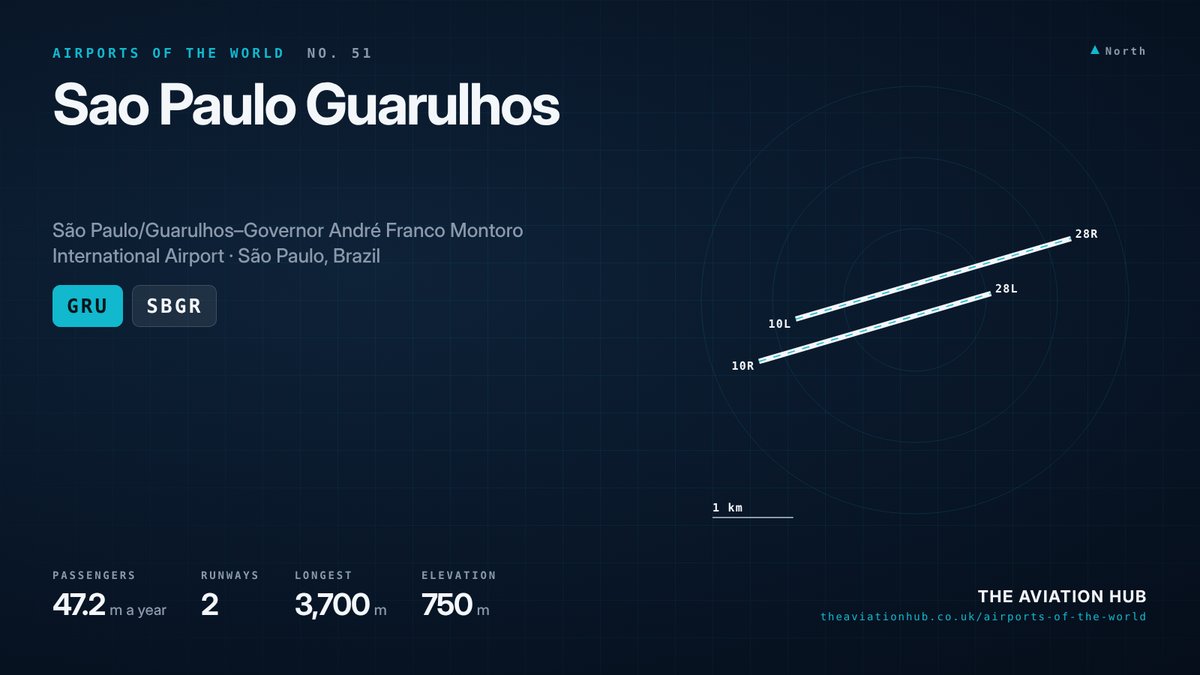
Sao Paulo Guarulhos International Airport is the principal international gateway to Brazil and the busiest airport in the country. It sits in the city of Guarulhos about 16 miles (25 km) northeast of central Sao Paulo and handled roughly 47 million passengers in 2025. Sao Paulo Guarulhos Airport, which locals still call Cumbica after its district, is the main hub of LATAM Brasil and a significant base for Gol and Azul. Almost every long haul flight into Brazil’s financial capital lands here.
Sao Paulo Guarulhos Airport at a Glance
The airport carries the IATA code GRU and the ICAO code SBGR. It lies at 750 metres (2,461 feet) above sea level on the plateau that surrounds Sao Paulo, with the Serra da Cantareira hills rising to the north. Two parallel asphalt runways serve three passenger terminals. A consortium led by Invepar, with the state airport company Infraero holding 49 per cent, has operated the field under concession since 2012 and brands it GRU Airport.
Passenger numbers reached about 47.2 million in 2025, a strong recovery and a record for the airport. LATAM Brasil is the dominant carrier and runs its largest hub here. Gol operates a major base and Azul, whose main hub is at Campinas, has expanded its presence. The Tropic of Capricorn crosses the southern edge of the site, and the airport shares its runways with the Sao Paulo Air Force Base. Parking and terminal maps are on the airport’s official website.
How Sao Paulo’s Airport Came to Be
Congonhas, the city centre airport, was hopelessly congested by the 1970s and hemmed in by housing. The military government chose a site beside the air force base at Cumbica in Guarulhos, and construction started on 11 August 1980. The airport opened officially on 20 January 1985 with two terminals and quickly took over long haul and most domestic trunk flying from Congonhas.
In November 2001 it was named after Andre Franco Montoro, the former governor of Sao Paulo state who had died two years earlier. Growth through the 1990s and 2000s outpaced investment, and by 2010 Sao Paulo Guarulhos Airport was notorious for queues. The federal government privatised the airport in February 2012 under a 20 year concession, and the new operator rebranded it GRU Airport.
Terminal 3 opened in May 2014, just before the FIFA World Cup, and became the international home of LATAM and most foreign carriers. A fourth domestic terminal converted from old VASP and Transbrasil cargo buildings opened in 2012 and was renumbered Terminal 1 in December 2015. Accidents on the site include a VASP Boeing 737 that tried to take off from a taxiway in fog in 1986 and a Transbrasil 707 freighter that crashed on approach in 1989, killing 25.
Runways at Sao Paulo Guarulhos Airport
Two parallel asphalt runways run east to west. Runway 10L/28R is the longer at 3,700 metres (12,139 feet) and Runway 10R/28L measures 3,000 metres (9,843 feet). The longer runway was widened to 60 metres in 2015 for the A380, while the shorter one is 45 metres wide. The runways were renumbered from 09 and 27 in the 2010s as magnetic variation shifted. They sit close together, so the airport runs dependent operations rather than fully independent parallel approaches.
Runway 10R/28L takes most landings and the longer northern runway, 10L/28R, most departures, including the heavy flights to Europe and Asia that need the extra length at this altitude on a warm evening. The direction in use switches between the 10s and the 28s with the wind. Sao Paulo Guarulhos Airport operates under a slot cap of around 45 movements per hour, which keeps it full at peak times.
Fog from the surrounding hills is a recurring problem in winter mornings between June and August, and it can still cause delays. A third runway was studied and dropped in 2008 as technically impracticable because of the terrain and the built up surroundings.
Terminals and Airlines
Terminal 2 is the original 1985 building, formed from the old Terminals 1 and 2, and handles most domestic flights and some international ones. Gol and LATAM’s domestic network concentrate here. Terminal 1, the small former Terminal 4, has no jet bridges, is reached by shuttle bus and has been used by Azul. Terminal 2 handles the larger share of traffic and hosts the main food courts and lounges.
Terminal 3 is the modern international building at Sao Paulo Guarulhos Airport, with 22 gates with jet bridges, five of them able to take the A380, and capacity for around 12 million passengers. LATAM uses it for all long haul flights, as do most foreign carriers, including Air France, KLM, Lufthansa, British Airways, Emirates, Qatar Airways, Turkish Airlines, American, Delta and United. Star Alliance members moved here when it opened.
Transfers between the domestic terminals and Terminal 3 take 10 to 15 minutes on foot or by shuttle bus. LATAM’s flagship lounge in Terminal 3 is among the best in South America. Cargo facilities handle more international freight than any other Brazilian airport.
Routes and Destinations
Domestic flying leads by volume. Rio de Janeiro Galeao, Brasilia, Belo Horizonte, Porto Alegre, Salvador, Recife, Curitiba and Fortaleza all see dozens of daily departures. The short hop to Rio’s downtown Santos Dumont airport is flown mainly from Congonhas, so Guarulhos carries the Galeao traffic instead.
Internationally, Buenos Aires, Santiago, Miami, New York, Lisbon, Madrid and Paris are the busiest routes from Sao Paulo Guarulhos Airport. LATAM flies nonstop to London Heathrow, Frankfurt, Milan, Rome, Johannesburg, Los Angeles and Boston. Foreign carriers add Dubai, Doha, Istanbul, Addis Ababa, Toronto and Mexico City. The longest routes are Doha and Dubai at around 7,500 miles (12,000 km), flown with Boeing 777-300ER and Airbus A350-900 aircraft.
Summer in the southern hemisphere, from December to February, brings the heaviest leisure demand, with Europe bound traffic peaking in July. Cargo throughput of several hundred thousand tonnes a year includes pharmaceuticals, electronics and aircraft parts for the Embraer factories nearby.
Getting to and from Sao Paulo Guarulhos Airport
CPTM Line 13 Jade, opened in 2018, links Aeroporto Guarulhos station with the suburban rail network at Engenheiro Goulart, where passengers change for the city. A free shuttle bus connects the station with the terminals. The combined journey to the centre takes about an hour for a few reais, the cheapest sensible option. A direct Airport Express train to Luz station operates at certain times of day.
The executive Airport Bus Service runs to Paulista Avenue, Congonhas and the main hotel districts in around an hour, depending on traffic. Passaro Marron buses 257 and 299 connect with Tatuape metro station every 30 minutes. By road, the Rodovia Helio Smidt links the terminals to the Dutra and Ayrton Senna highways, and the drive to the centre takes 45 to 90 minutes. A taxi to Paulista costs roughly BRL 150 to 200 (around £22 to £29). Multi storey parking serves all terminals.
Spotting and Photography
Terminal 3 has large windows facing the international apron and the runways, and the connecting walkway between Terminals 2 and 3 gives views of taxiing aircraft. The hotels along the Rodovia Helio Smidt, including the Marriott and Pullman, have rooms overlooking the runways.
Outside the fence, the Cumbica neighbourhood streets beneath the 28 approaches to the east and the road near the air force base gate to the west are used by local enthusiasts. Morning light suits the northern perimeter and afternoon light the southern. Sao Paulo’s reputation for street crime means spotters should go in groups, keep equipment discreet and avoid isolated spots after dark. Stay off military land and move on if asked.
What Comes Next
The concession runs to 2032 and the operator has committed to expand Terminal 3, add gates and improve the domestic buildings. A direct rail link into the terminals, long promised, remains at planning stage. The runway and slot constraints mean growth will come from larger aircraft, and LATAM’s expanding Airbus A321neo and Boeing 787 fleets point that way.
Rio de Janeiro’s Galeao and Campinas Viracopos both want more international traffic, but Sao Paulo Guarulhos Airport holds the geographic and commercial high ground. It will remain the continent’s leading hub for the foreseeable future. Compare it with its Latin American rivals on our Airports of the World map.
Continue to follow The Aviation Hub for more analysis and insight.
Advertise with us Your brand, in front of an aviation audience Home page and in-article placements, sold directly, one advertiser per slot. From £250 a year. See the rates

