
London Gatwick Airport Guide: The Single Runway Giant
London Gatwick Airport handles around 43 million passengers a year on one runway. Terminals, routes, rail links, spotting and the second runway plan.
 By The Aviation Hub
6 min read
Updated October 20, 2026
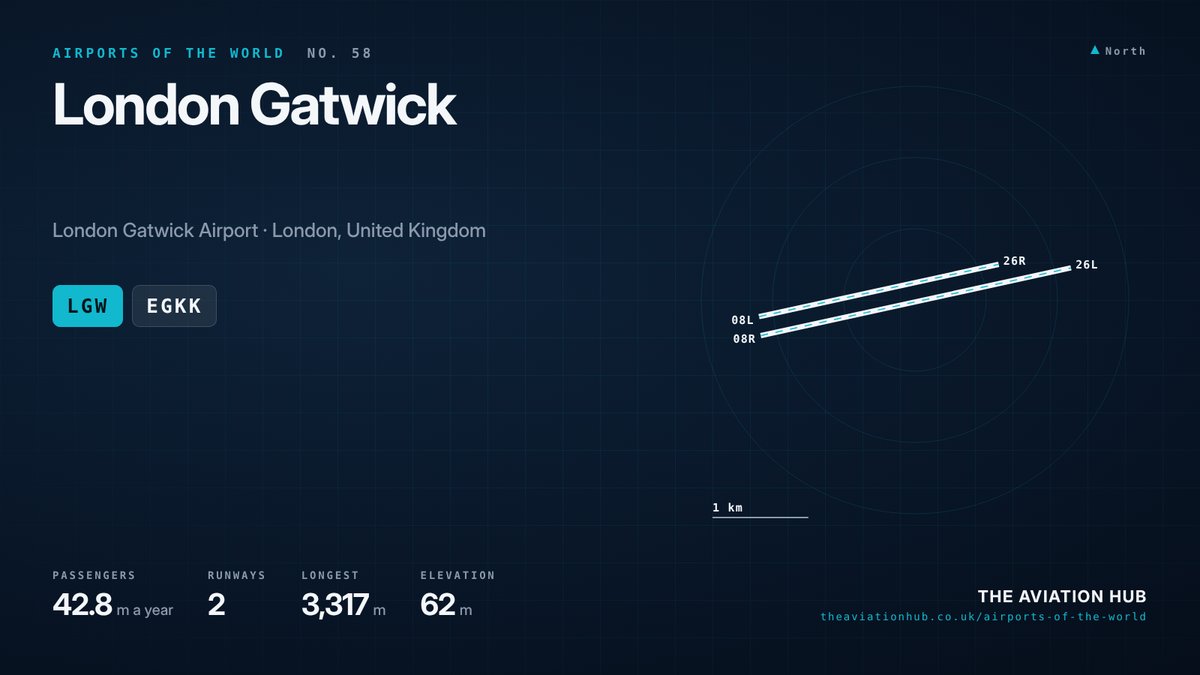
Gatwick lies beside Crawley in West Sussex, about 30 miles (48 km) south of central London and directly on the Brighton main line. London Gatwick Airport is the second busiest in the United Kingdom and, for decades, ran more flights off a single runway than any other airport in the world. It handled around 42.8 million passengers in 2025, a touch below the previous year. The largest easyJet base, a British Airways leisure hub and a long haul network that keeps growing make it far more than Heathrow’s overflow.
London Gatwick Airport at a Glance
The IATA code is LGW and the ICAO code is EGKK. The field sits at 62 metres (202 feet) above sea level on the Sussex Weald, with the M23 motorway on its eastern edge. One main runway and a standby runway serve the North and South terminals, linked by an elevated shuttle. Gatwick Airport Limited runs the operation, owned since 2019 by the French group VINCI Airports with 50.01 per cent and a consortium managed by Global Infrastructure Partners with the rest.
easyJet is the dominant carrier and has its largest base here. British Airways and its subsidiary BA EuroFlyer, TUI Airways, Wizz Air UK, Vueling, Jet2.com and Norse Atlantic UK all keep fleets at London Gatwick Airport. Aircraft movements reached roughly 263,000 in 2025. Live flight information, parking and the latest on the runway project are on the airport’s official website.
How Gatwick Came to Be
Flying began on farmland beside Gatwick racecourse in the late 1920s, and the Air Ministry licensed commercial flights in 1933. The circular Beehive terminal was completed in 1935, the first in the world to integrate rail, road and air travel under one roof, and scheduled services began the following year. The site became RAF Gatwick during the Second World War.
The modern airport dates from 1958, when the Queen opened a rebuilt field with a new runway, a pier served terminal and a railway station on the main line. The Beehive survives as offices to the south. A 1959 crash of a Turkish Airlines Vickers Viscount in fog near Newdigate killed 14 of the 24 on board, though Prime Minister Adnan Menderes survived.
The Gatwick Express rail service began in 1984, and the Queen opened the North Terminal in March 1988. BAA sold the airport in 2009 under competition rulings, ending its shared ownership with Heathrow and Stansted. In December 2018 drone sightings closed the runway for parts of three days, stranding around 110,000 passengers and bringing the army to the fence, an incident that changed airport security planning worldwide.
Runways at London Gatwick Airport
The main runway, 08R/26L, measures 3,317 metres (10,883 feet) by 45 metres and carries a Category III instrument landing system. The standby runway, 08L/26R, is 2,561 metres (8,402 feet) long and sits only 198 metres to the north. The two are too close to operate together, so the northern strip serves as a taxiway and opens only when the main runway is shut for maintenance or an incident.
That arrangement made London Gatwick Airport the most intensively used single runway in the world. At peak, controllers handle up to 55 movements an hour, mixing arrivals and departures with a precision that other airports study. The prevailing southwesterly wind means 26L is in use for most of the year, with arrivals approaching from the east and departures climbing out to the west.
Fog and snow are the weather risks, and because there is no second runway, any closure stops everything. Slots at the airport are in heavy demand for that reason.
Terminals and Airlines
The South Terminal at London Gatwick Airport is the original and larger building, with 32 air bridge gates and seven remote stands. British Airways moved here in 2017 in a swap with Virgin Atlantic, and it now hosts BA EuroFlyer, Wizz Air, Vueling, Ryanair and Jet2.com. It closed for almost two years from June 2020 and reopened in March 2022.
The North Terminal belongs to easyJet, which consolidated its entire Gatwick operation there in January 2017. Its 31 gates also serve long haul carriers such as Emirates, Qatar Airways and Air India. The two terminals are linked by a free elevated shuttle that runs every few minutes.
Alliance groupings matter less here than at Heathrow, since most carriers are low cost or leisure. SkyTeam is represented by Air France, Air Europa, Kenya Airways and Saudia, oneworld by British Airways and Qatar Airways, and Star Alliance by Turkish Airlines, Air India and TAP.
Routes and Destinations
Malaga was the busiest international route in 2025 with about 1.24 million passengers, followed by Barcelona and Dublin. Dubai and Alicante complete the top five, and sun routes such as Faro, Tenerife and Palma are also busy. Edinburgh, Glasgow and Belfast International lead the domestic routes on easyJet and British Airways.
Long haul has rebuilt strongly at London Gatwick Airport. British Airways flies 777s to Florida, the Caribbean, Cancun, Bangkok and Mauritius, and Norse Atlantic uses Boeing 787-9s to New York, Orlando, Bangkok and Cape Town. Emirates, Qatar Airways, Air India, Singapore Airlines and China Southern serve Asia and the Gulf. The Singapore Airlines nonstop, at about 6,750 miles (10,860 km), is among the longest from the airport.
Seasonality is extreme. Summer Saturdays see the terminals and runway at capacity, while January is quiet enough for runway maintenance. Cargo is modest and mostly travels in passenger holds.
Getting to and from London Gatwick Airport
Rail is the obvious choice, with the station built into the South Terminal. Gatwick Express runs nonstop to London Victoria in about 30 minutes for around £20 one way. Thameslink trains to London Bridge, Blackfriars, St Pancras and on to Luton and Cambridge are the cheapest sensible option, with off peak fares to central London of roughly £12 and a journey of 35 to 45 minutes. Southern services reach Brighton, Clapham Junction and the south coast.
By road, the airport sits at junction 9A of the M23, about 9 miles (14 km) south of the M25. National Express coaches run to Heathrow, Stansted and towns across the south, and Metrobus serves Crawley and the surrounding villages. Taxis to central London cost £90 to £120 and take an hour or more. Both terminals have multi storey short stay parks, with long stay sites around the perimeter served by shuttle buses.
Spotting and Photography
London Gatwick Airport is harder to spot than Heathrow but has its moments. The BLOC hotel at the South Terminal has rooms looking over the runway, and the upper floors of the Sofitel at the North Terminal face the airfield. Outside the fence, a perimeter path past the 26L approach lights covers arrivals in the usual southwesterly wind.
When the wind switches to the 08 direction, the crash gate on Lowfield Heath Road near Charlwood catches aircraft on short final. Light suits the southern side for most of the day. Stay on public footpaths, do not park in the farm gateways and expect the occasional visit from Sussex Police, who have been noticeably more alert since the 2018 drone episode.
The Northern Runway Decision
The future turns on 12 metres. Gatwick proposed shifting the centreline of the standby runway northwards so it could operate at the same time as the main runway for departures, lifting capacity towards 75 million passengers a year. The Transport Secretary approved the development consent order on 21 September 2025, and the High Court and Court of Appeal upheld the decision in 2026. Work on the privately funded project is expected to take several years.
Noise and surface access conditions attached to the approval will shape how much of that capacity is actually used. London Gatwick Airport is about to shed the single runway identity that defined it for 70 years. See how it compares with its rivals on our Airports of the World map.
Continue to follow The Aviation Hub for more analysis and insight.
Advertise with us Your brand, in front of an aviation audience Home page and in-article placements, sold directly, one advertiser per slot. From £250 a year. See the rates

