
Milan Malpensa Airport Guide: Italy’s Long Haul Gateway
Milan Malpensa Airport is Italy's main intercontinental gateway and its busiest cargo field. Explore its runways, terminals, routes and spotting.
 By The Aviation Hub
7 min read
Updated October 20, 2026
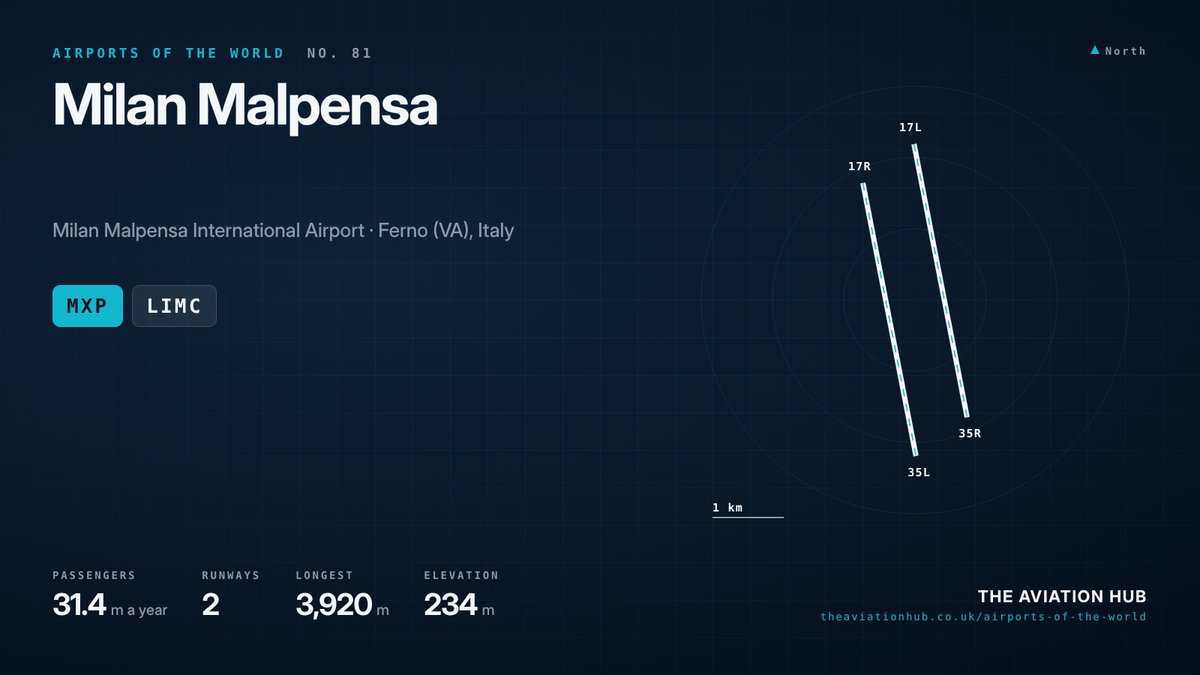
Milan Malpensa Airport is the main intercontinental gateway for northern Italy and the busiest cargo airport in the country. It sits in the Lombardy countryside near Ferno, around 30 miles (49 km) north west of Milan’s cathedral square, on the edge of the Ticino river valley. Close to 29 million passengers passed through in 2024, and the total rose to about 31.2 million in 2025. Two long parallel runways, two terminals and the largest easyJet base outside Britain make it a field of real substance, even if Linate still wins the business crowd.
Milan Malpensa Airport at a Glance
The codes are MXP and LIMC. The airfield lies at 768 ft (234 m) above sea level on a flat heath that forms part of the Ticino Valley Park, a UNESCO recognised biosphere reserve. Milan city centre is 30 miles (49 km) away by road and rail, and Switzerland is closer than many passengers realise. Lugano sits under 30 miles (48 km) to the north.
Milan Malpensa Airport has two runways and two terminals. The 2024 figure was around 28.9 million passengers, a record for the airport, alongside more than 730,000 tonnes of cargo. easyJet is the dominant carrier, with Ryanair, Wizz Air, AlbaStar and Neos all basing aircraft here. SEA, the Milan airports company controlled by the city council, operates both Malpensa and Linate. Timetables and parking rates are on the airport’s official website.
A Short History of Malpensa
Aviation began at Malpensa in 1909, when Giovanni Agusta and Gianni Caproni used the heath to test early prototypes. The name comes from an old farmstead on the site. Caproni built bombers here through the First World War, and the Luftwaffe took over the field in September 1943. Civil flights began in 1948, when local businessmen rebuilt the runway and opened the airport to international traffic.
For decades Linate carried most of Milan’s traffic and Malpensa handled the long haul overflow. That changed in 1998 when the vast Terminal 1 opened and the government shifted most of Linate’s flights north. Alitalia built a second hub here, then abandoned it in 2008 after years of losses. The withdrawal cost the airport millions of passengers overnight.
Low cost carriers filled the gap. easyJet grew Malpensa into its largest base outside Britain, and Ryanair arrived in December 2015. Terminal 2 closed during the pandemic and reopened in May 2023. In July 2024 the airport was formally renamed after Silvio Berlusconi, a decision that divided opinion in Milan and has barely changed how anyone refers to the place.
Runways at Milan Malpensa Airport
Runways 17L/35R and 17R/35L are identical twins. Each is 3,920 m (12,861 ft) long and 60 m (197 ft) wide, surfaced in asphalt and spaced about 800 m apart. The length comfortably handles a fully loaded Boeing 777F or Airbus A350-900 bound for Asia, which matters for a field that moves more cargo than any other in Italy.
Milan Malpensa Airport normally uses the 35 direction, with one runway for arrivals and the other for departures. The two swap roles each afternoon to share the noise between nearby villages, and operations on the 17s are rare. Winter fog is the historic enemy. The Po valley produces some of Europe’s thickest radiation fog, and Malpensa relies on Category III landing systems for that reason.
With the Alps to the north, most arrivals come in from the south over the Ticino valley. Approaches are busy but rarely slot constrained, which has helped the airport win long haul routes that Linate cannot physically take.
Terminals and Airlines
Terminal 1 opened in 1998 and remains the main building at Milan Malpensa Airport. It has three satellites. Concourse A handles domestic and Schengen flights, Concourse B takes non Schengen and intercontinental services, and Concourse C opened in 2012 for the most security sensitive long haul flights, including those to the United States and Israel. Delta, American, United, Emirates, Qatar Airways, Cathay Pacific, Singapore Airlines, Air China and LATAM all use Terminal 1.
Wizz Air, Ryanair and Neos also fly from Terminal 1. Emirates operates an Airbus A380 here, one of several daily wide body movements that give Terminal 1 a genuine hub feel in the evening bank. Lufthansa, Swiss, Turkish Airlines and British Airways round out the European network.
Terminal 2 belongs to easyJet. The airline is the only tenant and fills the building with Airbus A320neo and A321neo flights to much of Europe. A free shuttle bus links the two terminals in 15 to 20 minutes, and the rail station at Terminal 2 opened in December 2016 so passengers no longer need the bus to reach the train.
Routes and Destinations
Malpensa serves more than 200 destinations and ranks sixth in Europe for the number of countries reached nonstop. Barcelona, Paris Charles de Gaulle, Madrid and Lisbon lead the European list, while New York JFK, London Gatwick and Dubai top the routes outside the EU. Domestic traffic is strongest to Catania, Palermo, Naples and Bari, where the low cost carriers compete head on.
Long haul is where Malpensa stands apart from every other Italian airport. New York, Dubai, Doha, Singapore, Hong Kong, Shanghai and Sao Paulo all have direct links. Neos flies Boeing 787-9s on leisure routes to the Maldives, Zanzibar and the Caribbean. Cargo is enormous. Cargolux Italia, DHL and FedEx run hubs here, and Qatar Airways Cargo, Silk Way and Chinese freighter operators add more.
Getting to and from Milan Malpensa Airport
The Malpensa Express is the obvious choice. Trenord runs four trains an hour from both terminals to Milano Cadorna or Milano Centrale, taking between 30 and 50 minutes depending on the stops. A single costs around €13 (£11). TiLo trains also run north to Bellinzona in Switzerland, which makes Malpensa a useful entry point for the Ticino and the Italian lakes.
Coaches from Malpensa Shuttle and Flibco run to Milano Centrale in around 60 to 70 minutes for roughly €10, and they are the cheapest sensible option. Further coaches serve Como, Turin, Genoa and Novara. By road the A8 motorway runs direct from Milan, and a taxi to the city centre costs a high fixed fare, so most travellers take the train.
Parking at Milan Malpensa Airport ranges from short stay decks at each terminal to long stay fields with shuttle buses. Pre booking online cuts the price sharply for stays over three days.
Spotting and Photography
Milan Malpensa Airport is one of the better spotting airports in Italy, thanks to open countryside and two long runways. The classic position is the playground at Ferno on the eastern side, which looks across runway 35R and gives close shots of arrivals and departures in the morning sun. South of the field, the tracks off Via Gaggio near Lonate Pozzolo sit under the approaches, with 35L best in the morning and 35R in the afternoon.
Terminal 1 has large windows across the Concourse B gate area, which is fine for airside photography before a long haul departure. Outside the fence, the A380, the Neos 787s and a steady stream of freighters make the evening bank the most rewarding time. Mornings bring the Asian arrivals.
The land around the airport is protected parkland, so stay on marked tracks and leave gates as you found them. Italian police take an interest in anyone with a long lens near the perimeter, and carrying identification saves a lot of time.
What Comes Next
SEA has long argued that Malpensa needs room to grow, and a third runway has featured in past plans. The park authority and the villages south of the field have fought every expansion, so recent investment has gone into the existing terminals instead. Terminal 1 is gaining new gates and refurbished lounges, and a cargo city expansion on the west side is under way to keep pace with freight growth.
The bigger change is rail. Work to link the airport with Gallarate station will add new rail connections beyond the Malpensa Express. The Linate question never fully goes away either, and any move to cap the city airport would send more traffic north.
Milan Malpensa Airport is Italy’s real international hub and it keeps growing without a flag carrier to lean on. Compare it with the other European gateways on the Airports of the World map.
Continue to follow The Aviation Hub for more analysis and insight.
Advertise with us Your brand, in front of an aviation audience Home page and in-article placements, sold directly, one advertiser per slot. From £250 a year. See the rates

