
London Stansted Airport Guide: Ryanair’s Essex Fortress
London Stansted Airport is Ryanair's largest base and London's third busiest airport. Read about its single runway, Foster terminal, routes and spotting.
 By The Aviation Hub
7 min read
Updated October 20, 2026
London Stansted Airport is the third busiest of the London airports and the largest base in the Ryanair network. It sits in the Essex countryside near Bishop’s Stortford, around 31 miles (50 km) north east of central London, on a former United States bomber base. Close to 30 million passengers used the airport in 2024, almost all of them on low cost and leisure carriers. One long runway, a single Norman Foster designed terminal and a £1.1 billion expansion plan define a field that has grown from a wartime airstrip into a serious European airport.
London Stansted Airport at a Glance
The codes are STN and EGSS. The airfield sits at 348 ft (106 m) above sea level on a plateau between the M11 and the village of Takeley, 37 miles (60 km) from London by road and about 45 minutes by rail from Liverpool Street. Cambridge is closer, at around 22 miles (36 km) north.
London Stansted Airport has one runway and one terminal with three satellite gate buildings. The 2024 figure was a record of around 29.7 million passengers, well above the 28.1 million of 2019. Ryanair bases dozens of Boeing 737-800s and 737 MAX 8-200s here and serves more than 150 destinations. Jet2 and TUI Airways also have bases, and easyJet flies from the field without a base. Manchester Airports Group, owned by the Greater Manchester councils and IFM Investors, has run Stansted since buying it from Heathrow Airport Holdings in 2013. Timetables are on the airport’s official website.
A Short History of Stansted
The United States Army Air Forces built the airfield in 1943 as a base for Martin B-26 Marauder bombers. The official name was Stansted Mountfitchet after the nearby village, but nobody ever used the second word. After the war the field was used for storage, then converted for civil use in the late 1940s. The Ministry of Civil Aviation took over in 1949, and BAA assumed control in 1966.
For decades Stansted was a quiet charter and cargo field, and successive governments fought over whether to develop it as London’s third airport. The 1985 decision went in its favour. Foster and Partners designed a new terminal that opened in 1991, with its services tucked below the floor and a light roof held up on tree like columns. It became one of the most copied airport buildings of its era.
Growth was slow until the low cost revolution. Ryanair made Stansted its main British base in the late 1990s, and passenger numbers roughly tripled in a decade. A 2000 hijack of an Ariana Afghan Airlines 727 ended here after a four day stand off, because the government designates Stansted as the preferred airport for hijacked aircraft.
Runways at London Stansted Airport
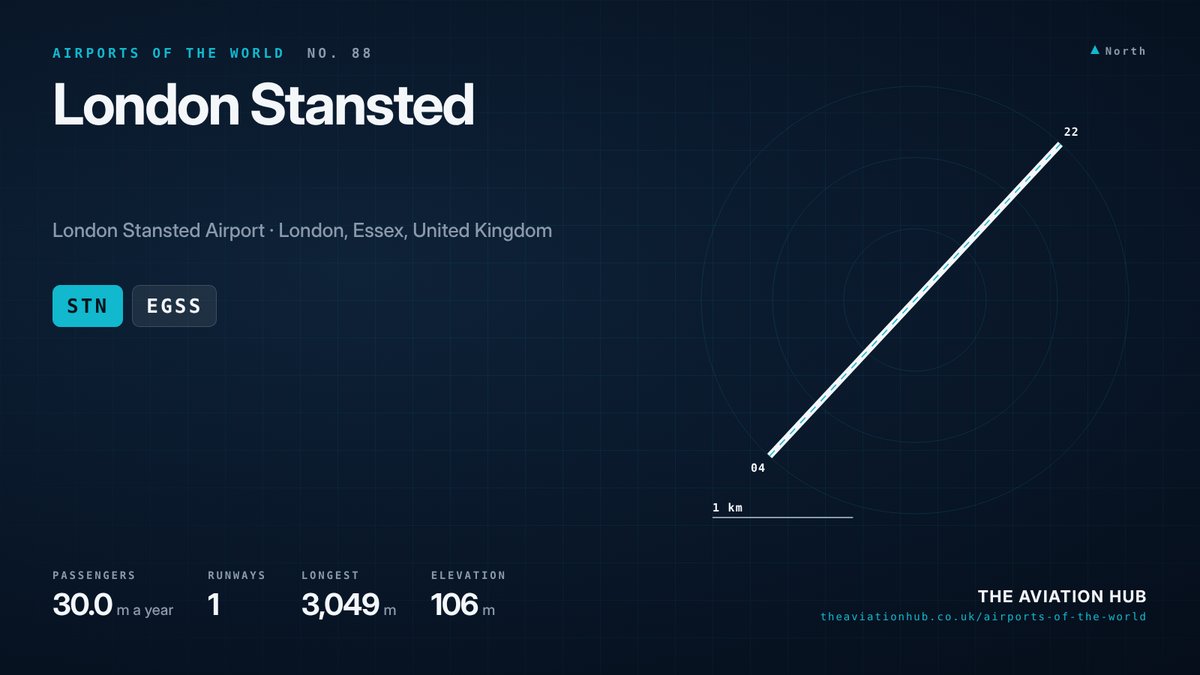
Stansted has a single runway, 04/22, which is 3,049 m (10,003 ft) long and 46 m (150 ft) wide with a grooved asphalt surface. It runs from south west to north east, with the terminal and satellites on the south eastern side. The length comfortably handles the Boeing 747 and 777 freighters of FedEx, UPS and Qatar Airways Cargo, and the Emirates Boeing 777-300ER on the Dubai route.
The prevailing south westerly wind means runway 22 is in use most of the time, with arrivals from the north east over the villages around Broxted and departures climbing out towards Bishop’s Stortford. Easterly winds, common in spring, switch operations to runway 04 with approaches over Great Hallingbury. London Stansted Airport has no crosswind runway, so strong northerly gales can cause diversions.
The single runway caps movements at around 274,000 a year under the current planning permission, and the airport’s planning consent limits annual passengers to 43 million. A second runway was proposed and rejected during the 2000s and is not currently on the table.
Terminals and Airlines
The single terminal at London Stansted Airport handles check in, security and departures on one level, with arrivals below. The departure lounge was reorganised in 2016 and is dominated by shopping and food, which draws complaints but keeps airline charges low. A transit train links the main building with Satellites 1 and 2, Satellite 3 is reached on foot, and the train is due to be retired around 2027.
Satellite 1, with gates 1 to 19, serves most of the full service airlines, including Emirates and Turkish Airlines. Satellite 2, with gates 20 to 39 and a walkway to gates 81 to 88, serves Ryanair, easyJet and others. Satellite 3, with gates 40 to 59, is used exclusively by Ryanair, which holds the lion’s share of the airport’s slots.
easyJet closed its base here in 2020 but still flies a handful of routes. Emirates has flown Dubai since 2018 and is the only regular wide body passenger operator. The airport also hosts a busy cargo centre and private aviation terminals at the south western end.
Routes and Destinations
The route map covers more than 180 destinations across Europe, North Africa and the Middle East. In 2025 Dublin was the busiest at close to a million passengers, with Istanbul Sabiha Gokcen a whisker behind and Edinburgh third. Both the Dublin and Edinburgh routes are Ryanair strongholds. Spain, Italy and Portugal generate the biggest volumes in summer, when Jet2 and TUI add Mediterranean capacity.
Emirates’ Dubai service, at around 3,400 miles (5,500 km), is the longest route from London Stansted Airport. Long haul has otherwise never stuck, with Primera, Air Asia X and others trying and failing. Cargo is strong, with Stansted one of the main freight gateways for London alongside Heathrow and East Midlands, and FedEx, UPS and Turkish Cargo all regular.
Getting to and from London Stansted Airport
The Stansted Express runs from the station beneath the terminal to London Liverpool Street every 15 minutes, taking between 45 and 53 minutes. Fares bought on the day are expensive, at around £20 one way, but advance tickets drop below £10. CrossCountry trains run hourly to Cambridge, Peterborough, Leicester and Birmingham, and some Stansted Express trains call at Tottenham Hale.
Coaches are the cheapest sensible option to London. National Express coaches run through the night to Liverpool Street, Stratford and Victoria for under £10 if booked ahead, taking 60 to 90 minutes depending on traffic. Essex Airlink and First Essex buses serve Chelmsford, Colchester and the local towns.
By road the M11 runs direct to north east London and Cambridge, and the A120 heads east to Colchester and Harwich. A taxi from London Stansted Airport to central London costs £80 or more. Parking is a profit centre. The drop off zone charges a fee for a few minutes, and the cheapest long stay is a shuttle bus away. Pre booking saves a great deal.
Spotting and Photography
Stansted is a decent spotting airport for a single runway field. The best known location is the spotting hill reached from Belmer Road, which gives side on views of the runway and taxiways. North of the boundary, Green Street and the field path off Hall Road sit under the approach to runway 22, where arrivals pass low overhead.
A mound at the south western end covers line ups and arrivals on runway 04, and the footpath at Molehill Green is another option. The field path suits the morning, while the spotting hill is best in the afternoon. The Emirates 777, the freighters and the business jets add variety to the stream of 737s and A320s.
Essex Police and airport security know the regular spots and rarely object, but do not block the lay bys, stay off farmland and keep ladders away from the fence. Several villages sit close to the flight paths, so courtesy to residents matters.
What Comes Next
Manchester Airports Group won planning permission in November 2023 to raise the passenger cap from 35 to 43 million a year, after a long fight with Uttlesford District Council. A £600 million terminal extension is the centrepiece of a £1.1 billion investment plan, adding check in, security and baggage capacity. The transit train will give way to walkways.
A separate arrivals building was cancelled in 2023. The real question is whether Stansted can attract airlines beyond Ryanair, and whether the Dubai route ever gains long haul company.
London Stansted Airport has quietly become one of Europe’s larger low cost hubs and is set to grow for another decade. See how it compares with the other London airports on the Airports of the World map.
Continue to follow The Aviation Hub for more analysis and insight.
Advertise with us Your brand, in front of an aviation audience Home page and in-article placements, sold directly, one advertiser per slot. From £250 a year. See the rates

