
Cancun Airport Guide: Mexico’s Caribbean Holiday Hub
Cancun Airport is Mexico's main leisure gateway with four terminals and two runways on the Caribbean coast. Read about its routes, access and spotting.
 By The Aviation Hub
7 min read
Updated October 20, 2026
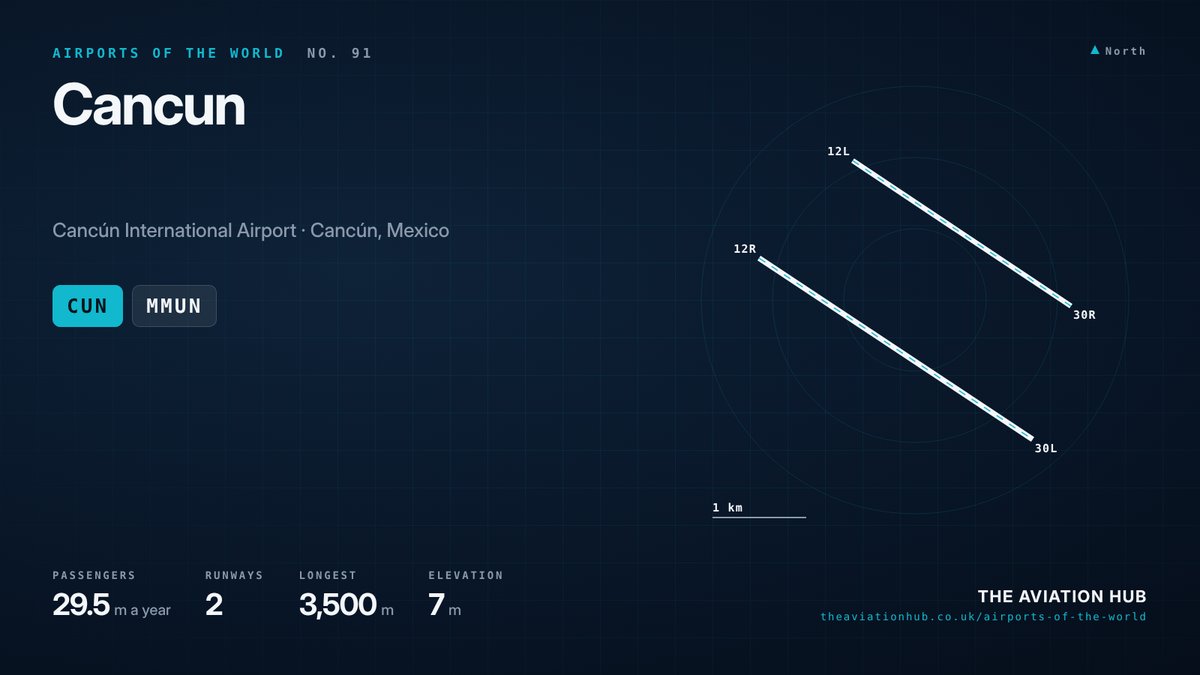
Cancun International Airport is the main gateway to the Mexican Caribbean and one of the busiest leisure airports in the Americas. It lies in the state of Quintana Roo, less than 6 miles (10 km) south west of the Hotel Zone, on flat jungle a few miles inland from the sea. Around 29 million passengers used Cancun Airport in 2025, two thirds of them on international flights, mostly from the United States and Canada. Four terminals, two parallel runways and more US destinations than any other airport outside the United States make it a field that punches well above the size of the city it serves.
Cancun Airport at a Glance
The codes are CUN and MMUN. The field sits at just 22 ft (7 m) above sea level on the limestone shelf of the Yucatan Peninsula, under 6 miles (10 km) from the Hotel Zone and about 10 miles (16 km) from downtown Cancun. Playa del Carmen is around 35 miles (56 km) south along Federal Highway 307 and Tulum a further 40 miles (64 km).
Cancun Airport has two runways and four passenger terminals, plus a general aviation building. The 2025 figure was around 29.3 million passengers, a little down on the 30.4 million of 2024. Viva runs a hub here and Volaris and Magnicharters treat it as a focus city, but the biggest flows come from American, United, Delta, Southwest, Air Canada and WestJet. Grupo Aeroportuario del Sureste, known as ASUR, has operated the airport under a federal concession since 1998. Flight and parking information is on the airport’s official website.
How Cancun’s Airport Came to Be
The first airstrip at Cancun dates from 1942 and had nothing to do with tourism. It was built to serve the chicle industry, the natural chewing gum base harvested from the jungle. Its control tower was made of wood and palm thatch and stayed in use until 1973. A replica stands near the entrance to the city today.
Cancun itself was invented by the Mexican government in the early 1970s as a planned resort on an empty sandbar. The new international airport was part of the master plan, and the first commercial flight landed on 12 May 1975. Growth followed the hotels. Terminal 2, now the oldest in use, served as the main building for decades, and Terminal 1 handled charters.
Hurricane Wilma battered the airport in October 2005 and closed Terminal 1. Terminal 3 opened in 2007 for international flights, and ASUR added a second runway and a 97 m control tower in 2009. Terminal 4 opened in October 2017, giving Cancun Airport its fourth terminal. An Airbus A380 visited in 2013, the first in Mexico.
Runways at Cancun Airport
Runway 12R/30L is the main strip at 3,500 m (11,483 ft) long and 60 m (197 ft) wide, with an asphalt surface. It handles the heavy departures, including the British Airways Boeing 777 and Boeing 787 flights to London and the wide bodies of Air France, KLM, Condor and Edelweiss. Runway 12L/30R is the newer parallel at 2,800 m (9,186 ft) long and 45 m (148 ft) wide, also asphalt.
The two runways are spaced far enough apart for simultaneous operations, which gives Cancun Airport far more capacity than it currently needs. The prevailing easterly trade winds mean the 12 ends see most of the traffic, with arrivals from the north west over the jungle and departures turning out over the Caribbean.
Weather is a seasonal story. The hurricane season from June to November brings the risk of closure, and Cancun Airport has shut several times, most recently for Hurricane Beryl in 2024. Outside that period conditions are benign, with afternoon thunderstorms the only regular interruption.
Terminals and Airlines
Terminal 2 is the busiest domestic building. Viva uses it as its hub, Volaris and Magnicharters operate from it, and a long list of Latin American and European carriers including Copa, Avianca, LATAM, GOL, Aerolineas Argentinas, LOT and TUI share its 22 gates. Terminal 3 is international only, with 21 gates, and handles American, Delta, United, Air Canada and British Airways. It was expanded in 2016 to take 10 million passengers a year.
Terminal 4 is the newest and most comfortable, with 14 gates and a capacity of 9 million passengers. Aeromexico, Air France, KLM, JetBlue, Southwest, Turkish Airlines and WestJet use it, with the second phase of construction adding more gate areas and a supplementary control tower. Terminal 1 closed after Wilma and returns for charter and private flights in 2026 following a rebuild.
A free shuttle bus links the terminals, which are spread along a loop road. Allow plenty of time, because walking between them is not practical in the heat.
Routes and Destinations
More than 100 cities have nonstop flights, and the United States dominates. Toronto Pearson is the busiest international route, ahead of Dallas Fort Worth, Houston, Chicago and Atlanta, with New York, Charlotte, Denver and Miami also heavy, and at weekends in winter the arrival banks from North America run almost continuously. Montreal follows Toronto among the Canadian routes. Mexico City, Monterrey and Guadalajara are the main domestic links.
Europe is well served for a leisure airport. British Airways, Virgin Atlantic and TUI fly from London and Manchester, Air France, KLM, Condor, Edelweiss, Iberia and Turkish Airlines connect the continent, and the Istanbul route at around 6,500 miles (10,450 km) is the longest. Traffic peaks from December to April and again in July. Summer is quieter and hurricane season quieter still.
Getting to and from Cancun Airport
The Tren Maya railway station sits across Federal Highway 180 from the terminals, linked by a shuttle bus. Trains run north to Merida and south towards Playa del Carmen and Tulum, although frequencies are limited and the service is still finding its feet. It is a novelty rather than the default option for most visitors.
ADO coaches are the cheapest sensible choice. They leave from all four terminals for downtown Cancun in around 30 minutes and for Playa del Carmen in about an hour, for a few hundred pesos. City taxis are not allowed to pick up at the airport, so most travellers pre book a shuttle or private transfer. Official airport taxis charge a premium, with fares of around 900 pesos (£37) to the Hotel Zone.
Rental cars are popular and all the major firms have desks and shuttle lots. Parking is available at every terminal. The drive to the Hotel Zone takes 20 to 30 minutes on the Kukulcan Boulevard.
Spotting and Photography
Cancun Airport is a rewarding spot for anyone who likes variety. The parallel runways and the mix of North American narrow bodies, European wide bodies and Mexican low cost fleets keep things busy from mid morning to late afternoon. The departure areas in Terminals 3 and 4 have large windows facing the aprons and the 12 thresholds.
Outside the fence, the roads around the north western end of the runways near the Highway 180 junction give views of arrivals on the 12s, and the fence along the eastern perimeter catches departures climbing out. Morning light favours the eastern side and afternoon light the west. The low sun in winter is excellent, and humidity is lower than in summer.
Mexican airport security and the National Guard patrol the perimeter. Stay on public roads, avoid the airport access ramps, carry identification and be ready to explain what you are doing. Airside photography from the terminals is tolerated.
What Comes Next
The Terminal 4 second phase becomes fully operational in 2026, adding gates, apron and a new tower. Terminal 1 returns the same year for charter and private traffic. The airport handled more than 32 million passengers in 2023, so the four buildings have spare room, and the runways could handle far more, so the constraint is demand rather than concrete.
The new Tulum airport, opened in late 2023, is the wildcard. It has started to take some leisure flights from the south of the Riviera Maya, and together with the softer 2025 numbers it suggests Cancun’s era of unbroken growth may be over.
Cancun Airport remains the engine of Mexican tourism and is better equipped than ever. Compare it with the other holiday hubs on the Airports of the World map.
Continue to follow The Aviation Hub for more analysis and insight.
Advertise with us Your brand, in front of an aviation audience Home page and in-article placements, sold directly, one advertiser per slot. From £250 a year. See the rates

