Qingdao Jiaodong International Airport serves the port city of Qingdao on the coast of Shandong Province in eastern China. It opened in August 2021 and took over every flight from the old Liuting field in a single night. Qingdao Airport now handles close to 27 million passengers a year through one of the largest single terminals in China. For spotters and route watchers it is one of the newest big airports in the country, with two full length runways built for the Airbus A380 and a growing network to Japan, Korea and beyond.
Qingdao Airport at a Glance
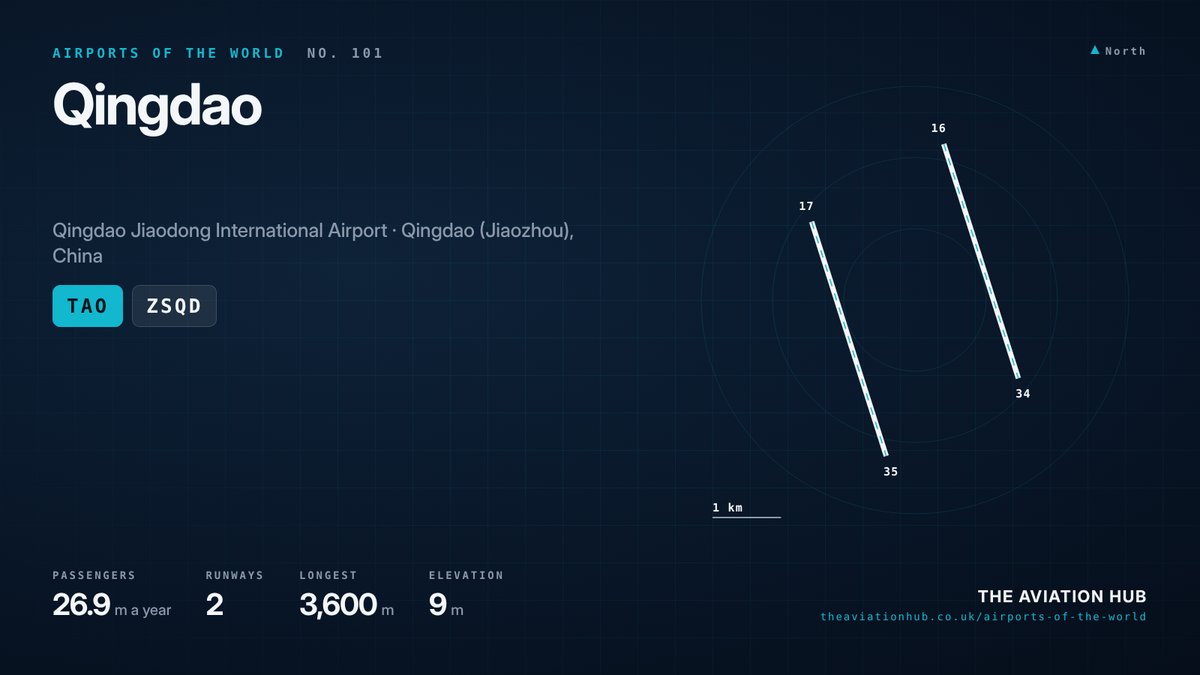
The codes are TAO and ZSQD. The airport sits in Jiaodong, part of the county level city of Jiaozhou, roughly 24 miles (39 km) northwest of central Qingdao. The elevation is just 9 m (30 ft), since the site lies on flat land near Jiaozhou Bay. Two concrete runways serve a single terminal of about 478,000 square metres, laid out in a starfish pattern with five concourses and 178 aircraft stands.
In 2025 Qingdao Airport handled around 26.9 million passengers according to the Civil Aviation Administration of China. Qingdao Airlines and Shandong Airlines treat it as a hub, while Beijing Capital Airlines and China Eastern run focus city operations. The design capacity is 35 million passengers, 500,000 tonnes of cargo and 300,000 movements a year. Flight information and parking details are on the airport’s official website.
How Qingdao’s Airport Came to Be
Qingdao’s civil aviation story belongs mostly to Liuting, the old airport on the northern edge of the city. Liuting served the city for roughly four decades and was designed for 12 million passengers a year. It hit that ceiling in 2012. By 2019 it was pushing through more than twice its design capacity, with over 25 million passengers squeezed through a cramped terminal and a single runway.
The state approved a replacement in December 2013 and chose a site at Jiaodong, well clear of the city and with room to grow. Ground was broken in June 2015. The project was a greenfield build with a new rail station, metro line and expressway link designed into it from the start.
The new airport opened on 12 August 2021, in the middle of the pandemic. The transfer from Liuting was done overnight. The final departure left the old field at around 1.30 in the morning, and by dawn the whole operation was running from Jiaodong. Liuting closed to commercial traffic at the same moment, ending almost 40 years of service.
Runways at Qingdao Airport
Qingdao Airport has two parallel concrete runways, both rated Class 4F. Runway 16/34 measures 3,600 m (11,811 ft) and is 60 m wide. Runway 17/35 is the same length at 3,600 m (11,811 ft) but 45 m wide. Both can accept the Airbus A380 and the Boeing 747-8, although neither type appears regularly.
The runways are spaced far enough apart to allow independent parallel operations, something the cramped Liuting site could never offer. Northerly and southerly flows alternate with the seasonal winds that sweep across the Shandong Peninsula. The flat terrain and sea level site give pilots straightforward approaches in both directions.
Terminals and Airlines
Everything runs through one terminal. The starfish design puts the check in hall at the centre and sends five concourses outwards, which keeps walking distances short for a building of its size. Domestic flights dominate, as they do at every Chinese airport outside Beijing, Shanghai and Guangzhou. Qingdao Airlines, the local carrier with an Airbus A320 fleet, and Shandong Airlines, which flies the Boeing 737-800 and 737 MAX, are the two anchor tenants.
China Eastern and Beijing Capital Airlines both run substantial operations. Air China, China Southern, Hainan Airlines and the low cost carriers Spring and China United fill in the rest of the domestic picture. International service comes from Korean Air, Jeju Air and other Korean carriers, plus Scoot to Singapore and Cathay Pacific to Hong Kong. Beijing Capital Airlines has flown long haul to London Gatwick and Moscow Sheremetyevo in recent years.
Routes and Destinations
Qingdao’s trunk routes run to the big three cities, with Beijing, Shanghai and Guangzhou all served many times a day. Chengdu, Xi’an, Shenzhen, Hangzhou and Kunming are also heavily flown. Within Shandong the airport works alongside Jinan, but Qingdao carries the larger share of international traffic thanks to its coastal position and Korean business links.
Seoul Incheon is the leading international destination, with several Chinese and Korean airlines competing on the route. Osaka, Busan, Hong Kong and Singapore are also served. Long haul is thin. Beijing Capital Airlines’ Vancouver service, which resumed in October 2026, is the airport’s only North American link. Cargo matters too, although tonnage fell by almost a fifth in 2025.
Getting to and from Qingdao Airport
The cheapest sensible route into the city is Metro Line 8. Trains run from the airport to Qingdao North railway station in around 37 minutes, with extra express services in the morning and evening peaks. From Qingdao North it is a short onward trip on the metro or by taxi to the old town and the seafront.
Qingdao Airport also has its own high speed railway station on the Jinan to Qingdao line. That makes it practical to fly in and continue directly by train to Weifang, Yantai, Linyi or Rizhao without entering the city at all. Several nearby cities run in town check in terminals for airport passengers.
By road the S62 expressway connects the terminal to the G20 and G22 expressways. A taxi into central Qingdao takes around 45 minutes to an hour depending on traffic and costs roughly CNY 120 to 150 (about £13 to £17). A five level car park sits beside the terminal for drivers and drop offs.
Spotting and Photography
Qingdao Airport is new, large and surrounded by flat farmland, so it has not yet grown the informal spotting culture of older Chinese fields. The terminal has large glass walls that give a good view of the stands and the inner taxiways, which is the easiest option for anyone passing through. Airside glass is tinted, so photography works best in the middle of the day.
Outside the fence, the approach paths to runways 16 and 17 cross open country north of the airport, and the roads around the perimeter offer views of aircraft on short final. Summer brings southerly winds and arrivals from the north. Winter brings northerly winds and arrivals from the south over the bay. The best light is in the afternoon for aircraft landing from the north.
Security around Chinese airports is strict and photography near fences can attract attention from police. Stay well back from the perimeter, keep away from any restricted signs and be ready to explain what you are doing politely. Carrying a copy of your passport helps.
What Comes Next
The airport has plenty of room before it needs to expand. Capacity is 35 million passengers against a 2025 total near 27 million, so the next few years are about filling the building rather than extending it. The master plan reserves land for more concourses and further runways when the time comes.
The more interesting question is the international network. Qingdao Airport wants to be the gateway for Shandong, and the return of long haul flying to North America and Europe would mark the end of its pandemic era recovery. The verdict is that this is a well built field waiting for traffic to catch up with it. Find its position relative to the rest of the world’s major fields on the Airports of the World map.
Continue to follow The Aviation Hub for more analysis and insight.
Advertise with us Your brand, in front of an aviation audience Home page and in-article placements, sold directly, one advertiser per slot. From £250 a year. See the rates