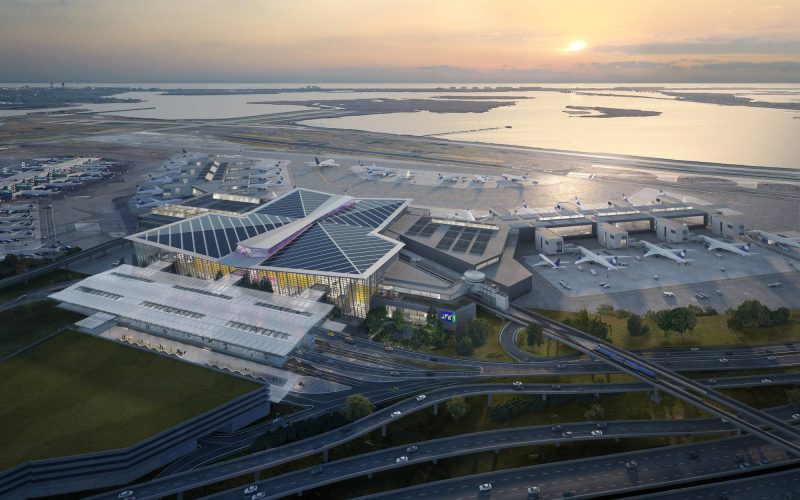
Comodoro Arturo Merino Benitez International Airport is the main airport of Chile and the largest in the country by a wide margin. It sits on the western edge of the capital, in the commune of Pudahuel, with the Andes forming a wall of rock and snow to the east. Santiago Chile Airport handled around 26.5 million passengers in 2025 and is the home hub of LATAM Airlines, the largest carrier in South America. A new international terminal that opened in 2022 has given it the capacity to grow for years.
Santiago Chile Airport at a Glance
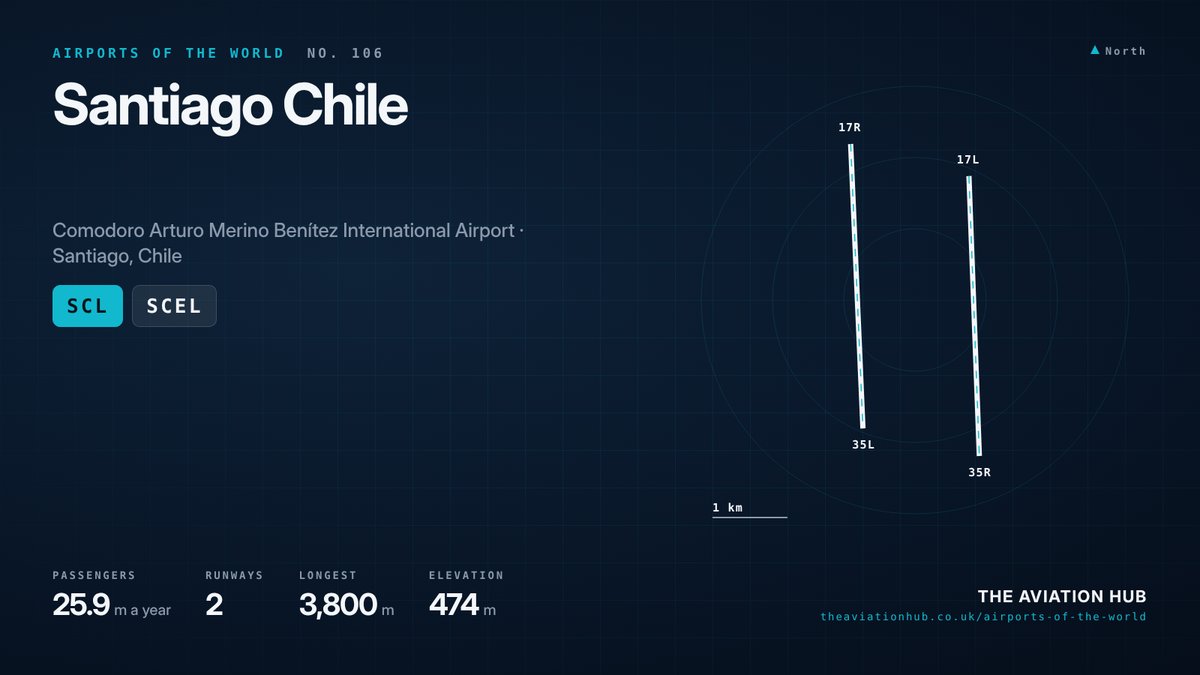
The codes are SCL and SCEL. The airport lies around 11 miles (17 km) northwest of central Santiago, at an elevation of 474 m (1,555 ft) on the floor of the central valley. Two parallel asphalt runways serve a terminal complex that was expanded into a single large processor with four piers between 2018 and 2022.
In 2025 Santiago Chile Airport handled around 26.5 million passengers, about 1 per cent more than in 2024. LATAM accounts for roughly four fifths of commercial movements, and the low cost carriers Sky Airline and JetSmart both use the field as their hub. Since October 2015 it has been run by Nuevo Pudahuel, a consortium of Aeroports de Paris, Vinci Airports and Astaldi, under a 20 year concession from the Chilean state. The Chilean Air Force keeps its Second Air Brigade on the military side. Flight and transport information is on the airport’s official website.
How Santiago’s Airport Came to Be
Santiago’s first airport was Los Cerrillos, in the southwest of the city, which opened in 1929 and became hemmed in by housing as the capital spread. The government chose a new site at Pudahuel, on open farmland to the west, and the airport opened in February 1967 as Aeropuerto Internacional de Pudahuel. Los Cerrillos lingered on for domestic and general aviation until its closure in 2006.
In 1980 the airport took the name of Comodoro Arturo Merino Benitez, the founder of the Chilean Air Force and of the national airline that became LAN Chile. Most locals still call it Pudahuel. A new terminal opened in 1994, and in 2001 all passenger flights, domestic and international, were consolidated into that building.
The earthquake of February 2010 damaged the terminal and brought down a pedestrian bridge, though the runways and tower survived intact. The airport became the base of a humanitarian air bridge to Concepcion and resumed commercial flights within days. The second runway, 17R/35L, had opened in 2005 but suffered surface defects and was not in regular use until March 2007.
Runways at Santiago Chile Airport
Santiago Chile Airport has two parallel asphalt runways aligned almost due north to south. Runway 17L/35R is the original, 3,750 m (12,303 ft) long and 55 m wide. Runway 17R/35L, the newer western runway, is slightly longer at 3,800 m (12,467 ft) and 45 m wide. The pair are far enough apart for simultaneous operations, with one typically taking arrivals and the other departures during the peaks.
The length and the elevation matter. At 474 m above sea level and with hot summer afternoons, departures to Sydney, Melbourne, Madrid and Miami need every metre of pavement, particularly for the Boeing 787-9 fleet that LATAM uses on its longest routes. Operations favour the 17 runways in the prevailing conditions, with arrivals descending from the north across the Chacabuco hills. The Andes to the east shape every approach and departure route, and winter fog in the valley can bring long delays.
Terminals and Airlines
The terminal complex is now a single building. The original 1994 terminal was converted to domestic use when the new international terminal opened in 2022, and the two are linked through a central processor. Four piers radiate from it. Piers C and E are mainly domestic, Pier D handles both domestic and international flights and Pier F is fully international. Each pier is themed on a region of Chile, from Easter Island to the Atacama Desert and Patagonia.
LATAM dominates everything at Santiago Chile Airport. Its Airbus A320 family works the domestic and regional network, while 787s and A350s have flown the long haul routes. Sky Airline and JetSmart, both all Airbus low cost carriers, compete fiercely on domestic trunk routes and across the Andes to Argentina and Peru. Foreign carriers include Iberia, Air France, British Airways, KLM, Turkish Airlines, American, Delta, United, Air Canada, Qantas, Aeromexico, Copa and Avianca. Lounges include LATAM’s flagship and a Priority Pass lounge in the international pier.
Routes and Destinations
Domestic flying in Chile is shaped by geography. The country is more than 2,600 miles (4,200 km) long and the roads are slow, so air is the only practical way to reach the mining north and the far south. Antofagasta and Calama, both serving the copper mines, each carried around 1.8 million passengers in 2023. Iquique, Puerto Montt, Punta Arenas, Concepcion and La Serena are all heavy routes.
Buenos Aires is the busiest international destination with about 1.5 million passengers, then Lima with 1.4 million and Sao Paulo Guarulhos with 1.1 million. Bogota, Rio de Janeiro, Mendoza and Cordoba are also busy. Long haul links reach Madrid, Paris, London, Amsterdam, Istanbul, Miami, New York, Toronto, Sydney, Melbourne and Auckland. The Sydney route is one of the longest in the LATAM network. Cargo is substantial, with Chilean salmon and fruit filling freighters bound for North America and Asia.
Getting to and from Santiago Chile Airport
There is no rail link yet. The cheapest sensible option is the Centropuerto bus, which runs every ten minutes to Los Heroes metro station in the city centre via Pajaritos, where passengers can join the metro. The fare is a few thousand pesos, roughly £2 to £3. Turbus runs a similar service to the Alameda terminal. Public bus routes 555 and 444 also connect to the metro for the price of a standard fare.
By road the Costanera Norte and Vespucio Norte expressways reach the city centre in around 25 to 35 minutes outside the peaks. Official taxis and TransVip shared shuttles sell tickets inside the arrivals hall at fixed rates, which avoids the touts who crowd the exit. A taxi to the Providencia business district costs around CLP 25,000 to 30,000 (about £20 to £24). Parking is plentiful across several car parks.
Spotting and Photography
Santiago Chile Airport is not an easy spotting airport. There is no viewing terrace, and the airport perimeter is patrolled by the Carabineros and the air force. The best views for most visitors are from the large windows of the international pier, which face the western runway and the long haul stands.
Outside the fence, the roads near the southern thresholds of runways 35L and 35R give views of departures climbing out over the valley, with the Andes as a backdrop on clear days. Winter, when the air is still and the mountains are white, gives the best photographs. The FIDAE air show, held every two years in March or April, is the only time the field welcomes the public airside. Keep well back from the fence, do not photograph the military ramp and expect to be asked for identification.
What Comes Next
The new terminal raised capacity from 16 million to 38 million passengers a year, so the airport has room to double before it needs more buildings. The concession runs to 2035, and Nuevo Pudahuel has land reserved for further piers. A light rail link to the metro appears in the master plan and remains the biggest missing piece.
Growth depends on LATAM, which emerged from bankruptcy protection in 2022 leaner and more profitable. Its decision to base more wide bodies in Santiago has brought new long haul routes. The verdict is that Santiago Chile Airport has the terminal, the runways and the anchor airline to become the dominant hub of the Southern Cone. See where it sits on the Airports of the World map.
Continue to follow The Aviation Hub for more analysis and insight.
Advertise with us Your brand, in front of an aviation audience Home page and in-article placements, sold directly, one advertiser per slot. From £250 a year. See the rates