
Dusseldorf Airport Guide: The Gateway to the Rhine Ruhr
Dusseldorf Airport serves the Rhine Ruhr region with two runways, three terminals and a Eurowings hub. Runways, routes, access and spotting explained.
 By The Aviation Hub
7 min read
Updated October 20, 2026
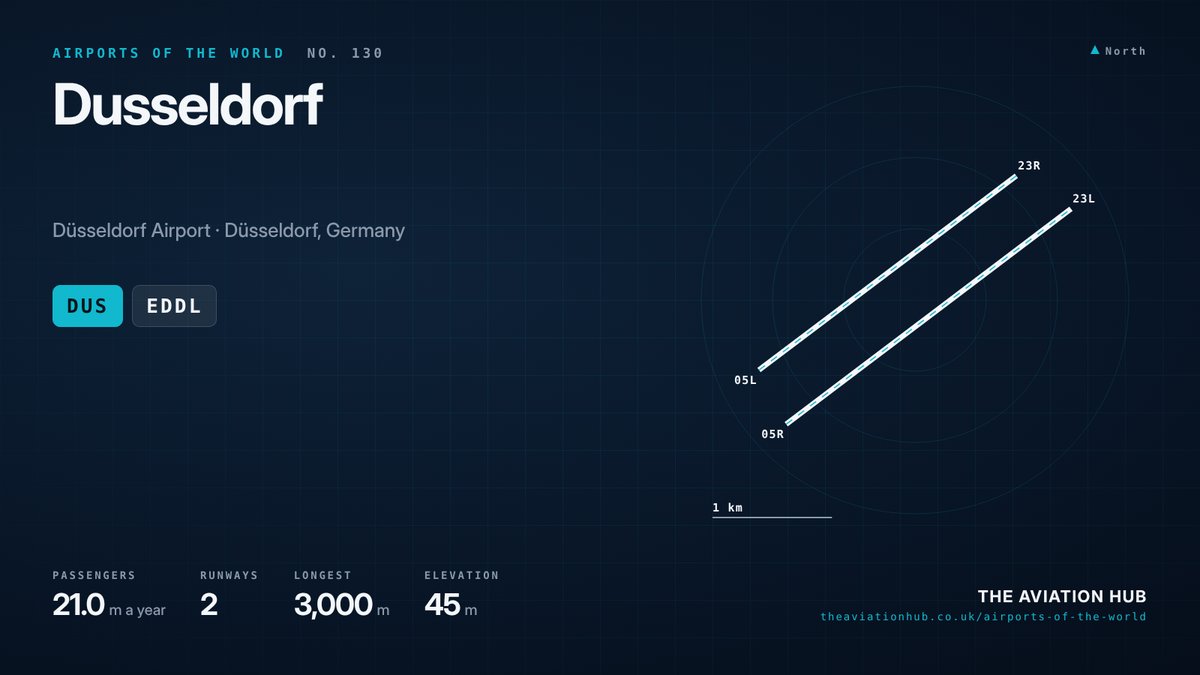
Dusseldorf Airport sits on the northern edge of the North Rhine Westphalia state capital, about 5 miles (8 km) from the city centre and within an hour of more than 10 million people across the Rhine Ruhr conurbation. It is the fourth busiest airport in Germany after Frankfurt, Munich and Berlin, handling around 21 million passengers in 2025. Two parallel runways and three connected terminals serve a network that leans heavily towards Mediterranean leisure and the Gulf, with Eurowings running its largest base here.
Dusseldorf Airport at a Glance
The codes are DUS and EDDL. The field lies at 45 m (147 ft) above sea level on flat ground between the districts of Lohausen and Unterrath, with the Rhine a short distance to the west. It has two runways, 05R/23L and 05L/23R, and a single terminal building split into three piers lettered A, B and C.
Flughafen Dusseldorf GmbH operates the airport. Half the shares belong to the city of Dusseldorf and half to Airport Partners, a consortium that includes AviAlliance. Eurowings, Condor, TUI fly Deutschland, SunExpress and Corendon Airlines all base aircraft here, and Lufthansa Group carriers together account for roughly 8.5 million of the annual passengers. The airport’s 2025 total was about 21.0 million, up nearly 5 per cent on the year before. Flight status and parking rates are on the airport’s official website.
How Dusseldorf’s Airport Came to Be
The present airfield opened on 19 April 1927 after two years of construction. SABENA flew the first international service in 1929, linking Brussels and Antwerp with Dusseldorf and Hamburg. The airport was rebuilt after the Second World War and grew with the industrial boom of the Ruhr, and for decades it was marketed as Rhine Ruhr Airport.
Terminal A opened in 1977 and Terminal C followed in 1986. The darkest day came on 11 April 1996, when welding work on an elevated roadway set fire to insulation above the arrivals hall. Smoke spread through the terminal within minutes and 17 people died. Terminals A and B were gutted and rebuilt, and the fire rewrote German building codes for public spaces.
The Airport 2000 Plus programme from 1998 delivered the rebuilt terminals, the SkyTrain monorail and a new long distance railway station. The name changed to Dusseldorf International in 1998 and the word International was dropped in March 2013. Airport City, an office quarter south west of the terminal, has been developing since 2003.
Runways at Dusseldorf Airport
The main runway, 05R/23L, is 3,000 m (9,842 ft) long and 45 m wide, surfaced in concrete. The parallel runway, 05L/23R, is 2,700 m (8,858 ft) long and also 45 m wide and concrete. They lie 500 m apart, too close for independent parallel approaches, so the airport works them as a dependent pair with the longer southern runway taking most of the heavy traffic.
The runways are the political fault line of Dusseldorf Airport. A 1965 agreement with the surrounding communities, known as the Angerland comparison, limits use of the northern runway and caps hourly movements. The airport has long wanted to extend 05R/23L to 3,600 m, but the town of Ratingen under the approach has blocked it, and permission to use both runways more freely has been fought through the courts for years.
Westerly winds mean the 23 direction dominates, with arrivals from the north east over Ratingen and departures out over the Rhine. The field can take an Airbus A380, and Emirates has sent one on the Dubai route, using the one stand built for it at Terminal C.
Terminals and Airlines
The terminal is one continuous building with a central hall and three piers. Terminal A, with gates A01 to A16, belongs to Lufthansa, Eurowings and the Star Alliance carriers including Austrian, Swiss, LOT and TAP. Terminal B, with gates B01 to B11, handles Air France, KLM, British Airways, Iberia and Finnair alongside the leisure airlines Condor and TUI fly.
Terminal C, with gates C01 to C08, takes non Schengen long haul flights by airlines outside Star Alliance. Emirates and Etihad use it, and the A380 stand with three jet bridges sits at its far end. Lounges include the Lufthansa Senator and Business lounges in A and the Hugo Junkers lounge in the central area.
Eurowings is the dominant carrier at Dusseldorf Airport, with a fleet of Airbus A320 family aircraft covering Europe and the Mediterranean. Condor flies Airbus narrow bodies to holiday destinations, and SunExpress and Corendon serve the large Turkish community of the Ruhr.
Routes and Destinations
Palma de Mallorca was the busiest route in 2025 with about 1.33 million passengers, barely ahead of Istanbul at roughly 1.32 million. Antalya came third at around 1.17 million. Munich, the busiest domestic route, carried about 918,000 passengers and London around 689,000 across its airports. Turkey is a particular strength, with Turkish Airlines, Pegasus, SunExpress and Corendon all competing on several Anatolian cities.
Long haul is thinner than the size of the catchment suggests. Emirates flies to Dubai, Etihad to Abu Dhabi and Qatar Airways to Doha. Delta dropped its Atlanta service from the 2024 summer season, leaving Dusseldorf Airport without a scheduled transatlantic route, which is a sore point locally. Eurowings flew long haul leisure routes to the Caribbean from here before the pandemic, but today it and Condor concentrate on short and medium haul flying.
Traffic peaks sharply in the summer school holidays, when the North Rhine Westphalia charter market fills the apron with 737s and A320s. Cargo is modest, with belly freight and a few dedicated freighters, because Cologne Bonn and Frankfurt take the integrator traffic.
Getting to and from Dusseldorf Airport
Rail is the strongest option. The Flughafen Terminal station sits beneath the building and is served by the S11 suburban line to Dusseldorf Hauptbahnhof in about 12 minutes, with trains continuing to Cologne. The main Dusseldorf Flughafen station, 2.5 km away, is on the Cologne to Duisburg line and sees ICE and InterCity trains to Berlin, Hamburg, Frankfurt and beyond. The SkyTrain, a suspended monorail, carries passengers between that station, the car parks and the terminals in a few minutes.
By road, the airport has its own exit from the A44 motorway, which meets the A52, A57 and A3 nearby. A taxi to the city centre costs around €30 (roughly £26) and takes 15 to 25 minutes. Several local bus routes serve the terminal, and the single journey rail fare to the city at under €4 is the cheapest sensible way in. Multi storey car parks beside the terminal are expensive for long stays, so the cheaper outlying parks linked by SkyTrain are worth the extra minutes.
Spotting and Photography
Dusseldorf is one of the better German airports for spotters. The Besucherterrasse observation deck on Terminal B gave a fine view of the aprons and both runways before it closed during the pandemic, so check whether it has reopened before visiting. The best outdoor spots for arrivals on 23L are the footpaths off Tiefenbroicher Weg and Kalkumer Schlossallee at the north eastern end, though a small ladder helps to clear the fence.
For 05 operations in easterly winds, the mound and footpath near the Lohausen district on the western side work well in afternoon light. Morning light favours the eastern end. Look for the Emirates A380 or Boeing 777, Etihad Boeing 787-9s, Qatar Airways A350s and a steady flow of Eurowings and Condor jets.
Spotters are a familiar sight at Dusseldorf Airport and the police rarely take an interest in people with cameras on public ground. Keep off the fence, stay clear of the roads near the thresholds and do not block residential driveways.
What Comes Next
Capacity is governed by politics rather than concrete. The airport applied in 2015 to lift its movement limits and use both runways more freely. An amended application filed in December 2025 drops the bid to raise the cap of 131,000 movements in the six busiest months and seeks more scheduled flights within it, eight new stands and flexible use of both runways. It went on public display in September 2026, and the state transport ministry will decide after hearing objections. The runway extension remains blocked.
Inside the fence the terminal is being refreshed, with new security lanes and a rebuilt central hall. Airport City continues to add offices and hotels. The bigger question is whether any airline will restore a transatlantic link, and whether Eurowings can grow its longer routes.
Dusseldorf Airport will stay a strong leisure and Gulf gateway, boxed in by its neighbours but busy from dawn to the night curfew. Compare it with its rivals on the Airports of the World map.
Continue to follow The Aviation Hub for more analysis and insight.
Advertise with us Your brand, in front of an aviation audience Home page and in-article placements, sold directly, one advertiser per slot. From £250 a year. See the rates

