
Johannesburg Airport Guide: Africa’s High Altitude Hub
Johannesburg Airport, O.R. Tambo, is the hub of southern Africa, with a 4,418 m runway built for thin air. History, terminals, routes and spotting explained.
 By The Aviation Hub
7 min read
Updated October 20, 2026
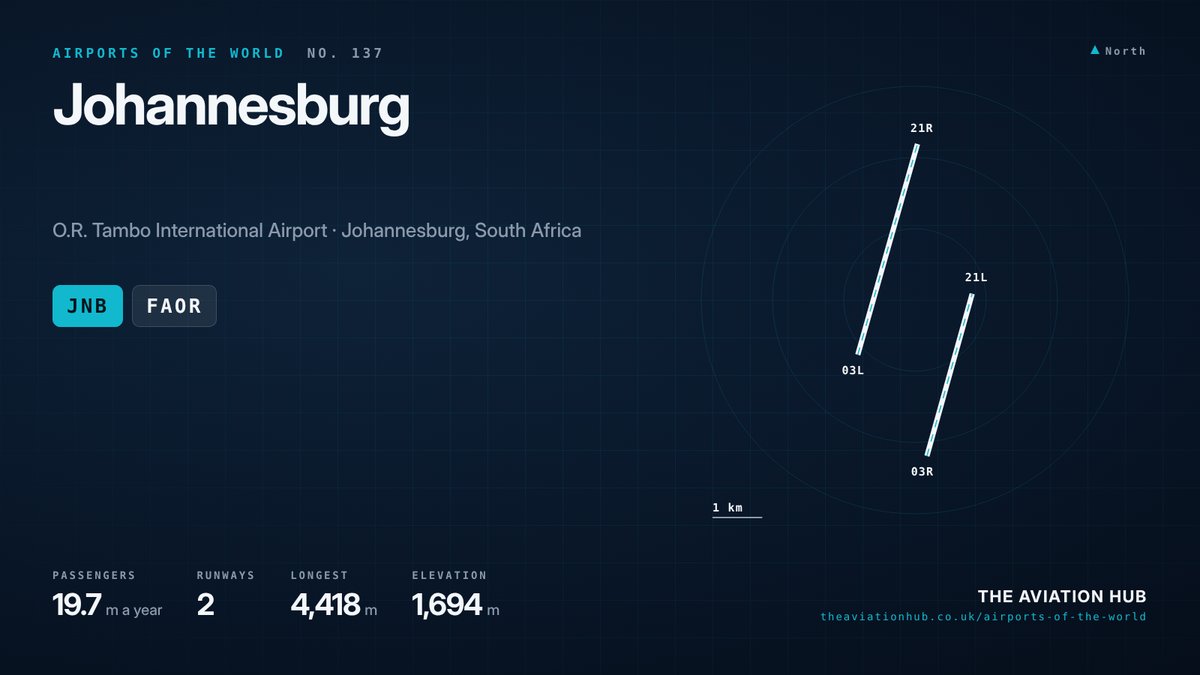
O.R. Tambo International Airport lies on the East Rand at Kempton Park, about 13 miles (20 km) north east of central Johannesburg and roughly halfway to Pretoria. It is the hub of southern Africa and has ranked as the second busiest airport on the continent since 2020. Johannesburg Airport handled around 20 million passengers in the year to March 2026 across two runways and a sprawling terminal complex. Its elevation of nearly 1,700 m shapes everything from runway length to the fuel loads of departing long haul jets.
Johannesburg Airport at a Glance
The codes are JNB and FAOR, the ICAO code having changed from FAJS in 2013 to drop the last reference to Jan Smuts. The field sits at 1,694 m (5,558 ft) above sea level on the Highveld plateau. It has two parallel runways, 03L/21R and 03R/21L, and a terminal complex of six interconnected buildings grouped into international, domestic and central sections.
Airports Company South Africa, the state controlled operator, runs Johannesburg Airport along with Cape Town, Durban and the other main airports of the country. South African Airways has its hub here, and Airlink, FlySafair, LIFT and CemAir base aircraft on the field. Traffic in the 2025 to 2026 financial year was about 20.1 million passengers and 212,000 aircraft movements, against a design capacity of 28 million. Terminal maps and parking rates are on the airport’s official website.
How Johannesburg’s Airport Came to Be
Johannesburg’s first post war international flights used Palmietfontein from 1945, a temporary field south of the city. The replacement was founded in 1952 as Jan Smuts International Airport, two years after the death of the wartime prime minister, and it opened for business on 1 September 1953 with the official ceremony on 4 October. South African Airways made it the home of its Constellations, Comets and later Boeing 707s and 747s.
The apartheid years made Johannesburg a hub by necessity, as African states denied SAA overflight rights and forced long detours around the west coast bulge. The airport was renamed Johannesburg International in 1994 after the first democratic election. On 27 October 2006 it took the name of Oliver Tambo, the president of the African National Congress in exile, a change that critics called expensive and political.
The 2010 World Cup drove the biggest rebuild. The Central Terminal Building opened to link the domestic and international halls, and a new International Pier added nine contact stands, four of them sized for the Airbus A380. The Gautrain rail link opened in June 2010, days before the tournament.
Runways at Johannesburg Airport
The main runway, 03L/21R, is 4,418 m (14,495 ft) long and 61 m wide, surfaced in asphalt, and is one of the longest civil runways in the world. The parallel runway, 03R/21L, is 3,400 m (11,155 ft) long and 60 m wide, also asphalt. In busy periods the airport uses the long runway mainly for departures and the shorter one mainly for landings. Two former runways, 09/27 and 14/32, survive as taxiways Juliet and Echo.
Altitude is the story here. At 1,694 m the air is roughly 17 per cent thinner than at sea level, so a fully loaded aircraft needs more speed and more runway to lift off, and engines produce less thrust. Summer afternoons on the Highveld push temperatures past 30 degrees and make it worse. Concorde was tested here in the 1970s precisely for hot and high data, and long haul departures to London, Atlanta and Sydney still take almost the full length.
In 2004 an Emirates Airbus A340-300 bound for Dubai failed to become airborne before the end of the runway, struck 25 approach lights and returned for an emergency landing, stopping with reverse thrust after its normal brakes failed. Investigators blamed an erroneous take off technique. Winds favour the 03 direction, with arrivals from the south west and departures towards Pretoria. Afternoon thunderstorms are violent between October and March.
Terminals and Airlines
Terminal A, split into A1 and A2, handles international flights, with the International Pier reaching out to the big contact stands. Terminal B handles domestic traffic and check in for SAA, Airlink, LIFT, FlySafair, KLM, Air France, Ethiopian, Qantas, RwandAir and Air Mauritius among others. The Central Terminal Building, designated A3, links the two sides with shops, the Gautrain station and a transit hotel. A separate transit area serves connecting passengers who do not clear immigration.
South African Airways has rebuilt a smaller network since its 2020 business rescue with Airbus A320s, A330s and A340s. FlySafair is now the largest domestic carrier with Boeing 737-800s, and Airlink flies Embraer E190s and E195s and regional jets across the continent. LIFT operates A320s on the Cape Town trunk and CemAir covers smaller cities.
Foreign airlines at Johannesburg Airport include British Airways, Virgin Atlantic, Lufthansa, Swiss, Air France, KLM, Turkish Airlines, Emirates, Qatar Airways, Etihad, Ethiopian, Kenya Airways, Qantas, Singapore Airlines, Cathay Pacific, Delta, United and LATAM. Lounges run to SAA, Bidvest, Emirates, British Airways and several bank branded rooms, with the Emirates lounge notable for its size.
Routes and Destinations
Cape Town is the busiest route from Johannesburg Airport by a distance, with more than 1 million seats a year from four airlines and flights roughly every half hour at peaks. Durban follows, with Gqeberha, East London and George next. Across the border, Harare, Lusaka, Maputo, Windhoek, Gaborone, Nairobi, Lagos and Mauritius are the big regional flows.
Long haul reaches London Heathrow, where BA and Virgin fly Boeing 777s and Airbus A350s, plus Frankfurt, Paris, Amsterdam, Zurich, Istanbul, Dubai, Doha, Abu Dhabi, Addis Ababa, Singapore, Hong Kong, Perth, Sydney, Sao Paulo, Atlanta and Newark. Qantas flies Sydney non stop at around 6,900 miles (11,100 km), and Delta’s Atlanta service runs about 8,400 miles (13,600 km), the longest from the airport. Cargo is substantial, with fresh produce, mining equipment and automotive parts moving through dedicated freighters from Emirates, Qatar, Cargolux and Lufthansa Cargo.
Getting to and from Johannesburg Airport
The Gautrain is the civilised way in. Its station sits inside the Central Terminal Building and trains reach Sandton in around 15 minutes and, with a change, Rosebank, Park Station and Pretoria. Fares to Sandton are roughly R200 (about £9). Taxis and Uber or Bolt cost around R350 to R500 (£15 to £22) to Sandton or the northern suburbs and take 30 to 45 minutes on the R24 and R21 freeways, longer in the evening peak. Hotel shuttles serve the many airport hotels.
Metrobus and Putco services call at the airport only twice a day, so for most visitors the Gautrain or a ride hailing app is the sensible choice. Car hire is extensive, with the major firms on site. Multi storey, shaded and long stay car parks surround the terminals, and parking fees are modest by European standards.
Spotting and Photography
Johannesburg Airport keeps two public viewing decks, one on the domestic side and one on the international side, with wide views across the aprons and the 03 approaches. They are the safest and most comfortable places to watch. Outside, the roads near the 03L threshold on the Kempton Park side give low approach shots in morning light, and the Rhodesfield area overlooks the domestic apron.
Highlights include the Emirates A380 and 777-300ERs, Qatar Airways A350-1000s, BA and Virgin 787s and A350s, Qantas 787-9s, SAA A340s and the rare visitors that the long runway attracts, including Antonov An-124 freighters. Wet season skies after a storm give dramatic light.
Security is a real concern around the perimeter and in the surrounding streets. Do not wander the outer roads alone with expensive equipment, use the viewing decks or stay in a vehicle, and expect questions from airport police if you linger near the fence.
What Comes Next
ACSA announced a multi year investment plan in March 2024 that at Johannesburg includes a new cargo terminal, a new passenger terminal built between the runways with its own midfield pier, and six additional bussing gates. Capacity of 28 million gives headroom, but the midfield terminal is the long term answer to the cramped linear layout.
The bigger uncertainties are South African. Power cuts, the slow recovery of SAA, the economy and competition from the Gulf carriers for connecting traffic all weigh on growth. Johannesburg still has no scheduled flights to many of the African capitals it once served, and Addis Ababa has overtaken it as the continent’s connecting hub.
Johannesburg Airport will remain the gateway to southern Africa and the busiest in the region, if not quite the hub it was in the 747 era. Compare it with other hubs on the Airports of the World map.
Continue to follow The Aviation Hub for more analysis and insight.
Advertise with us Your brand, in front of an aviation audience Home page and in-article placements, sold directly, one advertiser per slot. From £250 a year. See the rates

