
Chicago Midway Airport Guide: Southwest’s Square Mile Fortress
Chicago Midway Airport packs four short runways and a Southwest fortress hub into one square mile of the South Side. Runways, routes and access explained.
 By The Aviation Hub
7 min read
Updated October 20, 2026
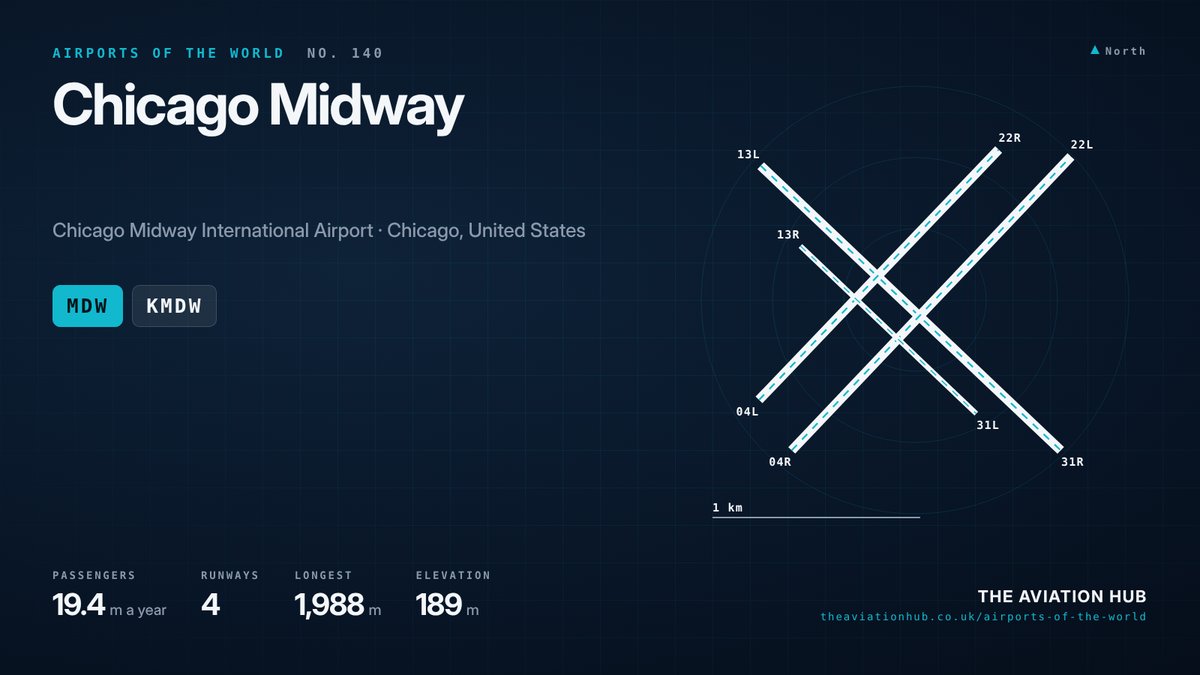
Midway International Airport sits on the South West Side of Chicago, about 12 miles (19 km) from the Loop, squeezed into a single square mile bounded by 55th Street, 63rd Street, Central Avenue and Cicero Avenue. It is the city’s second airport after O’Hare and one of the tightest urban airfields in the United States. Chicago Midway Airport handled around 19.4 million passengers in 2025, more than 90 per cent of them on Southwest Airlines. Four short runways and a 43 gate terminal serve a network that reaches across the United States and down to Mexico and the Caribbean.
Chicago Midway Airport at a Glance
The codes are MDW and KMDW. The field sits at 189 m (620 ft) above sea level on the flat prairie of the South Side, with bungalows and shops hard against the fence on every side. It has four runways, 13L/31R, 04R/22L, 04L/22R and 13R/31L, and one terminal with three concourses lettered A, B and C.
The Chicago Department of Aviation, a city agency, owns and operates Chicago Midway Airport as it does O’Hare. Southwest Airlines treats it as one of its largest bases and held a 91 per cent share of passengers in the year to May 2026. Traffic peaked at about 22.7 million in 2016, recovered to just over 22 million in 2023 and slipped to about 19.4 million in 2025 as Southwest trimmed its schedule. Parking and transit details are on the airport’s official website.
How Chicago’s Second Airport Came to Be
The field opened in 1923 as Chicago Air Park, a cinder runway built mainly for airmail. The city leased it in 1926 and named it Chicago Municipal Airport on 12 December 1927. Growth was explosive. By 1932 Chicago claimed it as the busiest airport in the world, and from 1948 until 1960 it carried more airline passengers than any other field in the United States.
The airport was renamed in July 1949 in honour of the Battle of Midway, the 1942 naval victory in the Pacific. Then the jets arrived. The Boeing 707 and Douglas DC-8 needed more runway than the square mile could offer, and the airlines decamped to O’Hare, which opened to scheduled flights in 1955. By the early 1960s Midway was almost deserted.
Revival came in stages. The locally based Midway Airlines took its name from the field in 1979 and rebuilt a hub there before collapsing in 1991, and Southwest arrived in 1985 and never left. A new terminal spanning Cicero Avenue opened in 2001 under a programme begun in 1997, replacing the cramped 1940s buildings and giving Chicago Midway Airport the shape it has today.
Runways at Chicago Midway Airport
The runways are short, and that defines the airport. The longest, 13L/31R, is 1,988 m (6,522 ft) long and 46 m wide, surfaced in concrete, and 04R/22L is 1,964 m (6,445 ft) long and 46 m wide in asphalt. These two carry almost all the airline traffic. The parallel 04L/22R is 1,679 m (5,507 ft) long, and the tiny 13R/31L is just 1,176 m (3,859 ft) long and 18 m wide, usable only by light aircraft.
The streets and houses outside the fence force displaced thresholds on several runway ends, cutting the landing distance available further still. A Boeing 737 arriving in winter has little margin, and pilots put the aircraft down firmly at the start of the runway. With no room for normal overrun areas, engineered arrestor beds of crushable concrete were installed at the runway ends after 2005.
That followed the accident of 8 December 2005, when Southwest Flight 1248, a 737-700, landed on 31C, now renumbered 31R, in heavy snow, failed to stop and slid through the fence onto Central Avenue, where it struck cars and killed a six year old boy. On the same date in 1972 United Flight 553, a 737-200, crashed into houses on approach, killing 43 aboard and two on the ground. Westerly winds favour 22L and 31R, and the airport swings quickly between runways as lake breezes shift.
Terminals and Airlines
The terminal is a long building on the east side of Cicero Avenue linked by a bridge to the concourses on the airfield side. Concourse A holds the international gates and federal inspection facilities, and Concourses B and C stretch along the apron with Southwest occupying almost every gate. The terminal is laid out for speed rather than comfort, with no large lounges.
Southwest flies an all Boeing 737 fleet of 737-700s, 737-800s and 737 MAX 8s from Chicago Midway Airport to more than 70 cities, with departures banked through the day. It uses Midway as a transfer point for Midwestern passengers heading to the coasts, Florida and Texas.
The other carriers are small. Frontier flies Airbus A320neo family jets on leisure routes, Delta connects to Atlanta, Detroit and Minneapolis, Porter Airlines ends its Embraer E195-E2 service to Toronto in late October 2026, Allegiant serves smaller cities and Volaris flies to Mexico. No other legacy carrier bothers, because O’Hare is their Chicago hub.
Routes and Destinations
Atlanta was the busiest domestic route in the year to May 2026 with about 408,000 passengers, followed by the Southwest strongholds of Phoenix, Orlando, Las Vegas, Denver, New York LaGuardia and Dallas Love Field. Florida routes swell in winter as Chicagoans flee the cold, and the Florida and Las Vegas flights are among the fullest in the schedule.
International service is thin. Cancun was the busiest foreign route with around 134,000 passengers, Southwest and Frontier serve Mexican resorts, Punta Cana and Montego Bay, while Volaris links Morelia, Guadalajara and other cities in central Mexico. Porter’s Toronto service, the only link to Canada, ends in October 2026. The longest scheduled flights reach Punta Cana and, in season, San Juan at around 2,000 miles (3,200 km), with no wide body operations because the runways cannot take them with a full load. Cargo is minimal, with the freighters using O’Hare.
Getting to and from Chicago Midway Airport
The CTA Orange Line is the answer. Its terminus station sits beside the terminal, reached by a covered walkway, and trains run to the Loop in 20 to 25 minutes for the standard fare of $2.50 (about £2), making it both the cheapest and often the quickest way into the city. The CTA has announced 24 hour operation on the line to match the Blue Line at O’Hare.
By road the airport sits beside Cicero Avenue, with Interstate 55 a mile to the north and the Loop 25 to 45 minutes away depending on traffic. Taxis to downtown cost around $35 to $45 (£28 to £36) and Uber and Lyft are a little cheaper from the dedicated pick up area. CTA and Pace buses serve the surrounding neighbourhoods. A large multi storey car park connects to the terminal, with cheaper economy lots nearby.
Spotting and Photography
Chicago Midway Airport is a spotter’s treat because the approaches are so low. Arrivals on 31R pass over 63rd Street at rooftop height, and aircraft landing on 22L cross 55th Street near Cicero Avenue a few hundred feet up. Windows in the concourses look onto the apron.
The traffic is almost all Southwest 737s in their heart liveries and special schemes, with Frontier’s animal tails, Delta and Volaris jets and business jets on the general aviation ramps as variety. Winter mornings with snow on the ground and jets flaring over the rooftops give the classic Midway shot.
The surrounding streets are residential and the airport police watch the fence lines closely. Stay on the public pavements, do not stand on the medians of busy roads and respect the privacy of the people who live beneath the approaches.
What Comes Next
There is nowhere to grow. The square mile is fixed by the street grid and the runways cannot be lengthened without demolishing neighbourhoods, which the city has ruled out. Recent investment has gone into the terminal, with an expanded security checkpoint, a widened bridge over Cicero Avenue, a larger parking garage and refreshed concessions, all completed by the mid 2020s.
The future rests with Southwest. The airline’s network changes in 2025 and 2026 have trimmed Midway’s flight count, and any shift of Southwest capacity would cut the airport’s traffic directly. The city’s lease with Southwest keeps the hub secure for now.
Chicago Midway Airport will stay what it has been for 40 years, a compact and efficient Southwest fortress with some of the lowest approaches in the Midwest. See how it compares with O’Hare and other hubs on the Airports of the World map.
Continue to follow The Aviation Hub for more analysis and insight.
Advertise with us Your brand, in front of an aviation audience Home page and in-article placements, sold directly, one advertiser per slot. From £250 a year. See the rates

