
Portland Oregon Airport Guide: PDX, Timber and Carpet
Portland Oregon Airport, better known as PDX, is Alaska Airlines' second hub and home to a timber roofed terminal. Runways, routes and access explained.
 By The Aviation Hub
6 min read
Updated October 20, 2026
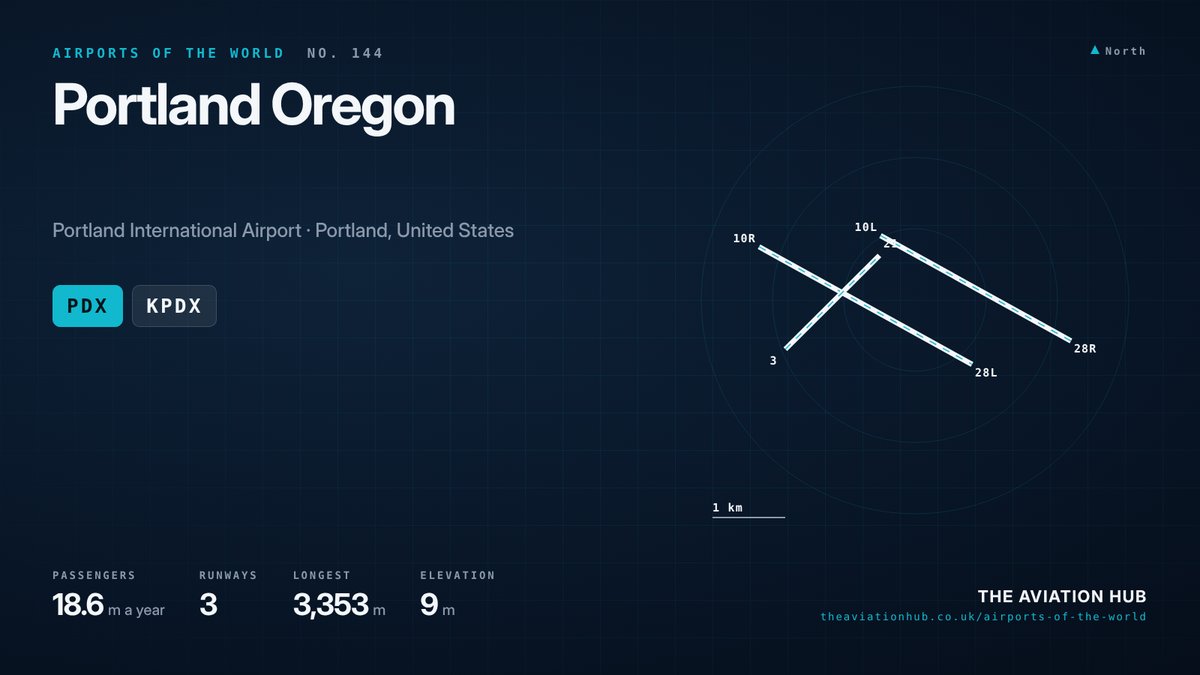
Portland International Airport sits on the south bank of the Columbia River, on the north east edge of Oregon’s largest city. Most people call it PDX, and the code has become a civic brand printed on T shirts and socks. Portland Oregon Airport handled more than 18.5 million passengers in 2025, making it the busiest in the state and a growing second hub for Alaska Airlines. A new timber roofed main terminal, opened in 2024, has made it one of the most talked about airport buildings in North America.
Portland Oregon Airport at a Glance
The IATA code is PDX and the ICAO code is KPDX. The field lies about 6 miles (10 km) north east of downtown Portland, at an elevation of just 9 m (31 ft) beside the river. There are three runways and one passenger terminal, split into four concourses labelled B, C, D and E with around 60 gates. The Oregon Air National Guard’s 142nd Wing flies Boeing F-15EX Eagle II fighters from a base on the south west side.
Portland Oregon Airport handled roughly 18.6 million passengers in 2025, up around 6 per cent on the previous year. Alaska Airlines is the dominant carrier and operates a hub here, with its regional arm Horizon Air running a maintenance facility. Southwest, Delta and United are the main competitors. The Port of Portland, a public agency, owns and operates the airport and publishes live flight data on the airport’s official website.
A Short History of PDX
Portland’s first proper airport opened on Swan Island in the Willamette River in 1927. It was obsolete within a decade, hemmed in by water and unable to take larger aircraft. The city bought land on the Columbia and opened Portland Columbia Airport on 13 October 1940, the Columbia name chosen to distinguish it from Swan Island. The word International arrived after improvements in the 1950s.
The 1948 Vanport flood submerged the airfield for several months, a reminder of how low the ground sits. United Flight 173 crashed short of the runway in December 1978 after the crew ran the DC-8 out of fuel while troubleshooting a landing gear problem. The accident became a foundation case for crew resource management training across the industry.
Delta ran a transpacific gateway at Portland from 1987 with flights to Tokyo and other Asian cities, but closed it in 2001. The 1987 teal patterned carpet became a beloved local icon before its replacement from 2014. Concourse A was demolished in 2019, an enlarged Concourse B opened in December 2021, and the first phase of the new main terminal opened on 14 August 2024.
Runways at Portland Oregon Airport
Portland Oregon Airport has two parallel east west runways and a shorter crosswind strip. The main runway is 10R/28L, a concrete runway of 3,353 m (11,000 ft) and 46 m wide, which suits the long haul flights to Europe. The northern parallel, 10L/28R, is asphalt and measures 2,995 m (9,825 ft). The two are spaced widely enough for simultaneous operations in good weather.
The third runway, 3/21, is an asphalt strip of 1,829 m (6,000 ft) that handles light aircraft and the occasional crosswind operation. Prevailing winds from the west mean the 28s are in use most of the time, with arrivals coming in from the east. Strong winter easterlies blowing down the Columbia Gorge flip operations to the 10s, and those approaches over the city are the ones photographers wait for. Mount Hood sits on the horizon to the east and dominates the view on a clear day.
Terminals and Airlines
The single terminal at Portland Oregon Airport has a new central hall roofed in Douglas fir sourced from regional forests, with trees and daylight replacing the usual airport gloom. Alaska Airlines, American and JetBlue work mainly from Concourses B and C. Southwest and United occupy Concourse E, while Delta and the international flights use Concourse D. The international section of Concourse D is named after former Governor Victor Atiyeh and houses the customs hall.
Alaska and its Oneworld partners American and British Airways form the largest grouping. United and Air Canada represent Star Alliance, while Delta and KLM cover SkyTeam. Alaska began moving some Seattle connections through Portland in May 2025 to ease congestion at its main hub, so the gate count in B and C is well used. Frontier, Allegiant, Sun Country, Volaris, Condor, Icelandair and Hawaiian round out the field.
Routes and Destinations
Denver was the busiest domestic route in 2025, followed by Phoenix, Los Angeles, Seattle and Las Vegas. Alaska serves the largest number of destinations, blanketing the West Coast with Boeing 737-900ER and Embraer E175 services. Southwest flies heavily to California and the South West, United feeds its hubs in Denver, San Francisco and Chicago, and Delta connects to Salt Lake City, Minneapolis and Atlanta.
Vancouver was the top international route in the year to June 2025, followed by Guadalajara, Amsterdam, London Heathrow and Puerto Vallarta. KLM’s Amsterdam service and British Airways’ Heathrow flight are the long haul anchors. The longest route is Condor’s seasonal Frankfurt service at around 5,200 miles (8,400 km), ahead of Amsterdam and London. Summer brings the heaviest traffic, with Hawaii and Mexico strong in winter. Cargo is handled by FedEx, UPS, Amazon Air, DHL and Cathay Cargo, among others.
Getting to and from Portland Oregon Airport
The TriMet MAX Red Line light rail is the cheapest and most reliable way to reach Portland Oregon Airport. The platform is about 150 ft from baggage claim, trains run roughly every 15 minutes and the ride to downtown takes around 40 minutes for a few dollars. The line continues west through the city centre to Beaverton. There is no faster option during the evening peak.
By road the airport sits beside Interstate 205, reached from Exit 24 southbound or 24A northbound. A taxi or ride share to downtown takes 20 to 30 minutes and costs roughly US$40 to US$50 (about £30 to £38). C Tran route 67 links the terminal to Vancouver, Washington, across the river, and Pacific Crest Lines runs intercity coaches to Union Station, Salem and Bend. Short term, long term and economy parking all sit beside the terminal, with the economy lot served by a shuttle.
Spotting and Photography
Portland Oregon Airport is friendly to spotters. The terminal’s large windows in Concourses C, D and E look over the aprons and the runways, and the top deck of the short term car park overlooks the north runway. Outside the fence, the Marine Drive levee path runs along the river on the north side of the airfield and gives clear views of 10L/28R near the 10L threshold, best in the early morning. The levee path is popular with cyclists and walkers, so photographers are a normal sight.
Westerly winds put arrivals on the 28s, and the hotels beside the NE Airport Way frontage road give good 28R shots from late morning to sunset. The winter easterlies that switch operations to the 10s bring aircraft in over Northeast Portland, with Mount Hood occasionally in the frame on a departure. The Air National Guard F-15 launches add military interest most weekdays. Stay off the airfield service roads, do not photograph the Guard ramp close up, and respect the signs along Marine Drive.
What Comes Next
PDX Next, the Port of Portland’s multi phase rebuild, continues after the 2024 opening of the new main terminal. Later phases will complete the remaining sections of the terminal, with the mass timber roof as the signature. In April 2026 the exit routes were redesigned to reduce crowding at the meeters and greeters area. The airfield itself has spare capacity.
Alaska’s decision to shift connecting traffic from Seattle is the growth story to watch, and the airline’s merger with Hawaiian adds the prospect of more Pacific flying. Portland Oregon Airport is heading towards 20 million passengers with a terminal built for it. See how it ranks on our Airports of the World map.
Continue to follow The Aviation Hub for more analysis and insight.
Advertise with us Your brand, in front of an aviation audience Home page and in-article placements, sold directly, one advertiser per slot. From £250 a year. See the rates

