
Buenos Aires Aeroparque Airport Guide: Riverside Hub
Buenos Aires Aeroparque Airport is Argentina's busiest, a single runway field on the Rio de la Plata minutes from downtown. Routes and access explained.
 By The Aviation Hub
6 min read
Updated October 20, 2026
Aeroparque Jorge Newbery is the city airport of Buenos Aires, a single runway field squeezed between the Rio de la Plata and the Palermo parklands barely 15 minutes from the Obelisco. Argentines call it simply Aeroparque, and it is the country’s busiest airport, ahead of the international gateway at Ezeiza. Buenos Aires Aeroparque Airport handled close to 18 million passengers in 2025, almost all of them on domestic flights and short regional hops to Uruguay, Brazil and Paraguay.
Buenos Aires Aeroparque Airport at a Glance
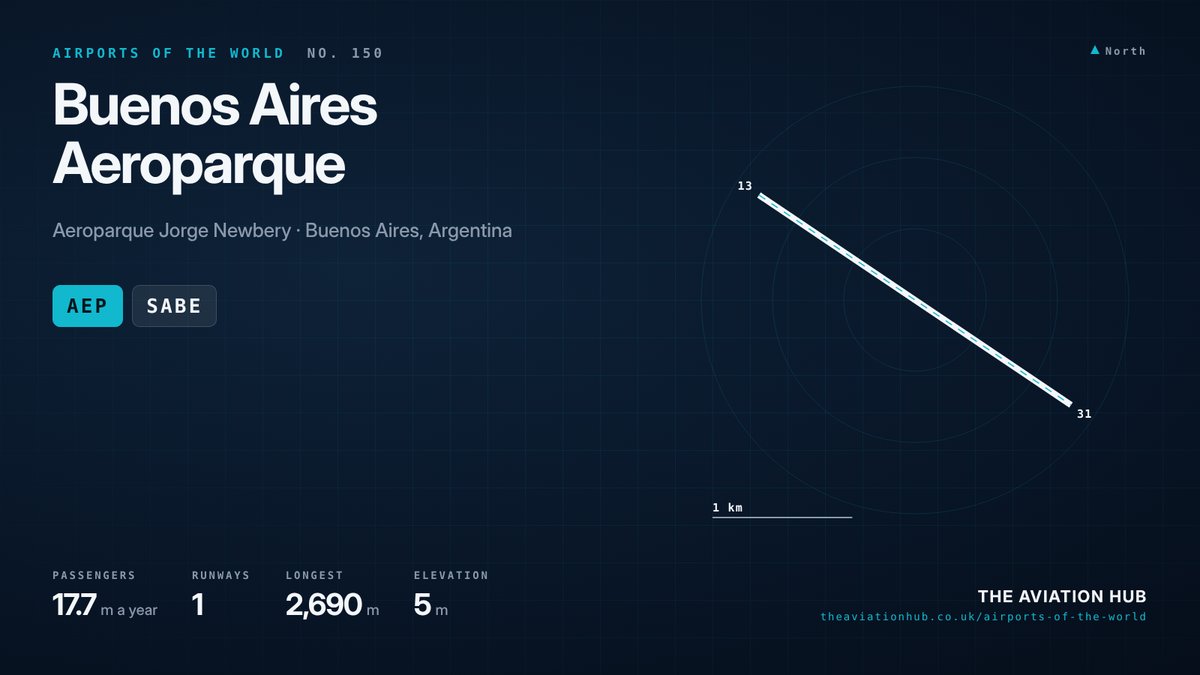
The IATA code is AEP and the ICAO code is SABE. The airport lies in the Palermo district, north west of Retiro and roughly 4 miles (6 km) from the Obelisco, at an elevation of just 5 m (18 ft) on reclaimed riverbank. There is one runway and a single linear terminal, extended in 2014, with a small air force base beside it. Nothing about the site is spacious.
Buenos Aires Aeroparque Airport handled roughly 17.7 million passengers in 2025, a jump of about 19 per cent on the previous year as Argentina’s deregulated market expanded. Aerolineas Argentinas operates its domestic hub here, with the low cost carriers Flybondi and JetSmart Argentina also based on the field. Aeropuertos Argentina, the private concession company that runs most of the country’s airports, operates the site. Timetables and terminal maps are on the airport’s official website.
How Buenos Aires’ City Airport Came to Be
The land was reclaimed from riverside wetland, and mayor Carlos Noel first proposed an airport on the waterfront in 1925. Construction waited two decades. The field opened in 1947 as Aeroparque 17 de Octubre, named for the date of the 1945 demonstrations that launched Juan Peron’s political career, and scheduled flights began in January 1948.
After the 1955 coup that removed Peron, the airport was renamed after Jorge Newbery, the engineer and aviator who was the father of Argentine flying before his death in a 1914 crash. A small air force base was built alongside in 1965, and it was there that President Isabel Peron was detained during the 1976 coup. A new terminal built for Aerolineas Argentinas opened in 1981.
The airport’s worst day came in August 1999, when a LAPA Boeing 737-200 failed to get airborne, crossed the coastal road and burst into flames, killing 65 people. The runway was lengthened in 2007, and work began in 2009 to move the coastal highway further from the eastern end of the runway. Terminals III and IV, adding around 35,000 square metres, opened in March 2014. Most international flights were pushed to Ezeiza in 2019, then partly allowed back.
Runways at Buenos Aires Aeroparque Airport
Buenos Aires Aeroparque Airport has a single runway, 13/31, which is 2,690 m (8,825 ft) long and 45 m wide. An extension in 2007 and a complete rebuild during the pandemic closure, which added 590 m to the old 2,100 m strip, produced that length, enough for wide body aircraft such as the Airbus A330-200. The runway runs parallel to the shore, with the river on one side and the city on the other.
Operations favour runway 13, with arrivals coming in from the north west over the Nunez and Belgrano districts and departing out over the water. The approach to runway 31 takes aircraft low along the shoreline past the city skyline, one of the most photogenic arrivals in South America. The short runway, coastal position and lack of overrun space keep safety margins under constant scrutiny.
Terminals and Airlines
The terminal at Buenos Aires Aeroparque Airport is a long, low building along the shore with the 1981 core and the 2014 extensions, Terminals III and IV. Aerolineas Argentinas and its Austral heritage dominate, running Boeing 737-800 and 737 MAX 8 aircraft, along with Embraer E190s, to every corner of the country. The airline also flies from here to Brazil, Asuncion, Montevideo and Bogota.
Flybondi and JetSmart Argentina bring low cost competition with Boeing 737-800 and Airbus A320 fleets respectively, and the pair have taken a large share of domestic traffic since 2018. Regional foreign carriers include LATAM Brasil, Gol, Paranair and Avianca, while Aerolineas covers the short hops to Montevideo and Punta del Este. Aerolineas Argentinas is a SkyTeam member and Avianca flies the Star Alliance flag.
Routes and Destinations
Cordoba and Mendoza are the heavy domestic trunk routes, followed by Bariloche, Salta, Tucuman, Iguazu, Neuquen and Ushuaia. The Patagonian routes swell in the southern summer and the ski season at Bariloche fills aircraft in July and August. Iguazu Falls runs busy year round. Aerolineas Argentinas, Flybondi and JetSmart compete head to head on all of them, which has driven fares down and passenger numbers sharply up.
Internationally, Montevideo and Punta del Este are a short flight across the river, and Sao Paulo, Rio de Janeiro, Porto Alegre, Florianopolis and Salvador form the Brazilian core. Asuncion and Bogota round out the regional network. The longest regular route is Bogota at around 2,900 miles (4,700 km), with Aerolineas due to add Cartagena from January 2027. Cargo is minimal; freight goes through Ezeiza.
Getting to and from Buenos Aires Aeroparque Airport
No train or metro reaches Buenos Aires Aeroparque Airport directly. City buses, known as colectivos, stop outside the terminal, with routes 33 and 45 running to Retiro and the centre for a fare of a few hundred pesos, paid with a SUBE card. That is the cheapest sensible option, and the ride takes 20 to 30 minutes. Retiro station then connects to the suburban rail lines and the Subte.
Taxis and ride hailing apps are the default for most visitors. A trip to the centre takes 15 to 25 minutes along the Costanera and Avenida del Libertador and costs roughly ARS 15,000 to 20,000 (about £9 to £12), though inflation moves fares quickly. The Tienda Leon shuttle links Aeroparque with Ezeiza in around an hour for connecting passengers. Short stay parking sits opposite the terminal, with longer stay options a short walk away.
Spotting and Photography
Buenos Aires Aeroparque Airport is one of the great urban spotting locations. The Costanera Norte, the riverside promenade along the eastern side of the airport, runs within metres of the runway and gives unobstructed views of every movement, with the Buenos Aires skyline behind departing aircraft. Food stalls line the promenade, so there is no hardship in waiting. Parque San Benito at the north western end catches arrivals on runway 13 in the late afternoon.
Morning light favours the promenade, and the terrace of the El Muelle restaurant shows runway 31 line ups and approaches against the city skyline. Expect a steady flow of 737s, A320s and E190s, with visiting Brazilian and Colombian aircraft as highlights. The promenade is public, but do not climb the fence, keep clear of the air force base, and be careful with equipment after dark along the waterfront.
What Comes Next
Aeroparque’s future is a political question as much as an engineering one. A 1990s plan to replace it with an airport on an artificial island in the river was dropped, and successive governments have swung between banning international flights and encouraging them. The pandemic era runway and apron works gave it wide body capability, and the current direction is growth, with regional international flights allowed back to connect tourists with domestic services.
Physical expansion is impossible, so Buenos Aires Aeroparque Airport will keep squeezing more passengers through a single runway with larger aircraft and fuller seats. Compare it with other city centre airports on our Airports of the World map.
Continue to follow The Aviation Hub for more analysis and insight.
Advertise with us Your brand, in front of an aviation audience Home page and in-article placements, sold directly, one advertiser per slot. From £250 a year. See the rates

