
Moscow Domodedovo Airport Guide: A Giant Past Its Peak
Moscow Domodedovo Airport once handled 33 million passengers a year and now carries well under half that. Runways, terminals, routes and access explained.
 By The Aviation Hub
6 min read
Updated October 20, 2026
Moscow Domodedovo Airport lies on the flat farmland of Moscow Oblast about 26 miles (42 km) south southeast of the Kremlin, the furthest out of the capital’s three main airports. For most of the 2000s it was the busiest airport in Russia, the home of Transaero and the gateway for Lufthansa, British Airways and Emirates. The 2014 peak of 33 million passengers is a distant memory. Around 14 million used the field in 2025, S7 Airlines is the one big carrier left, and the state seized and then sold the airport within a year.
Moscow Domodedovo Airport at a Glance
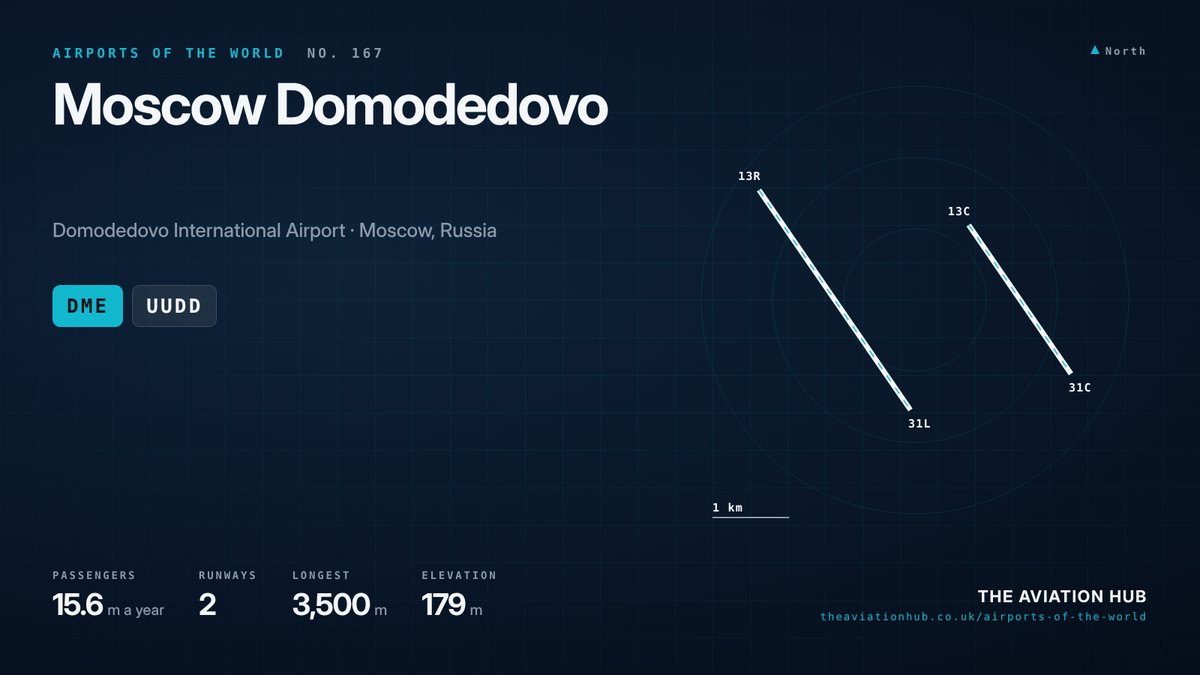
The codes are DME and UUDD. The airport stands 179 m (588 ft) above sea level beside the town of Domodedovo, from which it takes its name. There are two parallel runways in use and one enormous passenger terminal split into the original T1 segment and the newer T2 international wing, together close to 500,000 square metres. Passenger numbers fell from 15.6 million in 2024 to roughly 13.8 million in 2025, continuing a slide that began when sanctions took away the foreign airlines.
S7 Airlines, Russia’s largest private carrier, runs its Moscow hub at Moscow Domodedovo Airport, and Ural Airlines, Red Wings and Smartavia also base aircraft here. The Russian state took control of the operator in June 2025 and sold it in January 2026 to Perspektiva, a subsidiary of rival Sheremetyevo, for 66.1 billion roubles. Terminal maps and transport information are on the airport’s official website.
How Domodedovo Came to Be
Planning for a new airport south of Moscow began in 1948 under the code name Facility No. 306, on land that included the village of Elgazino. Construction was formally dated to 7 April 1962, scheduled passenger flights began in March 1964 and the airport opened officially in May 1965 as the Soviet capital’s second big civil field after Vnukovo. It took the long domestic routes to Siberia and the Far East, which is why Il-62s and later Il-86s were the everyday sights.
The Tupolev Tu-144 supersonic airliner flew its first scheduled service, carrying mail and freight to Alma Ata, from Domodedovo in 1975. After the Soviet collapse the airport fell into disrepair until the East Line group took a lease in the late 1990s and rebuilt the terminal. Foreign airlines moved across from Sheremetyevo in large numbers from 2003, British Airways and Lufthansa among them, and traffic tripled in a decade.
A suicide bombing in the arrivals hall in January 2011 killed 37 people and led to mandatory screening at the terminal doors, a practice that spread across Russia. The T2 wing opened in stages from 2018, and in 2019 the airport was named after the scientist Mikhail Lomonosov following a national vote.
Runways at Moscow Domodedovo Airport
Domodedovo was the first airport in Russia to run two parallel runways at the same time. The main runway, 13R/31L, is a concrete strip of 3,500 m (11,483 ft) by 60 m with a category III instrument landing system. The second, 13C/31C, is 2,370 m (7,776 ft) long and 53 m wide. It was originally 3,794 m and was shortened during construction of a new third runway on the far side, a project that has dragged on for years, which explains why the shorter strip carries the centre designation.
The parallel pair sits about 2 km apart, which allows independent arrivals and departures, and the field was approved for the Airbus A380 before any other airport in Russia. Emirates flew the type here before 2022. Approaches to the 13s come in over open country from the northwest and the 31s bring aircraft in over the farmland to the southeast, with the town of Domodedovo off to the west.
The runways at Moscow Domodedovo Airport have been the scene of tragedy. A Saratov Airlines Antonov An-148 crashed minutes after departure in February 2018, killing all 71 on board after the crew lost reliable airspeed data. In March 2025 debris from a drone attack forced a temporary closure.
Terminals and Airlines
Everything runs from a single giant terminal. The T1 section, rebuilt by East Line around 2000 and extended repeatedly, holds the domestic operation. S7’s green Airbus A320neo family and Boeing 737-800 fleet dominates the stands, with Ural Airlines A320s, Red Wings Tu-204s and Superjets and Smartavia 737s alongside. The hall is long and linear, with check in in the centre and piers either side.
T2, the international segment that opened in stages from 2018, was designed for the foreign carriers that have since gone. Emirates, flydubai, Qatar Airways, Etihad, Turkish Airlines and the Central Asian and Gulf airlines occupy it now, along with S7’s remaining international flights. Moscow Domodedovo Airport was the first airport in Russia with a hotel inside the terminal, opened in 2017, and the Aeroexpress rail terminal, linked to the building by a covered walkway in 2021, is the latest addition.
Routes and Destinations
S7 flies the backbone of the schedule. Novosibirsk and Irkutsk, its two Siberian hubs, are the thick routes, with Saint Petersburg, Sochi, Kaliningrad, Yekaterinburg, Krasnoyarsk and Vladivostok close behind. The Vladivostok and Petropavlovsk Kamchatsky services run more than 4,000 miles (6,400 km) and are the longest flights from the field. Domestic flying now accounts for the great majority of passengers.
The international map covers the countries that still accept Russian aircraft and the airlines still willing to fly in. Dubai, Doha, Abu Dhabi, Istanbul, Antalya, Tashkent, Dushanbe, Bishkek, Yerevan, Baku and Minsk make up most of the board. Ural Airlines and Red Wings add charters to Egypt and Thailand. Cargo is small compared with Sheremetyevo but Domodedovo keeps a freight terminal and handles Chinese e commerce volumes.
Getting to and from Moscow Domodedovo Airport
Aeroexpress trains run from the terminal to Paveletsky station on the Garden Ring in around 45 minutes, every half hour through the day, and this is the most reliable option at roughly 600 roubles (around £5). Ordinary suburban trains on the same line cost a fraction of that and take 65 to 70 minutes, but they run infrequently and are the cheapest sensible choice only for the patient.
Buses and minibuses connect the terminal with Domodedovskaya metro station on the green line in about 45 minutes, traffic permitting. By road a 22 km motorway spur links the airport with the Moscow Ring Road and the Kashirskoye highway. A taxi to the centre takes an hour or more and costs around 2,000 to 3,000 roubles (£18 to £27). Several multistorey car parks stand in front of the terminal.
Spotting and Photography
The terminal windows are the practical option at Moscow Domodedovo Airport, with the airside areas looking across the ramp to the main runway and S7’s colourful fleet providing most of the interest. The Emirates Boeing 777s and the occasional Red Wings Tu-204 or government Il-96 break up the Airbus and Boeing narrow bodies. There is no public terrace.
Outside, the fields along the approach to runway 31L south of the airfield give open views with afternoon light, and the lanes near the village of Yam offer low passes when the 13s are in use. The open country means there is nowhere to hide, and that cuts both ways. Russian police take photography near airports seriously, so stay well back from fences, carry identification, keep away from anything military and leave if asked.
What Comes Next
The grand plan once spoke of 60 million passengers a year and a third runway. That future vanished with the foreign carriers in 2022. The sale to a Sheremetyevo subsidiary in January 2026 puts the two biggest Moscow airports under common ownership, and the obvious risk is that Domodedovo becomes the overflow field while investment flows north. S7’s loyalty is the airport’s main asset.
Moscow Domodedovo Airport is heading for a quieter role as a domestic and Gulf gateway with plenty of spare concrete. Compare its fortunes with Sheremetyevo and Vnukovo on the Airports of the World map.
Continue to follow The Aviation Hub for more analysis and insight.
Advertise with us Your brand, in front of an aviation audience Home page and in-article placements, sold directly, one advertiser per slot. From £250 a year. See the rates

