
Osaka Itami Airport Guide: Kansai’s Domestic City Airport
Osaka Itami Airport sits in the suburbs north of Osaka and flies only domestic routes. Runways, the noise rules, spotting spots and monorail access explained.
 By The Aviation Hub
7 min read
Updated October 20, 2026
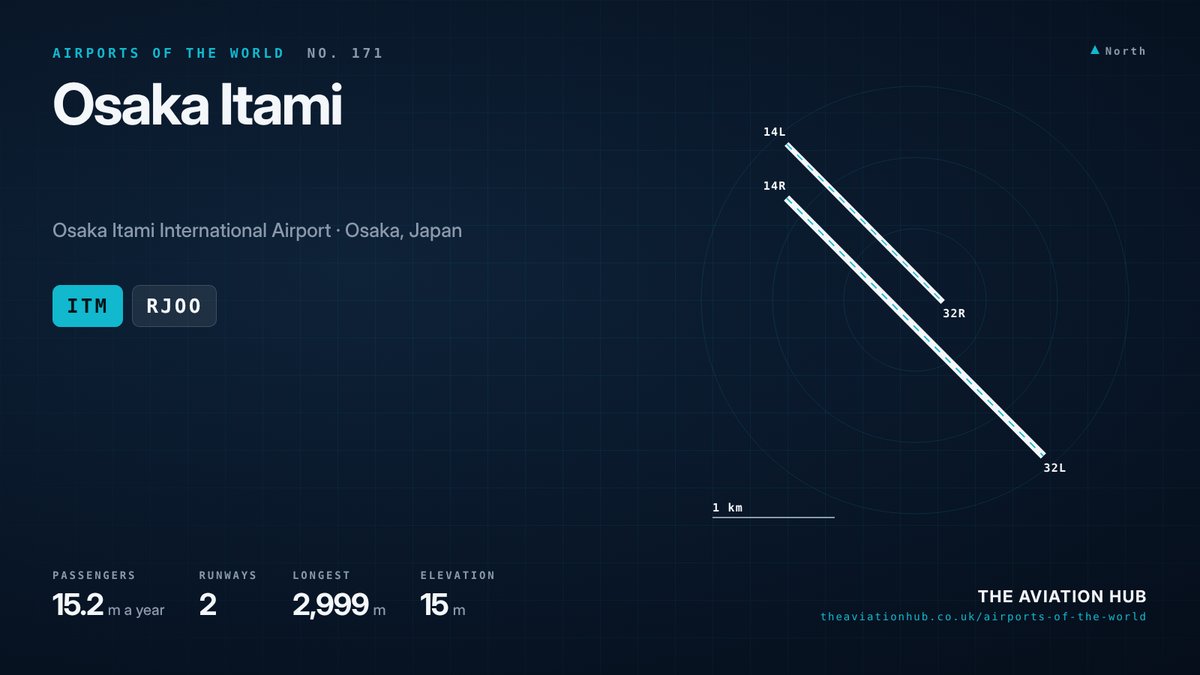
Osaka Itami Airport sits about 7 miles (11 km) northwest of Umeda, straddling the border of Osaka and Hyogo prefectures in the densely built suburbs of Itami, Toyonaka and Ikeda. It is formally Osaka International Airport, yet it has had no regular international service since Kansai opened in 1994. Instead it is the domestic workhorse of western Japan, with around 15 million passengers a year on wide body jets to Tokyo, Sapporo and Okinawa. The airport is also a textbook case of how a city can live with, and limit, a busy runway in its back garden.
Osaka Itami Airport at a Glance
The codes are ITM and RJOO. The field lies at 15 m (50 ft) above sea level on the flat plain north of the Yodo river, hemmed in by housing on every side. It has two parallel runways and one terminal building split into North and South halves. Traffic was around 15.2 million passengers and roughly 140,000 movements in the latest full year, with about 90,000 tonnes of cargo.
Japan Airlines and All Nippon Airways dominate the airport and between them operate the great majority of flights. Kansai Airports, the Orix and Vinci consortium that also runs Kansai and Kobe, has held a 45 year concession on Osaka Itami Airport since April 2016. Live arrival boards and the 07:00 to 21:00 operating hours are set out on the airport’s official website.
A Short History of Itami
The airfield opened on 17 January 1939 as No. 2 Osaka Airport, replacing the cramped Kizugawa field, and the Imperial Japanese Army was its main user in the early years. The name comes from Itami city in Hyogo prefecture, where most of the land sits. American forces took it over after the war as Itami Air Base, and Marilyn Monroe and Joe DiMaggio passed through on their honeymoon in 1954. Japan regained control in 1958 and the field became Osaka International Airport the following year.
The jet age brought growth and trouble in equal measure. The present 3,000 m main runway was completed in 1970 and Boeing 747s soon followed. Residents sued over noise, winning an injunction in 1975 that barred night operations before the Supreme Court overturned it in 1981. The government responded with a curfew, slot caps and a promise to move international traffic offshore, which it did when Kansai opened in 1994.
Since then the story has been one of managed decline followed by reinvention. Aircraft with more than two engines were banned in April 2006. The concession to Kansai Airports in 2016 unlocked a full renovation of the terminal, finished in August 2020. In January 2025 the English name became Osaka Itami Airport, chosen to stop travellers confusing it with Kansai.
Runways at Osaka Itami Airport
Two parallel runways run northwest to southeast. Runway 14R/32L is the main one, 2,999 m (9,840 ft) long and 61 m wide, with a concrete surface strong enough for Boeing 777s and Airbus A350s. Runway 14L/32R is the shorter asphalt strip of 1,828 m (5,997 ft) by 46 m, used mainly by regional turboprops and smaller jets. The two sit close together, so they operate as a dependent pair rather than fully independent parallels.
Prevailing winds mean arrivals usually land on the 32s, approaching from the southeast over Osaka city itself and the Senri river. The approach passes low over rooftops and a cluster of motorway junctions before touchdown. Departures on 32L climb out over Itami and Takarazuka and turn sharply to avoid the hills.
The rules are what make Osaka Itami Airport unusual. Operations are confined to 07:00 to 21:00 with no exceptions, so late arrivals must divert to Kansai. The airport is capped at 370 slots a day and 18 landings an hour. Four engine airliners may not use the field commercially, so the 747 and A380 are absent, though ferry flights for maintenance are permitted. Slots are also split into jet and propeller categories.
Terminals and Airlines
One long terminal faces the apron at Osaka Itami Airport with 21 gates. The North Terminal belongs to the Japan Airlines group, including JAL itself, its regional subsidiary J-Air with Embraer E170 and E190 jets, and Amakusa Airlines. The South Terminal belongs to the ANA group, with ANA, ANA Wings and partner IBEX Airlines flying Bombardier CRJ-700s. A central block linking the two halves holds shops, restaurants, an observation deck and a hotel.
The 2020 renovation moved security to a single centralised checkpoint, added a walk through retail area and brought in oversized Osaka food halls that rival any shopping street in Umeda. Both airlines run large lounges on the airside level. Oneworld is represented by JAL and Star Alliance by ANA, though with no international flights the alliance branding matters little.
Routes and Destinations
Tokyo Haneda is the dominant route from Osaka Itami Airport, with JAL and ANA each flying a near hourly pattern through the day on wide body aircraft. It ranks among the busiest city pairs in the world even after the Shinkansen took the bulk of the market. Sapporo New Chitose, Fukuoka, Naha, Sendai, Kagoshima, Kumamoto, Nagasaki and Miyazaki follow, with Fukuoka pushed to five daily JAL flights in 2013.
Naha, at about 750 miles (1,210 km), is the longest year round route, with New Chitose at about 650 miles (1,040 km), while seasonal flights to Memanbetsu in eastern Hokkaido reach a little further. Regional routes reach dozens of smaller cities from Hokkaido to Kyushu, many flown by turboprops and Embraer jets from the shorter runway. There is no international scheduled service, though JAL ran special Hong Kong flights in 2018 after Typhoon Jebi shut Kansai. Summer holiday traffic to Okinawa and Hokkaido fills the 777s and A350s, while the New Year rush to the regions is the other peak.
Getting to and from Osaka Itami Airport
The Osaka Monorail is the only rail link and stops directly outside the terminal. Change at Hotarugaike for the Hankyu Takarazuka line to Umeda, about 25 minutes in all, or at Senri Chuo for the Kita Osaka Kyuko line and the Midosuji subway into the centre. A combined fare of a little over 500 yen (£2.70) makes this the cheapest sensible option.
Airport limousine buses are quicker for most travellers. Coaches run to Osaka Station in about 30 minutes, to Namba in 35 and to Shin Osaka, Kyoto, Kobe, Nara and Universal Studios. The Hanshin Expressway Ikeda route serves the terminal directly and the Chugoku Expressway is five minutes away. A taxi to Umeda takes 25 to 30 minutes and costs roughly 5,000 yen (£27). Multistorey car parks stand opposite the terminal.
Spotting and Photography
Osaka Itami Airport rates among the best spotting airports in Japan. The rooftop observation deck, reopened with the 2020 renovation, overlooks the apron and both runways. Itami Sky Park runs along the western edge of the main runway with raised viewing mounds, giving close shots of departures on 32L. The embankment of the Senri river at the southeastern end puts enthusiasts directly under aircraft on short final to 32L, so low that landing gear fills the frame.
Afternoon light favours the Sky Park, which faces the runway from the southwest. The traffic is a wide body domestic parade found nowhere else, with JAL Airbus A350-900s, ANA Boeing 787-8s and 777-200s, a thick stream of Boeing 737-800s and Airbus A321neos, and turboprops on the short runway. Stay on the public side of the fence, keep away from the roads near the river embankment and respect the no drone rules that apply across the area.
What Comes Next
Growth at Osaka Itami Airport is a political rather than an engineering question. The movement cap and the 21:00 close are fixed by agreement with local governments, and proposals to add daytime jet slots or ease the four engine ban have gone nowhere. Kansai Airports has instead focused on yield, retail and quieter aircraft, and the A350 and 787 fleets have cut noise contours markedly. A 4 km rail spur from Sone on the Hankyu line was studied in 2018 but remains unbuilt.
The verdict is simple. Itami will stay a capped, high frequency domestic airport serving the second city of Japan, and will keep doing it very well. Compare it with Kansai and the rest of Asia on the Airports of the World map.
Continue to follow The Aviation Hub for more analysis and insight.
Advertise with us Your brand, in front of an aviation audience Home page and in-article placements, sold directly, one advertiser per slot. From £250 a year. See the rates

