
Surabaya Airport Guide: East Java’s Navy Shared Hub
Surabaya Airport, formally Juanda International, serves Indonesia's second city from a navy base in Sidoarjo. Runway, terminals, routes and access explained.
 By The Aviation Hub
7 min read
Updated October 20, 2026
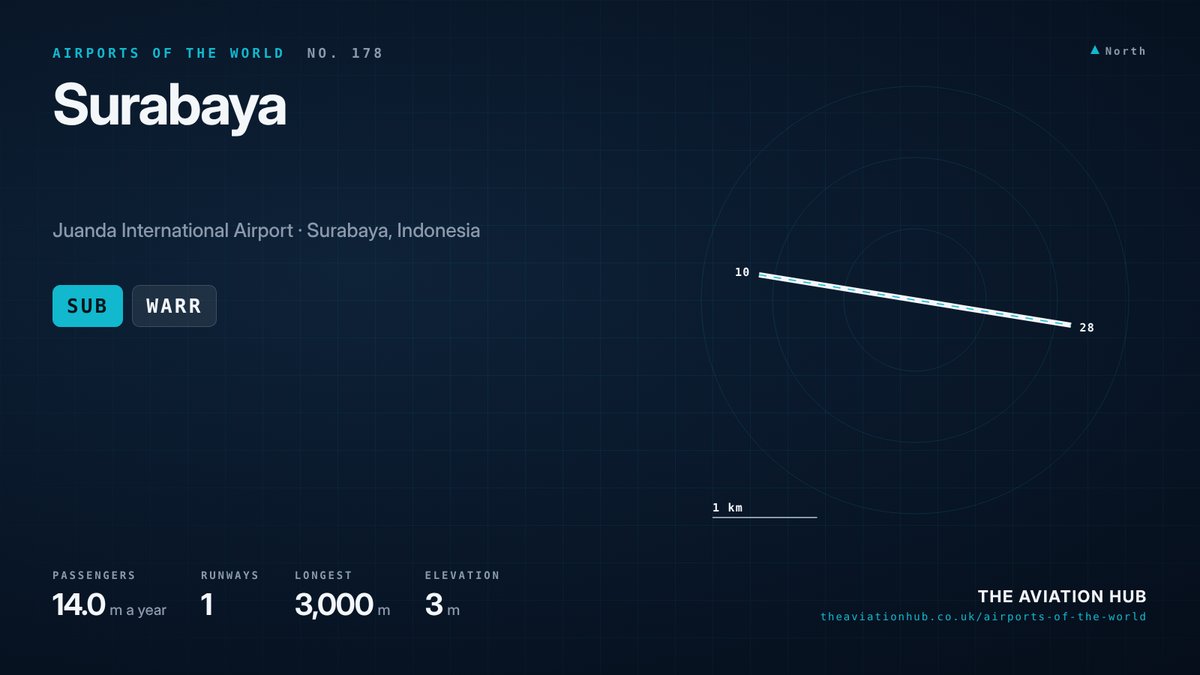
Surabaya Airport, formally Juanda International Airport, lies in the district of Sedati in Sidoarjo regency about 7.5 miles (12 km) south of the centre of Indonesia’s second city. It is the third busiest airport in the country and the gateway to East Java, handling around 14 million passengers a year, almost all of them on domestic routes. The field is also a working naval air station, which explains its single runway, its odd history and the museum full of old aircraft beside the terminal.
Surabaya Airport at a Glance
The codes are SUB and WARR. The airport sits just 3 m (9 ft) above sea level on the flat, marshy coastal plain beside the Madura strait, with fish ponds and reclaimed land on its eastern side. It has one runway, two passenger terminals and a cargo terminal opened in 2022. In 2024 Surabaya Airport recorded about 14.03 million passengers, a shade up on the previous year, along with roughly 81,000 tonnes of cargo.
Batik Air and Citilink both use the city as a hub, Garuda Indonesia treats it as a focus city and Lion Air and Super Air Jet keep bases here, so the Lion group and the Garuda group between them carry most passengers. InJourney Airports, the state company formerly known as Angkasa Pura I, runs commercial operations as a civil enclave on land owned by the Indonesian Navy. Flight status and transport details are on the airport’s official website.
How a Navy Base Became an Airport
Surabaya’s early flying took place at Morokrembangan on the northern waterfront, a seaplane and land base that had no room to grow. In the early 1960s the navy chose the flat ground at Sedati for a new air base, known as Project Waru, to support Operation Trikora in the dispute over western New Guinea. The base was named after Djuanda Kartawidjaja, the last prime minister of Indonesia, who had steered its finances through a crisis and died in November 1963. President Sukarno inaugurated it in 1964.
Garuda soon moved its commercial flights over from Morokrembangan, at first using a converted warehouse as a passenger terminal. The civil side grew steadily through the 1970s and 1980s, and international status followed in 1990, while the navy kept its squadrons on the far side of the runway. Two runways of about 3,850 m were planned at various points but never built.
The modern terminal, now Terminal 1, opened in 2006 and Terminal 2 for international flights followed in 2014. Two hard landings have marked recent years. An Adam Air Boeing 737 suffered structural failure after a heavy landing in 2007, and a Lion Air 737 bounced four times on touchdown in 2014, both without fatalities. Terminal 1 was expanded in 2021 to a capacity of around 8.7 million passengers a year.
Runways at Surabaya Airport
The airport has a single asphalt runway, 10/28, measuring 3,000 m (9,843 ft) by 45 m and running east to west across the site. For an airport of 14 million passengers this is a tight arrangement, and the runway handles airline traffic, naval patrol aircraft and training flights together. Arrivals on runway 10 come in from the west over the sprawl of Sidoarjo, while 28 brings aircraft in over the strait and the fish ponds.
The length is ample for the Boeing 737-800s and Airbus A320s that make up most of the traffic and for the wide bodies that appear on international and pilgrimage flights. The tropical weather delivers towering afternoon thunderstorms through the wet season from November to March, and holding and occasional diversions follow. Low lying ground means drainage is a constant concern after heavy rain.
The naval air station occupies the southern side, east of Terminal 2, and operates maritime patrol aircraft, transports and helicopters, with a Naval Aviation Museum open to visitors near the base gate. Civil and military movements share the one runway at Surabaya Airport.
Terminals and Airlines
Terminal 1 on the northern side of Surabaya Airport handles every domestic flight. Since 2023 that includes Garuda Indonesia, Indonesia AirAsia and Pelita Air, which moved across from Terminal 2 to concentrate domestic traffic in one building. Lion Air, Batik Air, Super Air Jet, Citilink and Wings Air fill the rest of the gates, and at peak times the building is crowded despite the 2021 expansion.
Terminal 2, opened in 2014 on the southern side on the site of the old terminal, handles all international flights. Indonesia AirAsia, Batik Air Malaysia, Malaysia Airlines, Singapore Airlines, Scoot, Cathay Pacific, Greater Bay Airlines, China Southern, Xiamen Airlines and Royal Brunei use it, with Saudia and Lion Air adding seasonal pilgrimage flights. A shuttle bus links the two terminals, which sit on opposite sides of the runway. All three global alliances are represented through carriers such as Singapore Airlines, Cathay Pacific and Saudia.
Routes and Destinations
Jakarta dominates. The combined Jakarta airports carried about 1.89 million passengers to and from Surabaya Airport in 2024, with Garuda, Lion, Batik, Citilink and Super Air Jet flying the 90 minute sector dozens of times a day, and the high speed railway has not yet reached East Java to challenge it. Denpasar follows with around 650,000 passengers and Makassar with roughly 519,000, then Balikpapan, Banjarmasin, Lombok, Kupang and the cities of Kalimantan and eastern Indonesia that depend on Surabaya as their link to Java.
Malaysia is the busiest international market at around 481,000 passengers, spread over Kuala Lumpur, Penang and Johor Bahru, with Singapore second at around 356,000. Hong Kong, Guangzhou, Shenzhen, Fuzhou and Brunei complete the scheduled network. Fuzhou, at roughly 2,350 miles (3,780 km), is the longest regular route. The Hajj and Umrah seasons bring Saudia and Lion Air wide bodies on flights to Jeddah and Medina, which at around 5,400 miles (8,650 km) are the longest flights of the year. Cargo is substantial for an Indonesian regional airport.
Getting to and from Surabaya Airport
There is no rail link. A station on the planned Surabaya to Sidoarjo commuter line is pencilled in for 2027 but remains at the feasibility stage. DAMRI buses run from both terminals to the Purabaya bus terminal at Bungurasih, to Bunder in Gresik and to Kertajaya in Mojokerto for a fare of around 30,000 rupiah (£1.50), and they are the cheapest sensible option at 45 minutes to an hour.
The 15 km Waru to Juanda toll road links the airport to the Surabaya ring road and the trans Java motorway, and the Aloha interchange works begun in 2022 are meant to clear the notorious bottleneck at its city end. A metered taxi to the centre takes 30 to 45 minutes and costs around 150,000 rupiah (£7.50), with ride hailing cars collected from a marked area. Both terminals have large surface car parks.
Spotting and Photography
Facilities for enthusiasts at Surabaya Airport are limited and the naval presence makes the fence line sensitive. The terminal windows give views of the domestic apron and aircraft taxiing to and from the runway. The roads and villages west of the airport sit under the approach to runway 10, and the fish pond embankments to the east offer wide shots of arrivals when runway 28 is in use.
The traffic is heavy on 737s and A320s in Lion, Batik, Citilink and Super Air Jet colours, with Garuda and Singapore Airlines wide bodies, Chinese carriers and the navy’s patrol aircraft for variety. Morning light favours the western approach and afternoons suit the eastern end. Photographing the naval air station is prohibited, so keep cameras pointed at civil aircraft, stay well back from the perimeter and expect to be moved on by security if you linger.
What Comes Next
The grand Juanda Airport City scheme approved in 2015 promised two new runways, a Terminal 3 and land reclaimed from the sea, but construction never started and the project has stalled. Surabaya Airport is instead squeezing more from what it has, with the 2021 Terminal 1 expansion, the 2022 cargo terminal and better road links. The single runway remains the hard limit, and any real growth needs a second strip and a settlement with the navy over land.
The field will keep growing on domestic demand from Java’s industrial heartland, but it is the Indonesian airport most in need of a new runway. Compare it with Jakarta and Bali on the Airports of the World map.
Continue to follow The Aviation Hub for more analysis and insight.
Advertise with us Your brand, in front of an aviation audience Home page and in-article placements, sold directly, one advertiser per slot. From £250 a year. See the rates

