Houston Hobby Airport sits about 7 miles (11 km) southeast of downtown Houston, hemmed in by freeways and suburbs on the flat Gulf coastal plain. It was the city’s main airport until Intercontinental opened in 1969, and today it is the second airport of the fourth largest city in the United States, with around 14 million passengers a year. Almost all of them fly Southwest Airlines, which has turned the old municipal field into one of its most important bases and its launch pad to Mexico, Central America and the Caribbean.
Houston Hobby Airport at a Glance
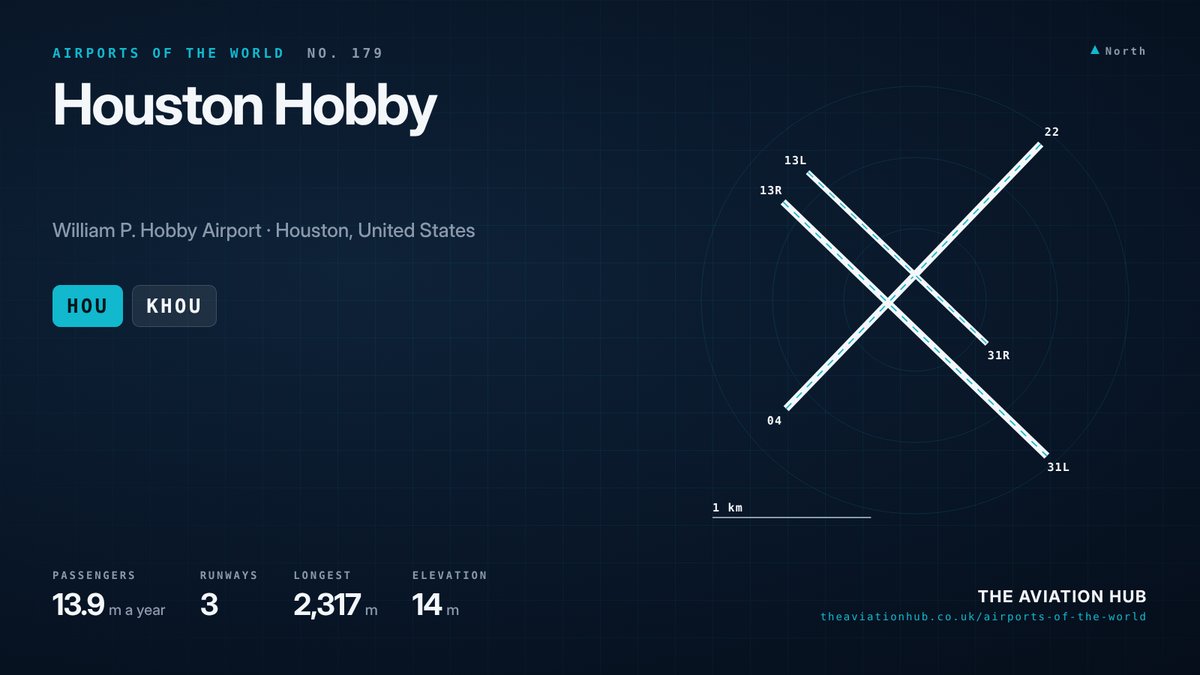
The codes are HOU and KHOU. The airport lies 14 m (46 ft) above sea level in the Gulf plain, close enough to the coast to feel every sea breeze and every hurricane. It has three runways, one terminal with two concourses and 30 gates, and the original 1940 art deco terminal preserved as a museum. In 2025 it handled about 13.94 million passengers, down roughly 4.6 per cent on the year before as Southwest trimmed its network.
Southwest carries around 95 per cent of passengers and operates its international flights from the West Concourse. Delta flies to Atlanta, American Eagle to Dallas Fort Worth, and Allegiant, JSX and seasonal Sun Country fill the remaining gates. The Houston Airport System, a department of the City of Houston that also runs Intercontinental and Ellington, operates the field. Parking rates and terminal maps are on the airport’s official website.
From Cow Pasture to City Airport
The field opened in June 1927 as a private landing strip in a 600 acre pasture known as W.T. Carter Field. The city bought it in 1937 and called it Houston Municipal Airport. A year later Howard Hughes, who had paid for improvements including the first control tower, had it renamed Howard R. Hughes Airport, but federal funding rules barred naming an airport after a living person and the old name returned. The art deco terminal that opened in 1940 still stands and houses the 1940 Air Terminal Museum.
The airport became Houston International in 1954 and took the name of former Texas governor William P. Hobby in 1967. Two years later every airline moved to the new Intercontinental Airport on the north side of the city and Houston Hobby Airport lost all scheduled service. In November 1971 a young Southwest Airlines brought jets back with Boeing 737 flights to Dallas Love Field, the start of a relationship that has defined the airport since.
The Central Concourse opened in 2003 and in October 2015 Southwest paid for a five gate international concourse and customs facility, ending Intercontinental’s monopoly on international flights. In 2020 Hobby became the first airport in Texas with full biometric entry and exit for international passengers, and Skytrax named it the first five star airport in North America in 2022.
Runways at Houston Hobby Airport
Three runways serve the field. Runway 04/22 is 2,317 m (7,602 ft) long and 46 m wide with a concrete surface and runs southwest to northeast. Runway 13R/31L matches that length at 2,317 m (7,602 ft) but is asphalt, and the shorter parallel 13L/31R measures 1,569 m (5,148 ft) by 30 m in concrete and serves general aviation and lighter traffic. The two long runways cross, so Houston Hobby Airport cannot run them independently at full capacity.
The prevailing southerly Gulf breeze means the 13 and 22 ends see most arrivals, with aircraft landing on 13R over the Gulfgate freeway junctions or on 22 over the eastern suburbs. Northerly winds behind winter cold fronts swing operations round to 04 and 31L. The 7,600 ft runways are ample for Southwest’s Boeing 737-700s, 737-800s and 737 MAX 8s on sectors to Central America, but they rule out the largest wide bodies and keep the airport firmly in the narrow body business.
The crossing layout has caused trouble. In October 2023 a business jet departed without clearance and its wing clipped a Cessna on the intersecting runway, with no injuries. A JSX Embraer ERJ-145 suffered a landing gear collapse on arrival in May 2024, injuring one crew member. Several fatal business jet and light aircraft crashes also mark the airport’s history.
Terminals and Airlines
One terminal building at Houston Hobby Airport faces Airport Boulevard, with ticketing and baggage claim on the ground floor and a single security checkpoint leading to both concourses. The Central Concourse, opened in 2003, has 25 gates and handles Southwest’s domestic operation along with Delta, American Eagle, Allegiant and Sun Country. The West Concourse, opened in 2015, has five gates with customs and immigration facilities and takes Southwest’s international flights.
Southwest has no alliance and no lounge, in keeping with its single class model, and the other carriers use shared gates. JSX operates from its own private terminal on the general aviation side, where passengers board its small jets from a lounge without passing through the main terminal. The terminal has been praised for its light, its local restaurants and its short walks, and the Skytrax rating reflected a building that works rather than one that impresses.
Routes and Destinations
Dallas Love Field is the busiest route from Houston Hobby Airport, as it has been since 1971, with around 417,000 passengers a year on Southwest’s hourly shuttle. Atlanta, split between Southwest and Delta, carries about 328,000, followed by Denver, Las Vegas and Phoenix at between 280,000 and 305,000 each. New Orleans, Chicago Midway, Nashville, Orlando, Baltimore and the Texas cities of Austin, San Antonio and Harlingen fill out a network that touches most of the Southwest map.
Internationally, Cancun leads with about 264,000 passengers, then San Jose del Cabo, San Jose in Costa Rica, Liberia and Puerto Vallarta, with Belize City and seasonal Montego Bay and Punta Cana completing the international list. San Juan in Puerto Rico, at around 2,000 miles (3,210 km), is the longest sector, ahead of seasonal Seattle and the Californian flights to Oakland, Sacramento and San Jose. Summer and spring break drive the Mexican and Caribbean peaks, and Houston’s energy trade keeps Dallas and Denver full all year. Cargo is minimal.
Getting to and from Houston Hobby Airport
Houston is a car city and the airport reflects it. Broadway Street and Airport Boulevard link the terminal to Interstate 45, the Gulf Freeway, and to Loop 610, and downtown is 15 to 25 minutes away outside the rush hours. A taxi to downtown costs around 30 dollars (£24) and ride share cars collect from Curb Zone 5, with taxis at Curb Zone 2. Hotel courtesy vans also leave from the kerb.
METRO bus route 73 is the cheapest sensible option, connecting the terminal with the Fannin South transit centre for the Red Line light rail into downtown and the Texas Medical Center, a journey of about an hour for a few dollars. Several other METRO routes serve the surrounding streets. Short stay parking sits in garages opposite the terminal and economy lots lie further out with shuttle buses.
Spotting and Photography
The 1940 Air Terminal Museum is the natural base for a day at Houston Hobby Airport. It sits on the general aviation side with a view of the ramp and the runways, hosts regular spotting and aviation events and keeps a small collection of aircraft outside. The upper levels of the terminal parking garages overlook the Central Concourse gates and the approach to runway 13R, and the public roads around the 04 and 22 ends offer arrival shots on the days when those runways are in use.
The traffic is almost entirely Boeing 737s in Southwest colours, with Delta Airbus A220s and 737s, Embraer regional jets and the business jet fleets of the energy companies for variety. Houston police patrol the perimeter regularly, so stay on public property, avoid the airfield fences and keep drones well away from the approaches.
What Comes Next
The big project is Southwest’s expansion of the West Concourse, announced in 2022 and under construction since November 2024. It adds seven gates, six for Southwest and one for other airlines, at a cost that has risen to about 470 million dollars, and is due to open in 2027. The city contributed 20 million dollars and Southwest the rest. Beyond that the crossing runways and the surrounding suburbs cap what Houston Hobby Airport can ever become.
The field will stay a busy, efficient narrow body airport tied to one airline’s fortunes, and the slight fall in 2025 traffic shows the risk in that. Compare it with Intercontinental and Dallas Love Field on the Airports of the World map.
Continue to follow The Aviation Hub for more analysis and insight.
Advertise with us Your brand, in front of an aviation audience Home page and in-article placements, sold directly, one advertiser per slot. From £250 a year. See the rates