
Sochi Airport Guide: Russia’s Black Sea Resort Gateway
Sochi Airport serves Russia's Black Sea resort coast with sea side approaches and two runways. Runways, routes, access and spotting explained.
 By The Aviation Hub
7 min read
Updated October 20, 2026
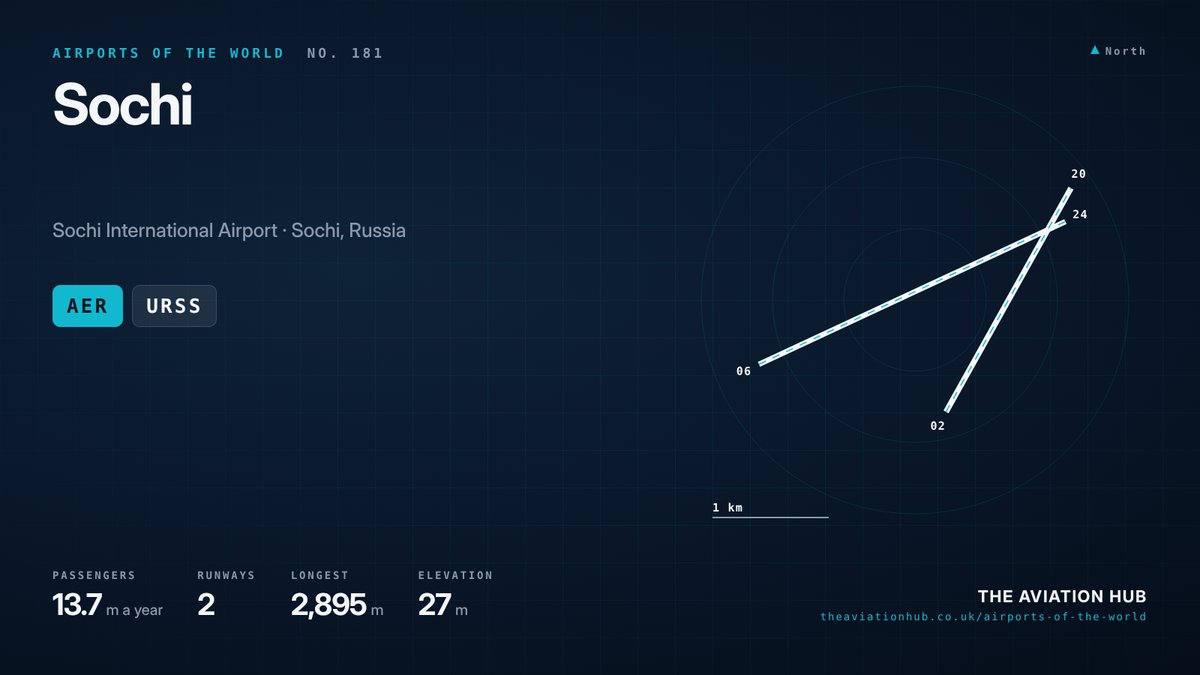
Sochi Airport sits at Adler on Russia’s Black Sea coast, wedged between the mountains of the Caucasus and the water. It is the gateway to the country’s best known summer resort and to the ski slopes above Krasnaya Polyana. The airport handled close to 14 million passengers in 2024, which makes it one of the five busiest in Russia. Its position, with high ground to the north and east, forces every approach and departure to run over the sea. That geography shapes everything about how the field operates.
Sochi Airport at a Glance
The IATA code is AER, from the Adler district in which the airport lies, and the ICAO code is URSS. The terminal is roughly 19 miles (30 km) southeast of central Sochi and only a few miles from the border with Abkhazia. Elevation is 27 metres (89 feet). There are two runways, one main passenger terminal that opened in 2007 and a separate VIP terminal built for the 2014 Winter Olympics.
Traffic at Sochi Airport in 2024 came to around 13.7 million passengers, slightly down on the previous year. Aeroflot, its subsidiary Rossiya, Pobeda, S7 Airlines, Ural Airlines and the Rostov based carrier Azimuth all put substantial capacity through the field. Azimuth lists more destinations from Sochi than any other operator. The airport is owned by Oleg Deripaska’s Basic Element through its Basel Aero airport holding company. Full timetables and parking tariffs are published on the airport’s official website.
How Sochi’s Airport Came to Be
The first airfield was built in a hurry between July and September 1941 on the land of a former state seed farm called Chernomorets. Its job was to defend the Black Sea coast during the Second World War. Civil operations began after the war and scheduled passenger service dates from 1957. For decades the airport was a Soviet holiday gateway, fed by Aeroflot Tupolevs from Moscow and Leningrad.
The modern era started in 2006 when the state sold the airport at auction for 5.5 billion roubles to a company linked to Oleg Deripaska’s Basic Element. The new owners spent more than 14 billion roubles between 2007 and 2013, opening the present three storey terminal in 2007 with ten air bridges and about 62,000 square metres of floor space. The 2014 Winter Olympics drove the final push, including a VIP terminal and new aprons. The airport handled more than 350,000 passengers in February 2014 alone.
Since 2022 the field has taken on a new role. With many Russian airports in the south closed to civil traffic, Sochi Airport became the only open gateway on that stretch of coast. Aeroflot announced a hub operation here in March 2022, using Rossiya Sukhoi Superjet 100s on short haul international routes.
Runways at Sochi Airport
Sochi Airport has two runways that cross each other. The main runway, 06/24, measures 2,895 metres (9,498 feet) and is 45 metres wide. The secondary runway, 02/20, is 2,500 metres (8,202 feet) long and 49 metres wide. Both are built on the flat delta of the Mzymta River, with the sea at one end and rising ground at the other.
The mountains to the north and northeast rule out any approach from the land side. Aircraft land towards the hills and depart towards the water, whichever runway is in use. That means a tailwind is often accepted on landing rather than a risky turn over terrain. Pilots treat the field as a demanding one, and the approach plates carry steep climb gradients for the missed approach.
The runway layout has been evolving, and published figures for both runways vary between sources. The Sochi Airport authority has also published plans to stretch 06/24 to 3.5 kilometres, with part of the extension crossing the Mzymta River itself. That would allow fully loaded wide body aircraft to depart in the heat of summer without payload penalties.
Terminals and Airlines
All scheduled flights use the single passenger terminal opened in 2007. It is laid out over three floors with check in and arrivals on the lower levels and departures above. Domestic traffic dominates, and the international section is small, with a modest duty free offer. Ten boarding bridges serve the busiest stands and a large number of remote positions handle the summer peaks.
Aeroflot and Rossiya hold the largest share, with Pobeda adding low cost frequencies to Moscow and the regions. S7 Airlines flies from its Novosibirsk and Moscow Domodedovo bases. Ural Airlines, Utair, Nordwind, Red Wings, Smartavia and Azimuth fill out the domestic network. Foreign carriers include flydubai, Etihad, Oman Air, Air Serbia, Belavia, Uzbekistan Airways and Armenia’s FlyOne, with Gulf Air and Jazeera Airways in season. The VIP terminal, about 4,000 square metres, handles government and business aviation.
Routes and Destinations
Moscow is the dominant market. All three main Moscow airports see multiple daily departures, and in summer the Sochi to Moscow corridor runs at the frequency of a shuttle. St Petersburg follows, then a long tail of Russian regional cities from Kazan and Yekaterinburg to Novosibirsk and Krasnoyarsk. The closure of nearby airports pushed demand for Krasnodar, Rostov and the Crimea through Sochi as well.
International flying centres on Turkey, with Istanbul and Antalya served year round, plus Dubai, Yerevan, Tbilisi, Belgrade, Tashkent and Minsk. Aeroflot’s 2022 hub plan promised 17 short haul international routes in six countries. The longest sectors are seasonal charters to Phuket, about 4,260 miles (6,860 km) away, and Red Wings flights to Mattala in Sri Lanka, while S7’s Irkutsk service is the longest domestic route. Traffic is strongly seasonal, peaking from June to September on the beach trade and again in January and February for the ski resorts. Cargo is minor compared with the passenger business.
Getting to and from Sochi Airport
Rail is the best option. Sochi Airport railway station stands next to the terminal, linked by a covered walkway, and Lastochka electric trains run to Adler, central Sochi and the Olympic Park. The journey to Sochi station takes about 45 minutes. Trains also run up the Mzymta valley to Rosa Khutor for the ski slopes.
Buses and marshrutka minibuses connect the terminal with Adler and the city centre and are the cheapest way to travel. Taxis are plentiful but agree the fare or use an app, since the coast road is slow in summer. The A147 highway runs along the shore and the drive to central Sochi takes 40 minutes to over an hour depending on traffic. Short stay and long stay car parks sit in front of the terminal.
Spotting and Photography
The sea side approach is the main attraction. Because every arrival comes in over the water, the beach at Adler gives a clear view of aircraft on final to runway 06 or 02, often with the mountains behind. The Imeretinsky embankment near the Olympic Park is a fine place to watch departures climb out over the Black Sea. Afternoon light favours the beach side for arrivals.
The terminal windows and the station footbridge offer views across the apron. There is no formal viewing terrace at Sochi Airport. Security attitudes in Russia are strict and photography near airport perimeter fences can draw attention, so stay on public ground, keep cameras away from fences and expect to be asked what you are doing. Be polite and move on if asked.
What Comes Next
The main project at Sochi Airport is the runway extension across the Mzymta River, which would give 06/24 a full 3,500 metres. Terminal capacity is the other pressure point, with summer peaks well above what the 2007 building was designed to handle. A second terminal phase has been discussed for years, and the owners have floated expansion to 20 million passengers.
The airport’s history carries a sombre thread. An Aeroflot An-10 struck mountains near the field in 1962, an Il-18 went into the sea after take off in 1972, and an Armavia Airbus A320 crashed during a go around in 2006. A military Tu-154 was lost in the sea in 2016 and a Utair Boeing 737-800 overran into the riverbed in 2018. The terrain and the water demand respect. Even so, Sochi Airport is heading towards more traffic, not less, as long as it remains the south’s open door. Compare it with other Russian and Black Sea gateways on the Airports of the World map.
Continue to follow The Aviation Hub for more analysis and insight.
Advertise with us Your brand, in front of an aviation audience Home page and in-article placements, sold directly, one advertiser per slot. From £250 a year. See the rates

