Nanning Airport, known in full as Nanning Wuxu International Airport, serves the capital of the Guangxi Zhuang Autonomous Region in the far south of China. The city sits close to the Vietnamese border, and the airport has been built up as the air gateway between China and the ASEAN countries. Around 13.5 million passengers used it in 2025. A striking Terminal 2, a third terminal under construction and a role as the hub of GX Airlines make it one of the more interesting mid sized airports in the country.
Nanning Airport at a Glance
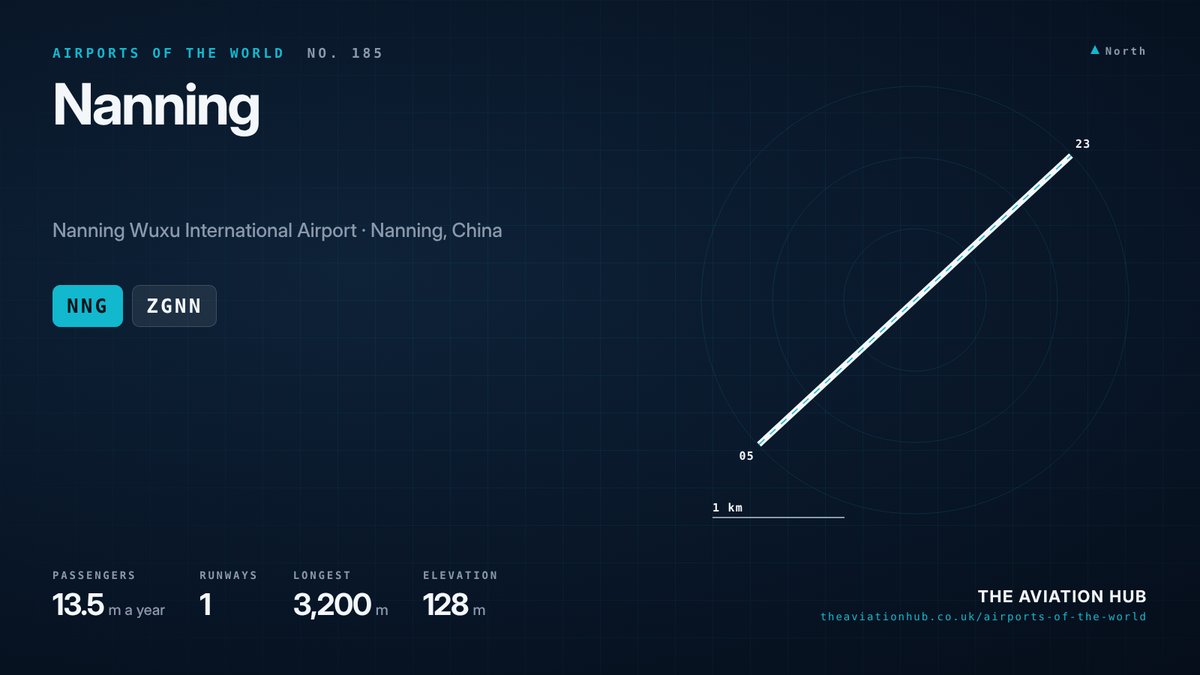
The IATA code is NNG and the ICAO code is ZGNN. The airport lies at Wuxu in the Jiangnan district, roughly 20 miles (32 km) southwest of central Nanning. Elevation is 128 metres (421 feet). The site is a joint civil and military field, and the air force still uses it as Nanning Air Base. Terminal 2 handles all scheduled passenger flights, and a third terminal is being built alongside it.
Passenger traffic in 2025 was about 13.5 million, a drop of around 3.6 per cent on the previous year, which placed the airport 33rd in China. Cargo throughput was roughly 187,000 tonnes. GX Airlines, a joint venture between Tianjin Airlines and the Guangxi government, is based here, and Shenzhen Airlines maintains a base. China Southern and Air China also run large schedules. The operator is Guangxi Airport Management Group. Flight details are posted on the airport’s official website.
From Military Airstrip to ASEAN Gateway
Aviation in Nanning began in 1929, when the New Guangxi Clique built Yongning Airfield for military use closer to the city. During the war against Japan it served the United States Fourteenth Air Force from 1942 to 1945, mainly with Lockheed P-38 reconnaissance aircraft, and closed in October 1945. In December 1949 retreating Nationalist aircraft strafed the fuel depot before the People’s Liberation Army took the field and renamed it Nanning Airport.
Civil flying used that airfield until November 1962, when operations moved to the new site at Wuxu because the old one was too close to the city. The runway was upgraded and extended by 300 metres in 1989. The apron was enlarged in 2006 to take Boeing 747s, and a new 3,200 metre runway opened in 2008, with the original strip becoming a taxiway. That work supported the China ASEAN Expo, which brings regional leaders to Nanning every year.
The airport took its present name in 2003. The modern chapter opened on 25 September 2014 with Terminal 2, a 189,000 square metre building whose double curved roof echoes a Han dynasty bronze lamp unearthed at Hepu. Terminal 3 began construction in January 2023.
Runways at Nanning Airport
Nanning Airport operates runway 05/23, a concrete strip of 3,200 metres (10,499 feet) and 45 metres width, opened in 2008. It handles everything from Comac ARJ21 regional jets to the Boeing 777 freighters and Airbus A330s that occasionally visit. The length is generous for the mix of narrow body domestic traffic and medium range international flights that make up the bulk of the schedule.
A second runway, 04/22, of 3,800 metres (12,467 feet), entered service in 2025 as part of the current expansion programme. It allows independent operations and should help lift the field’s capacity to the 34 million passengers that Terminal 3 is designed for. The original 1960s runway survives as a parallel taxiway.
Operations are straightforward. The terrain around Wuxu is gently rolling and the main weather hazards are the summer thunderstorms and low cloud of the subtropical wet season. Military flying from the shared base occasionally imposes short holds on civil traffic.
Terminals and Airlines
Terminal 2 is the only terminal in use for scheduled flights. It is laid out over three floors with 32 air bridges, split between a domestic concourse and a smaller international and regional pier for flights to Hong Kong, Macau and Southeast Asia. The building is bright and spacious, and it was designed with the ASEAN link in mind.
GX Airlines is the home carrier and flies Embraer E190s and Airbus A320 family aircraft across southern and central China. GX has the longest destination list from Nanning, and China Southern, Shenzhen Airlines and Air China also run large schedules. Other regular operators include China Eastern, Hainan Airlines, Xiamen Airlines, Sichuan Airlines, Spring Airlines and Juneyao. Foreign carriers include AirAsia, Scoot, Royal Brunei, Lao Airlines, Air Cambodia and Air Macau. The old Terminal 1 has been retired from passenger use.
Routes and Destinations
Domestic routes carry the overwhelming majority of traffic at Nanning Airport. Beijing, Shanghai, Guangzhou, Shenzhen, Chengdu, Chongqing, Hangzhou, Xi’an, Kunming and Haikou are the heavyweights, most served several times a day.
The international board is the airport’s point of difference. Hanoi, Ho Chi Minh City, Bangkok, Kuala Lumpur, Singapore, Vientiane, Phnom Penh, Yangon, Manila and Bandar Seri Begawan have all appeared on the schedule, alongside Hong Kong and Macau. Hanoi, under 200 miles away, is the shortest international sector. Singapore and Kuala Lumpur are the longest regular international flights, but China Southern’s Urumqi service, at about 1,890 miles (3,035 km), is longer still. Traffic peaks around Chinese New Year and the China ASEAN Expo in September. Cargo is growing on fresh produce and electronics bound for Southeast Asia.
Getting to and from Nanning Airport
Rail is the newest option. Wuxu Airport railway station on the Nanning to Pingxiang high speed line sits beside the terminal and links the airport with the city. Trains continue south towards the Vietnamese border at Pingxiang.
Two airport bus lines are the cheapest choice. Line 1 runs to the Chaoyang Road ticket office near Nanning Railway Station and Line 2 serves Wuxiang Square in the new business district. The journey takes 45 minutes to an hour. Taxis use the Wuxu Expressway and reach the centre in around 40 minutes outside peak hours. Multi storey and surface car parks stand in front of Terminal 2.
Spotting and Photography
Nanning Airport is a quiet spotting venue by Chinese standards, which is both a blessing and a problem. The terminal’s upper level windows look across the apron and offer the best views of the GX Airlines and China Southern fleets. Glass reflections are an issue, so a lens hood or rubber cup helps.
Outside, the approach to runway 05 passes over farmland southwest of the field, and country roads near the villages give clear views of arrivals in the morning when the light is from the east. Runway 23 approaches cross the expressway side. The military presence means the authorities are sensitive about cameras near fences and hangars. Stay well back from the perimeter, avoid photographing military aircraft and be ready to show identification if asked.
What Comes Next
Terminal 3 is the headline project. Construction began in January 2023 and completion is expected in 2027, with a design capacity of 34 million passengers a year, more than double today’s throughput. The new runway, a larger international zone and better rail integration are all part of the plan to turn Wuxu into the gateway of the Belt and Road corridor into Indochina.
The challenge is demand. Passenger numbers dipped in 2025 and the city competes with Guangzhou, Shenzhen and Kunming for Southeast Asian traffic. Even so, the policy support is strong and the infrastructure is arriving ahead of need. Nanning Airport is heading for a much bigger future than its current traffic suggests. See it in context on the Airports of the World map.
Continue to follow The Aviation Hub for more analysis and insight.
Advertise with us Your brand, in front of an aviation audience Home page and in-article placements, sold directly, one advertiser per slot. From £250 a year. See the rates