
Naples Airport Guide: Capodichino, Vesuvius and the Bay
Naples Airport at Capodichino is Italy's fourth busiest, squeezed into the city beneath Vesuvius. History, runway, routes, access and spotting explained.
 By The Aviation Hub
6 min read
Updated October 20, 2026
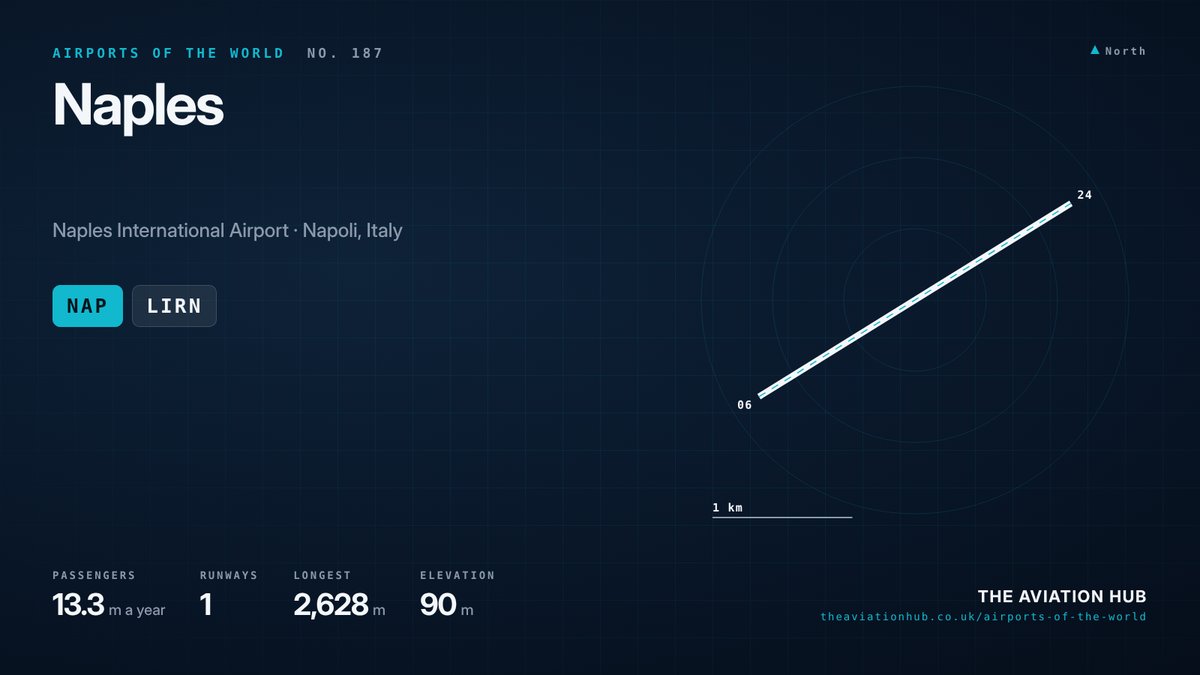
Naples Airport, officially Aeroporto di Napoli Capodichino, is the air gateway to Campania, the Amalfi Coast, Pompeii and the islands of the Bay of Naples. It sits inside the city, barely four miles from the centre, on a plateau beneath Vesuvius. Around 13.3 million passengers used it in 2025, which made it the fourth busiest airport in Italy and the busiest in the south of the country. One short runway, one terminal and a crowded urban site make it an airport that punches far above its physical size.
Naples Airport at a Glance
The IATA code is NAP and the ICAO code is LIRN. The terminal is about 4 miles (6 km) northeast of the city centre and the port. Elevation is 90 metres (294 feet). There is a single runway, 06/24, and a single passenger terminal, Terminal 1, with 22 gates. The United States Navy occupies buildings in the north western corner of the field, beside an adjacent base of 41 hectares.
Passenger traffic in 2025 reached roughly 13.3 million. easyJet, Ryanair, Volotea and Wizz Air all base aircraft here, and ITA Airways, Lufthansa, British Airways, Air France and KLM provide the legacy links. The airport is run by GESAC, controlled by the 2i Aeroporti group, and in 1997 it became the first privatised airport in Italy. Current timetables are on the airport’s official website.
A Short History of Capodichino
Flying at Capodichino began on 5 May 1910 with aircraft demonstrations on the old Campo di Marte parade ground. Two years later the aviator Rosina Ferrario dropped red carnations over the city from the field. A Zeppelin raid on Naples in 1918 prompted the military to expand the airfield, and in June 1921 it was named after Ugo Niutta, a pilot killed in the First World War. The name still appears in the official title.
The Second World War brought heavy Allied use after the capture of Naples in 1943. Civil traffic began in 1950, with Alitalia and the domestic carriers linking the city to Rome and Milan. A charter terminal, Terminal 2, opened in 1995 and was demolished in 2015 to make room for the metro station. Privatisation in 1997 handed a majority stake in GESAC to BAA of Britain, bringing a run of investment in the terminal, and control passed to the Italian fund F2i in 2010.
The low cost era transformed the airport. easyJet arrived in the early 2000s, Ryanair later built a large base, and Wizz Air and Volotea followed. Seasonal transatlantic flights from United, Delta, American and Air Canada followed, and 2025 brought a new record.
Runways at Naples Airport
Naples Airport has one asphalt runway, 06/24, of 2,628 metres (8,622 feet) and 45 metres width. It is short for an airport of this traffic, and the surrounding hills and housing leave no room to extend it. Both ends have instrument landing systems and PAPI lights. The limit shows on the transatlantic flights, where Boeing 767s and 787s to New York sometimes carry payload restrictions in hot weather.
Runway 24 is the usual direction, with aircraft approaching over the eastern suburbs and Vesuvius off to the left. Departures climb straight out over the bay towards Capri before turning. Runway 06 operations bring arrivals in from the sea with the city spread below and send departures out over the northern districts, where noise complaints are routine. Night flights are restricted.
The single runway runs close to its practical capacity in the summer peaks, with slots tightly controlled. The US Navy’s Capodichino base uses the same runway for transport and liaison aircraft, adding a Gulfstream or a C-130 to the civil mix.
Terminals and Airlines
All flights at Naples Airport use Terminal 1, which has grown through repeated extensions into a long, low building with 59 check in desks, 16 eGates and 22 gates on two piers. Schengen and non Schengen areas are separated upstairs. The terminal hosts a permanent Archaeological Airport exhibition, opened in 2016, that displays statues loaned by the museums of Naples and Capua.
Ryanair and easyJet are the largest carriers, followed by Wizz Air and Volotea. ITA Airways runs the Rome and Milan shuttles. Lufthansa, Swiss, Austrian, British Airways, Air France, KLM, Iberia Express, Aegean, Turkish Airlines and flydubai cover the full service market, with Vueling and Transavia adding low cost links. United, Delta, American and Air Canada operate seasonal North American routes. Lounges are modest, with a single pay in lounge airside.
Routes and Destinations
Milan Malpensa is the busiest route from Naples Airport, with more than 800,000 passengers in a typical year, while Milan Linate, Bergamo, Venice and Catania fill out the domestic trunk. Paris Orly and Barcelona lead the international list, each above 300,000 passengers, followed by London Gatwick, Madrid and Munich. The British market is large, with several London airports and the northern cities served daily in summer.
Long haul is seasonal. New York JFK and Newark, Atlanta, Chicago, Philadelphia and Montreal run from spring to autumn, and Delta’s Atlanta flight, at about 5,150 miles (8,285 km), is the longest sector. Dubai, Istanbul, Casablanca and Tel Aviv are flown year round. Summer dominates, with July and August bringing twice the winter traffic. Cargo is small, as freight for the region goes by road from Rome and Milan.
Getting to and from Naples Airport
The Alibus, run by ANM, is the cheapest and simplest option. It leaves from outside arrivals and runs to Piazza Garibaldi, by the central station, and on to Piazza Municipio at the port in about 30 minutes. Tickets cost €5 (roughly £4.30). Regional coaches run to Caserta, Salerno, Sorrento, Avellino and Benevento.
Taxis use fixed fares to the centre and the port, which avoids arguments, and the journey takes 15 to 25 minutes. Road access is via the A56 Tangenziale ring road, which connects to the motorways to Rome, Caserta, Salerno and Bari. Parking is tight, with a multi storey and surface car parks close to the terminal. There is no rail link yet, but a Line 1 metro station at Capodichino is under construction and due to open in 2027.
Spotting and Photography
Naples Airport offers some of the most dramatic backdrops in Europe. Arrivals on runway 24 pass over the north eastern suburbs around Casoria, and the roads and rooftops there give views of aircraft on final with Vesuvius behind. The terminal’s windows look over the main apron and are fine for the Ryanair and easyJet fleets and the visiting wide bodies.
On the city side, the hill at Capodimonte and its park show arrivals on runway 06 and departures from runway 24 over the rooftops, though they are distant. Morning light favours the eastern approach and evenings the city side. The US Navy base is strictly off limits for photography, and Italian police are sensitive about cameras near the perimeter. Stay on public roads, keep away from the base fences and be prepared to show identification.
What Comes Next
The metro station is the main project. Built on the site of the old Terminal 2, it is due to link the airport directly to Line 1 and the city centre in 2027. Terminal upgrades continue in stages, with more eGates and a reworked security hall. Wizz Air is adding a string of new routes from the winter of 2026 and the transatlantic carriers keep coming back each summer.
Capacity is the problem. The single runway and the hemmed in site cap growth, and GESAC, which absorbed Salerno Costa d’Amalfi in 2019, runs it as a second airport for Campania. Naples Airport will stay the main gateway, but the next phase of growth may be shared. Compare its constraints with Rome and Milan on the Airports of the World map.
Continue to follow The Aviation Hub for more analysis and insight.
Advertise with us Your brand, in front of an aviation audience Home page and in-article placements, sold directly, one advertiser per slot. From £250 a year. See the rates

