
Tenerife South Airport Guide: Reina Sofia and the Sun Routes
Tenerife South Airport handles almost 14 million passengers a year, many from the UK. Explore its history, runway, airlines, routes, buses and spotting.
 By The Aviation Hub
6 min read
Updated October 20, 2026
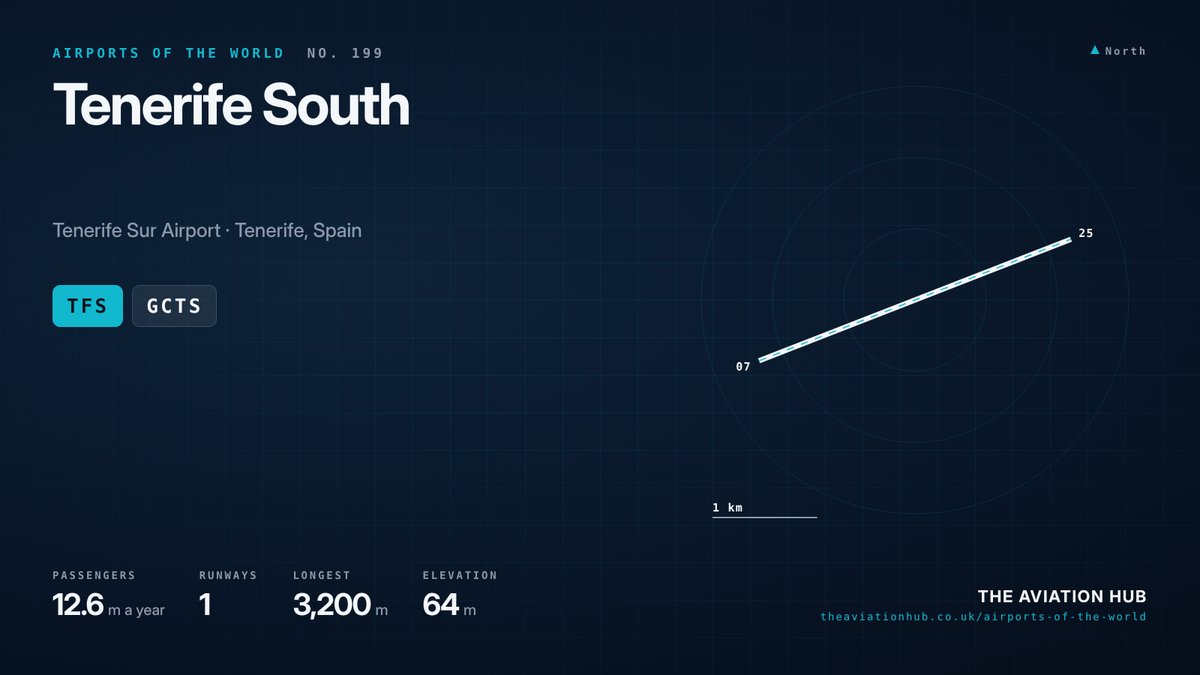
Tenerife South Airport, officially Tenerife Sur Reina Sofia Airport, is the main holiday gateway to Tenerife in the Canary Islands. It sits on the dry southern coast near Granadilla de Abona, a short drive from the resorts of Los Cristianos, Playa de las Americas and Costa Adeje. Almost 14 million passengers used it in 2025, and British travellers make up a large share of them. Its origins lie in one of the darkest days in aviation history.
Tenerife South Airport at a Glance
The IATA code is TFS and the ICAO code is GCTS. The airport lies about 37 miles (60 km) southwest of Santa Cruz de Tenerife and roughly 10 miles (16 km) east of the main resorts. Elevation is 64 metres (209 feet). There is a single runway and one terminal building with 40 gates, ten of them with jet bridges.
Tenerife South Airport handled 13,969,678 passengers in 2025, up 1.7 per cent on 2024. That makes it the second busiest airport in the Canary Islands after Gran Canaria. Ryanair has an operating base here, while Jet2, easyJet and TUI run heavy schedules from Britain. Aena, the Spanish state airport operator, owns and runs the airport. Flight information and parking details are on the airport’s official website.
How Tenerife’s Southern Airport Came to Be
For decades the island relied on Los Rodeos, now Tenerife North, high in the hills near La Laguna. Cloud and fog regularly swallowed the field, and it lacked the equipment to cope with low visibility. On 27 March 1977, two Boeing 747s collided on its runway in thick fog, killing 583 people.
Work on a second airport on the sunny, flatter south coast was already under way, and the disaster gave it fresh urgency. The new field opened on 6 November 1978, less than two years after the collision. The first arrival was an Iberia DC-9, flight IB187 from Lanzarote, which touched down at 10:17. Queen Sofia inaugurated the airport, which is why it carries the name Reina Sofia.
The south quickly became the island’s charter airport as package tourism boomed. Viasa added flights to Caracas in June 1980, reflecting the deep ties between the Canaries and Venezuela. The terminal has been extended several times since, and Tenerife North now concentrates on inter island and domestic flights.
Runways at Tenerife South Airport
Tenerife South Airport has one asphalt runway, 07/25, which is 3,200 metres (10,499 feet) long and 45 metres wide. It runs roughly west to east, parallel to the coast. The length comfortably handles the Boeing 787 and Airbus A330 on long haul services as well as the narrow body fleets that dominate.
The northeasterly trade winds mean runway 07 is in use most of the time. Arrivals approach from the southwest, close to the coast, and departures climb out over the coast near El Medano before turning. When the wind swings round, runway 25 brings arrivals in over the coast near El Medano.
A single runway carries every movement, and the ramp fills quickly on Saturday and Sunday peaks. Weather is rarely a problem compared with the north of the island, which was the point of building here. Gusty trade winds can still make for lively landings on some days.
Terminals and Airlines
The single terminal spreads over three floors. The ground floor holds check in, departure lounges, arrivals and baggage reclaim, while the upper floor carries offices and transit corridors. The basement adds extra baggage belts. Ten gates have jet bridges, and the rest use buses or walk out boarding.
Ryanair is the largest airline at Tenerife South Airport, flying Boeing 737-800 and 737-8200 aircraft from its base. Jet2 and easyJet compete closely on British routes with Boeing 737-800 and Airbus A320neo jets, and TUI flies 737 MAX and 787 aircraft. Wizz Air, Norwegian, Vueling, Transavia, Condor and Eurowings complete a broad European line up.
Routes and Destinations
Britain dominates the route map. Manchester was the busiest route in 2023 with 963,741 passengers, followed by London Gatwick with 712,288, London Stansted with 519,686, Birmingham with 393,055 and Bristol with 369,394. Madrid was the busiest domestic route with 417,917 passengers. Germany, Scandinavia, Belgium, the Netherlands and Ireland supply most of the rest.
Winter is peak season, when northern Europeans chase guaranteed sun. United linked Newark with the island from June 2022 to May 2025. Air Serbia added Belgrade flights from September 2026, and easyJet resumed Newcastle in August. Air Canada flies seasonally to Toronto from 26 October 2026 and to Montreal from 1 November, the longest routes from the airport.
Getting to and from Tenerife South Airport
There is no rail link to Tenerife South Airport, so buses and road transport carry everyone. The TF-1 motorway runs past the terminal, linking it with the resorts to the west and Santa Cruz to the northeast. Los Cristianos and Playa de las Americas are around 20 minutes away by car, and Santa Cruz roughly 45 minutes to an hour.
TITSA buses run from outside arrivals to Los Cristianos, Playa de las Americas, Costa Adeje, Santa Cruz and Puerto de la Cruz. Fares are a few euros, which makes the bus the cheapest sensible option. Taxis wait outside the terminal and charge metered fares. Car hire desks sit in the arrivals halls, and many tour operators include coach transfers. Parking is available in front of the terminal.
Spotting and Photography
Montana Roja, the red volcanic cone beside El Medano beach, is a favourite with photographers. Its summit gives elevated views of departures from runway 07 climbing out over the coast. The beaches and promenade at El Medano are also good places to watch, with kite surfers in the foreground.
Light favours the southern side of the runway for most of the day, because the sun stays in the southern sky. Winter weekends bring the widest variety, from British and Scandinavian charters to occasional wide bodies. Montana Roja is a protected natural area, so stay on marked paths. Keep clear of perimeter fences and follow instructions from the Guardia Civil and airport staff. Respect local rules at all times.
What Comes Next
A second runway at Tenerife South Airport has been proposed for years, but it remains on hold amid environmental objections and political debate on the island. Aena has focused instead on improving the terminal, the aprons and passenger flows. A railway linking Santa Cruz, the airport and the southern resorts has also been planned for years without being built.
Tourism pressure is a live issue in the Canaries, with residents protesting about housing and overcrowding. Tenerife South Airport is heading for steadier, more modest growth as long haul links from North America add new markets. Explore other island airports on the Airports of the World map.
Continue to follow The Aviation Hub for more analysis and insight.
Advertise with us Your brand, in front of an aviation audience Home page and in-article placements, sold directly, one advertiser per slot. From £250 a year. See the rates

