
New Orleans Airport Guide: Jazz, Floods and a New Terminal
New Orleans Airport sits barely above sea level in Kenner, Louisiana. Read about its 2019 terminal, its routes, its stormy history and the best spotting.
 By The Aviation Hub
6 min read
Updated October 20, 2026
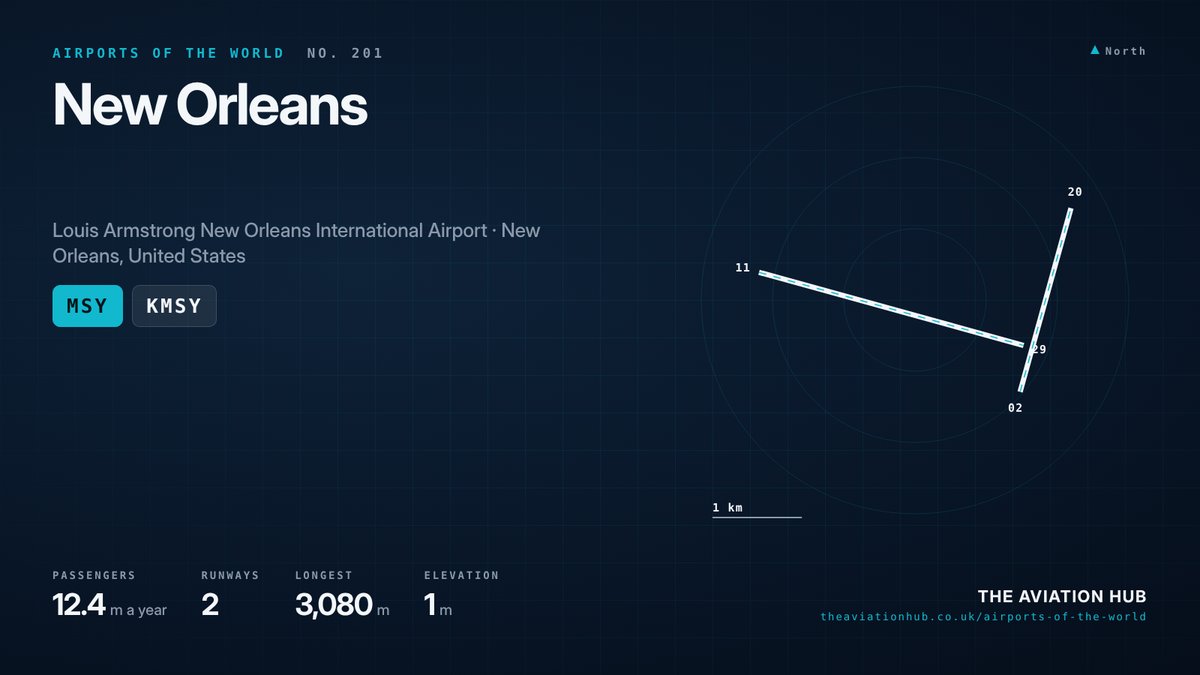
Louis Armstrong New Orleans International Airport is the main gateway to Louisiana and to one of the most visited cities in the American South. It lies in the suburb of Kenner, around 11 miles (18 km) west of the French Quarter, on reclaimed land barely above sea level. Around 12 million passengers a year pass through New Orleans Airport, most of them on Southwest, Delta and American. A striking $1.3 billion terminal opened in 2019 and replaced a building that dated from 1959. Its history is also a story of hurricanes.
New Orleans Airport at a Glance
The codes are MSY and KMSY. The IATA code is a relic of the Moisant Stock Yards that occupied the site a century ago. The field sits at just 4 ft (1 m) above mean sea level, lower than any international airport except Amsterdam Schiphol and Atyrau in Kazakhstan. It covers around 1,500 acres between Interstate 10 and the Mississippi River levee.
New Orleans Airport has two runways and one terminal with three concourses and 35 gates. The 2025 total was around 12.4 million passengers, down roughly 5 per cent on 2024 and short of the 2019 record. Southwest carries about a third of all traffic, with Delta and American at about 17 per cent each. Breeze Airways has an operating base here. The City of New Orleans owns the airport through its Aviation Board. Flight information and parking rates are on the airport’s official website.
A Short History of Moisant Field
Planning began in 1940 once New Orleans Lakefront Airport, built on fill in Lake Pontchartrain in 1934, proved too small for the coming airliners. The chosen site in Kenner had been a stockyard named for John Moisant, a pioneer aviator who died in a crash there in 1910. The government used the half built field as an air base during the Second World War. Commercial flights began in May 1946 under the name Moisant Field.
A new terminal opened in 1959, and in 1961 the city renamed the field New Orleans International Airport. A 1947 hurricane had already put the whole site under two feet of water, a warning that would be repeated. In July 2001 the airport took the name of Louis Armstrong on the hundredth anniversary of the trumpeter’s birth.
Hurricane Katrina in August 2005 turned the terminal into a field hospital and evacuation centre. Flights resumed on 13 September 2005, but traffic only regained its 2004 level in 2014. The city approved a wholly new terminal on the north side of the field in December 2015, and it opened in November 2019.
Runways at New Orleans Airport
Runway 11/29 is the main strip at 3,080 m (10,104 ft) long and 46 m (150 ft) wide. It handles the overwhelming majority of movements, including the British Airways Boeing 787 from London. Its western end pokes into St Charles Parish, and its eastern threshold sits close to the old terminal and Airline Highway.
Runway 02/20 crosses it at 2,134 m (7,002 ft) and the same width. It serves as a crosswind runway when strong northerly or southerly winds blow, and it takes general aviation and business jet traffic. Two small helipads, H1 and H2, complete the airfield.
The low elevation and high water table shape everything at New Orleans Airport. Drainage pumps run constantly, and the whole field relies on the parish levee system to stay dry. Pan Am Flight 759 crashed into Kenner in July 1982 after hitting a microburst on departure from Runway 10, as it was then numbered, and the accident helped drive the wind shear detection systems now fitted at airports worldwide.
Terminals and Airlines
The 2019 terminal at New Orleans Airport, designed by Cesar Pelli’s practice, stands on the north side of the airfield beside Interstate 10. Departures are on Level 3, security on Level 2 and arrivals on Level 1, under a long curving roof that recalls the Mississippi. Three concourses, A, B and C, branch off a central hall full of local food, from Leah’s Kitchen to Cafe du Monde.
Concourse A holds the federal inspection facility, so it handles the international arrivals from British Airways and Air Canada. Southwest, by far the biggest airline here, shares Concourse B with American and runs daily banks of Boeing 737-800s and 737 MAX 8s. Delta flies from Concourse C, where its Sky Club sits at the entrance. Breeze, Frontier, JetBlue, Allegiant, Alaska and Sun Country take the remaining gates, and allocations shift with the seasons.
The 1959 terminal on the south side of the field stands empty beside the car rental centre. A dedicated cargo apron hosts FedEx, UPS, DHL and Amazon Air.
Routes and Destinations
Nonstop service covers around 60 destinations. Atlanta is comfortably the busiest route at almost 600,000 passengers a year, driven by Delta’s hub bank. Houston Intercontinental, Dallas Fort Worth and Orlando follow, each carrying around 290,000 to 340,000 passengers. Denver, Dallas Love Field, Chicago and Charlotte are also strong.
International flying is thin but growing. British Airways resumed London Heathrow in 2017 with the 787 and still flies it several times a week, making it the longest route at around 4,600 miles (7,400 km). Air Canada serves Toronto, and Southwest and Breeze serve Cancun. Mardi Gras and Jazz Fest bring the two biggest surges of the year, and schedules slump in the humid late summer.
Getting to and from New Orleans Airport
There is no rail link, and no credible plan for one. Interstate 10 passes the terminal’s front door, and a new flyover interchange at Loyola Drive has cut the queues that plagued the terminal’s first years. Driving to the Central Business District takes around 25 minutes in good traffic and 45 or more at rush hour.
The cheapest option is the RTA Airport Express bus, Route 202, which runs downtown for a few dollars in around 40 minutes. Jefferson Parish Transit route E1 serves Kenner and Metairie. Taxis charge a flat rate of around $36 (£28) for one or two passengers to the French Quarter, and rideshares cost slightly less.
Short term parking sits in the garage opposite the terminal, with economy lots a shuttle ride away. New Orleans Airport is roughly 350 miles (560 km) by road from Houston, yet the Houston routes still rank among the busiest.
Spotting and Photography
New Orleans Airport is not a classic spotting destination, but it rewards patience. The terminal’s landside roadway and the upper level of the parking garage look out over the ramp and Concourse C. The glass walls of each concourse give close views of the gates, and of the British Airways 787 when it parks on Concourse A in the late afternoon.
Outside the fence, the approach to Runway 29 passes low over the homes of Kenner to the east, while the approach to Runway 11 comes in over the wetlands to the west. Light favours the south side of the field for most of the day. Summer haze flattens long lens shots, so winter gives the clearest air.
Respect the residential streets, park legally and keep away from the perimeter fence. Airport police and Kenner officers patrol, and a polite explanation usually ends any conversation.
What Comes Next
The 2019 terminal was designed for growth, with room to extend its concourses. The gate count already grew from 30 to 35 during construction, and the Aviation Board expects to add more once traffic climbs back past the 2019 peak. The runways need little beyond routine resurfacing, which has kept 02/20 closed for spells in recent years.
The bigger question is climate. Rising seas and stronger hurricanes threaten a field that sits at sea level behind a levee, so every master plan now begins with drainage and flood protection. The old south side terminal site is earmarked for redevelopment.
New Orleans Airport is a mid sized field with an outsized role, and its future depends as much on the levees as on the airlines. See how it compares with its Gulf Coast neighbours on the Airports of the World map.
Continue to follow The Aviation Hub for more analysis and insight.
Advertise with us Your brand, in front of an aviation audience Home page and in-article placements, sold directly, one advertiser per slot. From £250 a year. See the rates

