
Catania Airport Guide: Sicily’s Busiest Gateway Under Etna
Catania Airport handles more than 12 million passengers a year in the shadow of Mount Etna. Read about its runway, terminals, routes and rail link.
 By The Aviation Hub
6 min read
Updated October 20, 2026
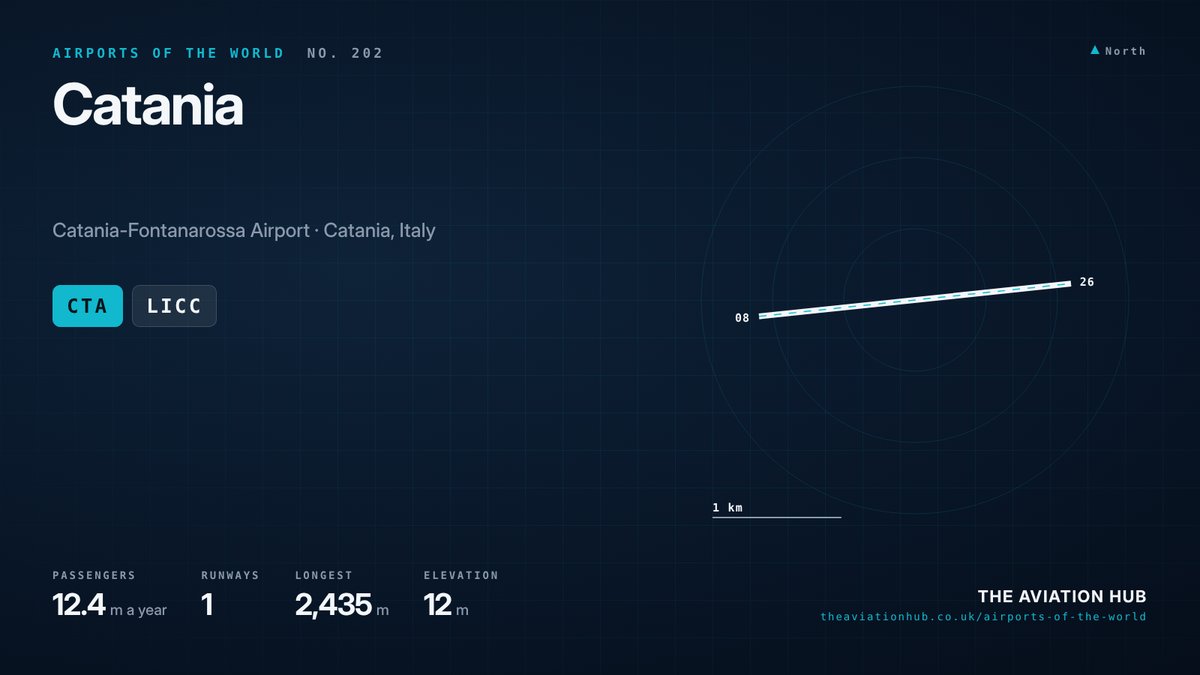
Catania Fontanarossa is the busiest airport in Sicily and one of the busiest in southern Italy. It sits on the coastal plain just south of the city, with the smoking cone of Mount Etna filling the northern horizon. Catania Airport handled around 12.4 million passengers in its latest reported year, most of them on Ryanair, easyJet, ITA Airways and Wizz Air. A short runway, a volcano next door and a 2023 terminal fire make it one of the more eventful fields in Europe.
Catania Airport at a Glance
The codes are CTA and LICC. The airfield lies in the Fontanarossa district, roughly 2.7 miles (4.3 km) south west of the city centre, which makes it one of the closest major airports to a city centre in Italy. Elevation is 39 ft (12 m), and the sea lies a few hundred metres beyond the eastern perimeter. The official name honours Vincenzo Bellini, the composer born in Catania in 1801.
Catania Airport has a single runway and three passenger terminals, A, B and C. Traffic reached about 12.35 million passengers with roughly 82,500 aircraft movements, which places it among the five busiest airports in Italy. Ryanair and Wizz Air both base aircraft here, easyJet has its own terminal, and ITA Airways runs a dense shuttle to Rome. SAC, the Societa Aeroporto Catania, operates the field under a long concession. Live flight information is on the airport’s official website.
A Short History of Fontanarossa
Aviation on the Fontanarossa plain began in 1924, which made it the first airport in the region. The Allies seized it during the invasion of Sicily in 1943, and the United States 340th Bombardment Group flew B-25 Mitchells from its strip during the Italian campaign. Civil control returned after the war, but the original field was cramped, so a larger airport opened on the present site in 1950.
The old terminal struggled by the 1990s, and the modern Terminal A opened in 2007 with 22 gates and six air bridges. Ryanair arrived in 2013 and changed the traffic mix for good. Terminals B and C followed in 2018, with Terminal C handed over entirely to easyJet.
Ash from Etna closes the airport several times in a bad year, usually for less than a day, with flights diverted to Comiso and Palermo. In July 2023 a fire gutted part of Terminal A and forced three weeks of diversions before normal operations resumed on 5 August.
Runways at Catania Airport
There is one runway, 08/26, which measures 2,435 m (7,989 ft) long and 45 m wide with an asphalt surface. That is a modest length for an airport of this size, and it rules out the heaviest long haul aircraft at full weight. Airbus A320 family jets and Boeing 737s dominate.
Runway 08 points towards the sea and is the preferred direction when the wind allows, with aircraft arriving over the plain south of the city. Departures from 08 climb out over the Ionian Sea, which keeps noise away from the dense suburbs to the north. The sea breeze in summer afternoons often swings operations between the two ends during the day.
Capacity at Catania Airport is fixed by that single strip and by the apron, not by the terminals. Peak summer Saturdays run close to the limit, and any Etna eruption or thunderstorm quickly backs up the schedule.
Terminals and Airlines
Terminal A is the main building and handles the bulk of the traffic. It serves ITA Airways, Lufthansa, KLM, Air France, Swiss, Austrian and Aegean, along with Ryanair, Wizz Air, Volotea, Vueling and Transavia. The fire of 2023 led to a partial rebuild of the departure areas.
Terminal B stands next door and absorbs overflow and some seasonal and charter flights. Terminal C is the easyJet building, a low cost facility with its own check in and security that opened in 2018. There are no alliance hubs here, so lounges are limited to pay on entry rooms in Terminal A.
Ryanair is the largest airline at the field with a large base of Boeing 737-800s and 737 MAX 8s. Wizz Air bases Airbus A321neos, and easyJet flies Airbus A320 family jets from its own terminal. ITA Airways flies Airbus A320neos and A220s on the Rome and Milan shuttles.
Routes and Destinations
Rome Fiumicino is the busiest route by a distance and ranks among the busiest domestic routes in Italy, with close to two million passengers in a typical year. Milan Linate and Milan Malpensa follow, with Bologna, Turin, Venice, Naples and many other cities on the domestic network at Catania Airport.
International traffic is heavily European. London, Paris, Munich, Frankfurt, Amsterdam, Berlin and Barcelona are among the main foreign links. Summer brings dozens of seasonal links from Germany, Scandinavia and Eastern Europe. Delta flies to New York JFK and Air Canada runs seasonal flights to Montreal, the longest routes from the airport, while flydubai serves Dubai.
The seasonal pattern is sharp. July and August run at almost double the winter rate as tourists flow in for Taormina, Syracuse and the Etna slopes. Cargo is small at around 5,000 tonnes a year, mostly express freight and Sicilian produce.
Getting to and from Catania Airport
Catania Aeroporto Fontanarossa station opened in 2021 on the regional line between Messina and Syracuse. Trains reach Catania Centrale in under ten minutes, and Syracuse or Taormina in about an hour. Frequencies are thin, so check the timetable before relying on it.
The Alibus shuttle run by AMTS is the cheapest reliable option. It links the terminals with the city centre and Centrale station every 20 to 25 minutes for a flat fare of 4 euro (about £3.50). Etna Trasporti, SAIS and Interbus coaches leave from outside the terminal for Taormina, Syracuse, Ragusa, Agrigento and Palermo.
Drivers reach the field from the A19 motorway from Palermo and the A18 from Messina, with the E45 running south to Syracuse. A taxi to the city centre costs around 25 euro (£21) and takes 15 minutes outside rush hour. Car parks sit directly in front of Terminal A.
Spotting and Photography
Catania Airport is a rewarding spot mainly because of its backdrop. On a clear winter morning, aircraft on approach to Runway 08 line up with a snow capped Etna behind them, which is one of the more dramatic airfield images in Europe. The perimeter road along the southern boundary near the threshold of 08 gives open views of landings, with the sun behind the camera until early afternoon.
The eastern end near the beach at Playa di Catania works for Runway 08 departures, which climb out over the water. The Terminal A departure lounge has large windows onto the apron and the runway beyond. In summer the afternoon sea breeze blows in off the water and favours Runway 08.
The fence line is patrolled, and the Guardia di Finanza takes an interest in cameras near military areas. Stay on public roads, do not block the perimeter track and leave if asked.
Expansion Plans
SAC has an investment programme worth several hundred million euro over the next decade. The headline project is a new runway on the airside, which would finally give the field a second strip and relieve the pressure on 08/26. Plans also include a reworked apron, a panoramic restaurant above the terminal and new office space.
The constraints are familiar. The site is hemmed in by the city, the sea and the Simeto river plain, and Etna will keep closing the field whenever the wind carries ash south. Fifteen million passengers a year is within reach by the end of the decade.
Catania Airport is heading for more of the same, more low cost flying and more summer peaks, on a site that cannot easily grow. See how it compares with Palermo and the rest of Italy on the Airports of the World map.
Continue to follow The Aviation Hub for more analysis and insight.
Advertise with us Your brand, in front of an aviation audience Home page and in-article placements, sold directly, one advertiser per slot. From £250 a year. See the rates

