
Shijiazhuang Airport Guide: Hebei’s Low Cost Hub by Rail
Shijiazhuang Airport serves the capital of Hebei with 12 million passengers a year and a high speed rail station. Read about its runway, airlines and routes.
 By The Aviation Hub
6 min read
Updated October 20, 2026
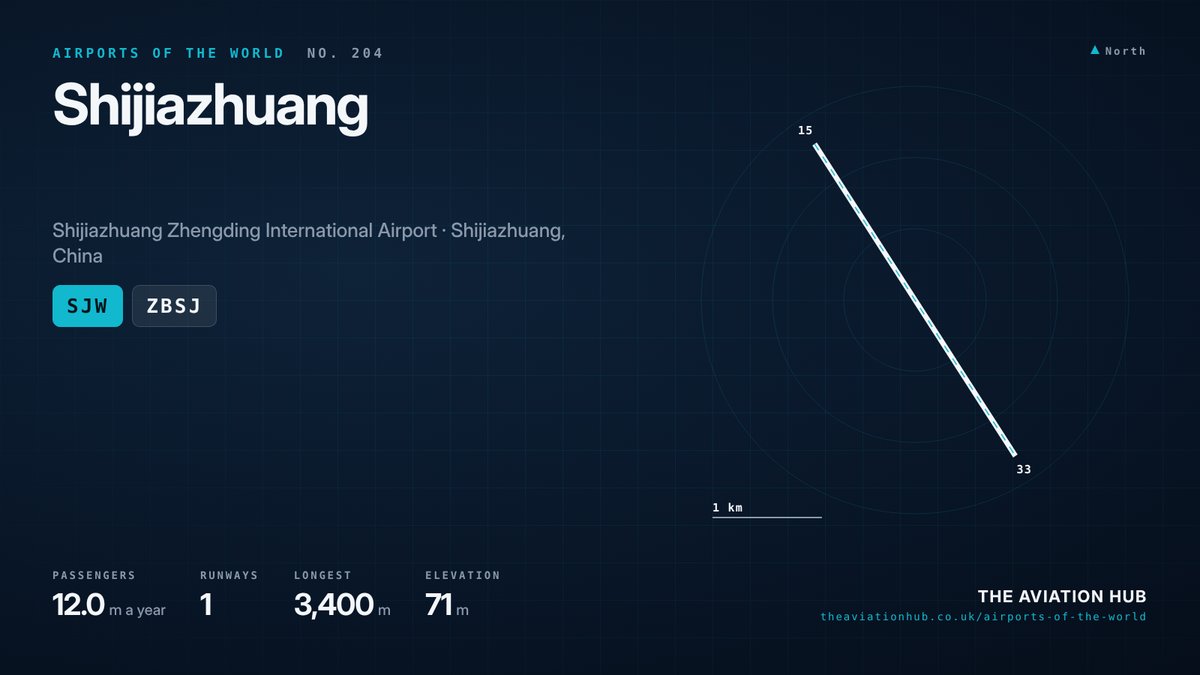
Shijiazhuang Zhengding International Airport is the main gateway to Hebei, the province that wraps around Beijing and Tianjin. It stands on the North China Plain north east of the provincial capital, beside the high speed railway that runs from Beijing to Guangzhou. Shijiazhuang Airport handled around 12 million passengers in 2025, a record, and it has built its growth on low cost carriers and a rail link that few Chinese airports can match. Spring Airlines and Hebei Airlines are the carriers to watch.
Shijiazhuang Airport at a Glance
The codes are SJW and ZBSJ. The field lies in Xinchengpu township in Zhengding county, about 20 miles (32 km) north east of the Shijiazhuang city centre. Elevation is 233 ft (71 m) on flat farmland, with the Taihang mountains visible to the west on a clear day, which in Hebei is not every day. Winter smog is a regular feature.
Shijiazhuang Airport has one runway and two passenger terminals, Terminal 1 and the larger Terminal 2. Traffic in 2025 reached roughly 12.01 million passengers on about 85,700 aircraft movements, with cargo of around 66,000 tonnes. Hebei Airlines calls it home, and Spring Airlines and China United Airlines both base aircraft here. Hebei Airport Management Group, a unit of Capital Airport Holding, runs the field. Timetables are on the airport’s official website.
How Shijiazhuang’s Airport Came to Be
Shijiazhuang grew from a railway junction into a provincial capital, and air travel arrived late. The present airport opened on 18 February 1995 as Shijiazhuang Zhengding Airport, replacing an older military field closer to the city. Early traffic was thin, with a handful of trunk routes to Shanghai, Guangzhou and Shenzhen.
The turning point came in 2008 when Capital Airport Holding, the operator of Beijing Capital, took control and added the word International to the name in July that year. The idea was to turn the field into a relief airport for Beijing to the north. Hebei Airlines began flying as the provincial carrier in 2010, and Spring Airlines built up a base alongside it.
Terminal 2 opened in the mid 2010s and multiplied the capacity of the original building. Zhengding Airport railway station opened on the Beijing to Guangzhou high speed line beside the field, and the airport began refunding train fares to passengers who arrived by rail. During the pandemic the airport also took diverted Beijing flights to keep imported cases out of the capital.
Runways at Shijiazhuang Airport
There is a single runway, 15/33, which measures 3,400 m (11,155 ft) long and 45 m wide with a concrete surface. The airport was one of the few in China able to take the Antonov An-225, and heavy freighters such as the Boeing 747-400F and 777F use it without restriction.
Winds on the plain are light for most of the year, with northerlies in winter favouring Runway 33 and southerlies in summer bringing operations onto Runway 15. Arrivals from the south pass over open farmland, and departures to the north climb away from the city. There are no parallel operations and no crosswind runway, so a single incident or a snowfall can stop everything.
One runway is enough for now. Shijiazhuang Airport handles about 230 movements on a typical day, well within the capacity of the strip. The limit lies in apron space and in the terminals, which is why a second runway remains a longer term idea.
Terminals and Airlines
Terminal 2 is the main building and handles all domestic flights. It is a long, glass fronted hall with a central check in area and piers running out to contact stands. Spring Airlines occupies the largest share of the gates with its Airbus A320s and A320neos, and Hebei Airlines operates Boeing 737-800s from the same concourse. China United Airlines, the low cost arm of China Eastern, bases 737s here as well.
Air China, China Eastern, China Southern and Beijing Capital Airlines fly in from their own hubs, and Jeju Air brings Boeing 737s from Seoul Incheon and Busan. International and Hong Kong flights use Terminal 1, the original building, which has its own check in and immigration halls. A shuttle bus links it with Terminal 2.
Lounges are modest and sit on the departures level of Terminal 2. Cargo moves through a separate freight terminal on the eastern side of the apron.
Routes and Destinations
The network at Shijiazhuang Airport is dominated by domestic trunk routes. Shanghai Pudong and Hongqiao, Guangzhou, Shenzhen, Chengdu, Chongqing, Kunming, Xi’an and Hangzhou carry the heaviest loads, with Spring Airlines and Hebei Airlines competing on the biggest pairs. Hebei Airlines also reaches Hong Kong, and leisure flights serve Sanya and Haikou in winter.
International service is thin but useful. Spring Airlines flies to Bangkok, Seoul Incheon and Tokyo Narita, and Jeju Air serves Seoul and Busan. Charter programmes to South East Asia come and go with the seasons. New domestic routes keep arriving, with China United Airlines adding Qionghai and Donghai Airlines adding Shenzhen and Wuxi from late October 2026.
Cargo matters more than at most airports of this size. Freighters link the field with Hong Kong, Nanjing, Seoul, Tokyo, Zhengzhou, Ostrava and Bishkek, carrying Hebei’s steel and pharmaceutical exports. The longest passenger route is Spring Airlines’ Bangkok service at roughly 1,900 miles (3,060 km).
Getting to and from Shijiazhuang Airport
The rail link sets this field apart. Zhengding Airport station sits around 2 miles (3 km) south of the terminals on the Beijing to Guangzhou high speed line, and a free shuttle bus runs between the two every 30 minutes from 6.30 am to 8.30 pm. A G or D class train reaches Shijiazhuang station in under 15 minutes and Beijing West in about an hour and a quarter.
Only a few trains a day stop at the airport, so timing matters. The airport has offered free or refunded rail tickets to some air passengers, which is unusual anywhere in the world. Five city bus routes serve the terminals for up to 20 yuan (£2), and intercity coaches run across Hebei and into neighbouring provinces.
Taxi ranks stand on the arrivals level of both terminals. A fare to the city centre costs around 100 yuan (£11) and takes about 40 minutes on the expressway. Short and long stay parking sits in front of Terminal 2.
Spotting and Photography
Shijiazhuang Airport is open country, which helps. The approach to Runway 33 crosses farm tracks south of the threshold, where a patient spotter can photograph arrivals with little traffic around. Runway 15 arrivals come in from the north. The terminal windows in Terminal 2 give close views of the Spring Airlines and Hebei Airlines fleets at the contact stands.
Light is best in the morning on the eastern side of the field, and the haze that hangs over Hebei in winter flattens everything after midday. Freighter movements are the prize here, with cargo jets appearing through the week on the Hong Kong and European runs.
Chinese airports take security seriously. Stay well clear of the fence, keep cameras out of sight near police posts and expect to be asked what you are doing. A polite answer and a quick exit avoid problems.
What Comes Next
Growth towards 20 million passengers a year would need more terminal space and more apron. A second runway is a longer term prospect. The bigger driver is Beijing. With Daxing and Capital both busy, Hebei wants Shijiazhuang to take relief traffic, and the rail refund scheme is designed to make that work.
Growth depends on the airlines. Spring and Hebei Airlines keep adding routes, and cargo is rising with the province’s exports. The constraint is demand in a city of 11 million people that has never been a tourist draw.
Shijiazhuang Airport is a well built regional field with national ambitions and a rail link that already outperforms its terminals. See how it compares with Beijing and Tianjin on the Airports of the World map.
Continue to follow The Aviation Hub for more analysis and insight.
Advertise with us Your brand, in front of an aviation audience Home page and in-article placements, sold directly, one advertiser per slot. From £250 a year. See the rates

