
Buenos Aires Ezeiza Airport Guide: Argentina’s Long Haul Door
Buenos Aires Ezeiza Airport carries most of Argentina's international traffic through a terminal opened in 2023. Read about its runways, airlines and routes.
 By The Aviation Hub
7 min read
Updated October 20, 2026
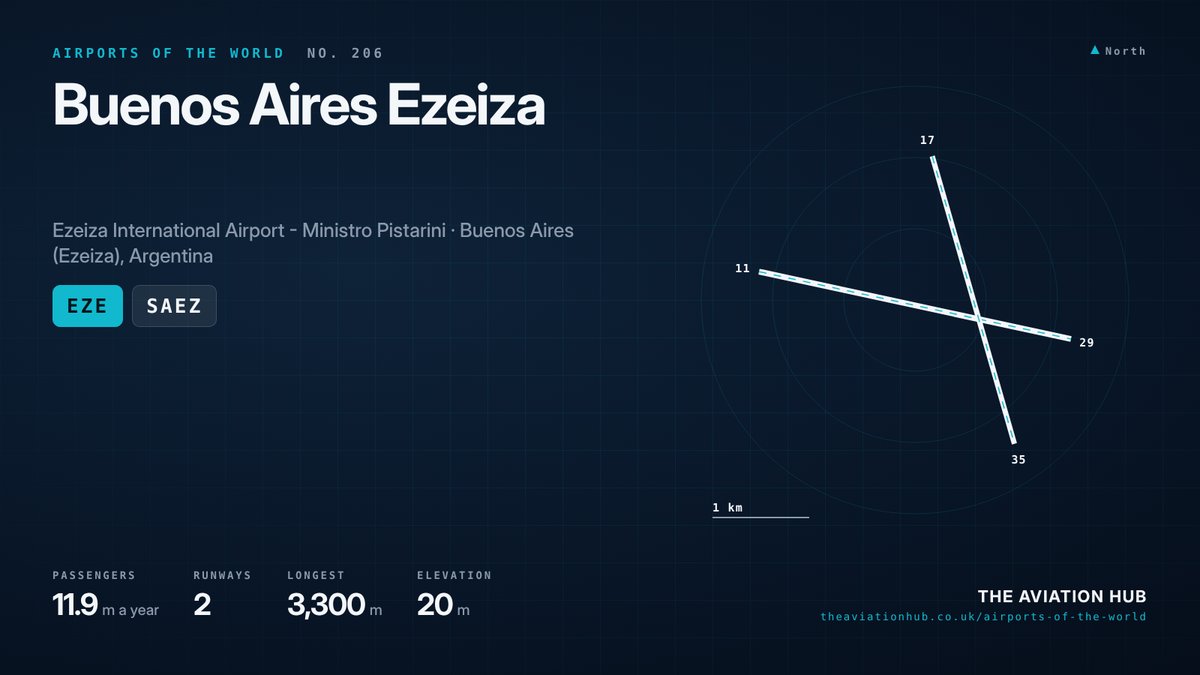
Ministro Pistarini International Airport, known to everyone as Ezeiza, is the international gateway to Argentina. It lies on the flat pampa south west of the capital, far enough out that the journey into town is part of the experience. Buenos Aires Ezeiza Airport handles around 12 million passengers a year and about 85 per cent of the country’s international traffic. Aerolineas Argentinas runs its long haul hub here, and a new departures terminal opened in 2023 after years of delay. The domestic shuttle traffic belongs to Aeroparque, the city airport by the river.
Buenos Aires Ezeiza Airport at a Glance
The codes are EZE and SAEZ. The field sits in the town of Ezeiza, around 14 miles (22 km) south west of the Plaza de Mayo in central Buenos Aires. Elevation is 67 ft (20 m) on open grassland, and the site covers roughly 3,475 hectares, which gives it room that most capital city airports can only envy. The official name honours Juan Pistarini, the minister who laid the cornerstone in 1945.
Buenos Aires Ezeiza Airport has two runways and three terminal buildings, with the 2023 Departures Terminal at the centre and Terminals A and C converted to arrivals. Recent figures put it at 11 to 12 million passengers a year, which makes it the second busiest airport in Argentina after Aeroparque. Aerolineas Argentinas is the hub carrier and by far the largest operator. Aeropuertos Argentina 2000 has run the site under concession since 1998. Flight status and parking details are on the airport’s official website.
How Ezeiza Came to Be
Juan Peron’s first five year plan included a grand airport for the capital, and Pistarini laid the cornerstone on 22 December 1945. Argentine engineers designed and built it over four years, and it opened on 30 April 1949. A Flight magazine report of the time ranked it as the third largest airport in the world, with three crossing runways and a terminal built for the age of the Constellation.
The original terminal, now Terminal A, served for decades with only piecemeal change. The Ezeiza massacre of June 1973, when rival Peronist factions opened fire on a crowd gathered near the airport for Peron’s return from exile, left the name with a darker association in Argentine politics. An Air Force Boeing 707 crashed short of the runway in October 1996, killing two.
Aeropuertos Argentina 2000 took over in 1998 and rebuilt the field piece by piece. Terminal C opened in July 2011 and a smaller Terminal B followed in March 2013, before the 2023 rebuild reorganised the complex. The long promised new Departures Terminal, 50,000 square metres over four floors, finally opened on 14 April 2023 with a design capacity of 30 million passengers a year.
Runways at Buenos Aires Ezeiza Airport
Runway 11/29 is the main strip at 3,300 m (10,827 ft) long and 60 m wide, asphalt surfaced. Runway 17/35 crosses it at 3,105 m (10,187 ft) and 45 m wide, also asphalt. The pampa wind blows mostly from the east and north east, so 11/29 handles the bulk of movements, with 17/35 used for crosswind conditions and during maintenance.
Both runways are long enough for any aircraft in service. Aerolineas Argentinas operates Airbus A330-200s on its long haul routes, and foreign carriers bring Boeing 777-300ERs, 787-9s, Airbus A350-900s and the occasional 747-8 freighter. The approach to Runway 11 crosses open country, and the climb out from 29 passes over the sprawling suburbs of the south west.
Fog is the operational problem. The low, flat Rio de la Plata basin produces thick winter fog in June and July, and Buenos Aires Ezeiza Airport has invested in Category III instrument landing on 11 to keep the long haul bank arriving. Diversions to Montevideo and Cordoba are still common on the worst mornings.
Terminals and Airlines
The 2023 Departures Terminal handles check in and departures, with a long row of counters, a central security hall and gates reached through the older piers. Aerolineas Argentinas, a SkyTeam member, has the largest presence with its A330s and Boeing 737-800s and 737 MAX 8s. Its SkyTeam partners Air France, KLM, Delta and Aeromexico sit alongside.
Star Alliance is represented by Lufthansa, United, Air Canada, Avianca, Copa and Turkish Airlines, and oneworld by American, British Airways and Iberia. LATAM, Air Europa, Plus Ultra, Swiss, Ethiopian, Emirates, China Eastern, JetSMART and Flybondi complete the list, and El Al is due from November 2026. Terminal A, the 1949 building, is now the international arrivals hall, and Terminal C handles domestic arrivals.
Lounges cluster on the upper level of the new building, led by the Aerolineas Argentinas Salon Condor and the American Express and Star Alliance rooms. Immigration queues on the long haul arrival bank remain a weak point.
Routes and Destinations
Santiago, Miami, Lima and Madrid are the busiest routes from Buenos Aires Ezeiza Airport, with Madrid served by Aerolineas Argentinas, Iberia, Air Europa and Plus Ultra. Sao Paulo, Rio de Janeiro, Bogota and Panama City follow, and Rome, Paris, Frankfurt, London and Amsterdam make up the European bank. Flights to Europe leave in the afternoon and evening and arrive the next day.
Lufthansa’s nonstop Frankfurt flight, at around 7,150 miles (11,500 km), is among the longest routes, and El Al’s planned Tel Aviv service will be longer still. Emirates reaches Dubai through Rio de Janeiro, while Ethiopian and Turkish Airlines stop in Sao Paulo. Several carriers have come and gone, including Qatar Airways, Air New Zealand and Norwegian, which all left in 2020, and Qantas, which switched to Santiago in 2012. Domestic flights reach El Calafate, Mendoza, Bariloche, Iguazu and Ushuaia, with Flybondi and JetSMART adding low cost links. Cargo is significant, with freighters from Europe and the United States carrying beef, fruit and pharmaceuticals.
Getting to and from Buenos Aires Ezeiza Airport
There is no train or metro. The Autopista Riccheri motorway runs from the terminal forecourt into the city, and a taxi or remis to the centre takes 40 to 60 minutes and costs around 50,000 pesos (£35). Uber and Cabify operate from designated pickup points. Traffic on the Riccheri in the evening rush can add half an hour.
The cheapest sensible option is the Tienda Leon coach, which runs every half hour to its Retiro terminal near the main railway station in about an hour. Manuel Tienda Leon also serves Aeroparque directly for passengers connecting to domestic flights, a trip of 50 minutes on a good day. Colectivo bus route 8 reaches the city for an ordinary bus fare but takes two hours. Car parks sit opposite the terminals, with a long stay lot further out.
Spotting and Photography
Buenos Aires Ezeiza Airport is one of the better long haul spotting fields in South America. The approach to Runway 11 crosses open fields to the west, where enthusiasts gather on the roadside for the morning arrivals from Europe. The threshold of Runway 35 is reachable along the perimeter roads to the south.
The upper level of the Departures Terminal has windows onto the apron and the heavy aircraft stands. Afternoon light suits the western side of the field, and the winter fog gives dramatic conditions once it lifts. The afternoon and evening departure bank offers the greatest variety.
The Policia de Seguridad Aeroportuaria patrols the perimeter and takes an interest in long lenses. Stay on public roads, keep away from the fence and have identification ready. Most encounters end with a nod.
What Comes Next
The 2023 terminal was built for 30 million passengers, more than double current traffic, so capacity is not the issue. Later phases could bring more contact stands and a replacement for the ageing Terminal A arrivals hall. A rail link has been studied for decades without result.
Argentina’s open skies policy since 2024 has brought new routes from Plus Ultra, LATAM and El Al, and the recovery of the peso will decide whether foreign carriers return. The runways and the vast site give the field decades of headroom.
Buenos Aires Ezeiza Airport has room to grow and a country that needs it to. See how it compares with Sao Paulo and Santiago on the Airports of the World map.
Continue to follow The Aviation Hub for more analysis and insight.
Advertise with us Your brand, in front of an aviation audience Home page and in-article placements, sold directly, one advertiser per slot. From £250 a year. See the rates

