
Valencia Airport Guide: Manises, Metro Links and Routes
Valencia Airport at Manises carried nearly 12 million passengers in 2025. Read about its runway, terminal, airlines, routes, metro link and spotting.
 By The Aviation Hub
6 min read
Updated October 20, 2026
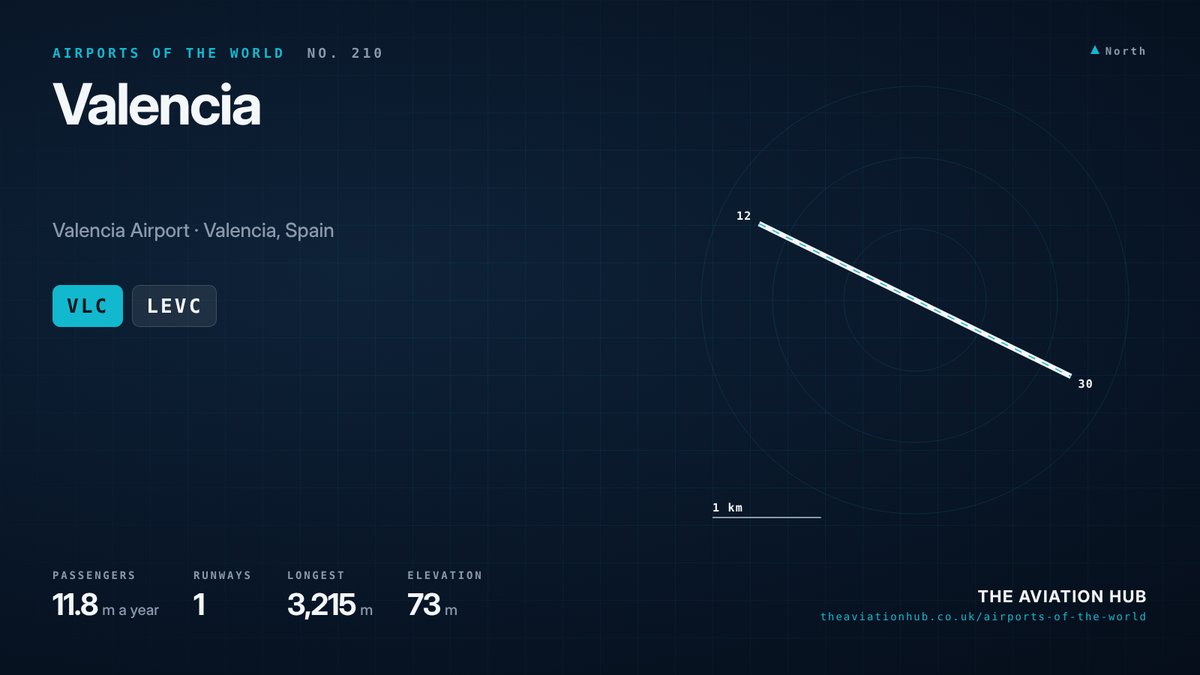
Valencia Airport sits in the town of Manises, just west of Spain’s third largest city, and most locals still call it by that name. It is a compact, busy field that carried around 11.8 million passengers in 2025, three quarters of them on international flights. Low cost carriers drive the growth, but it is also the home of Air Nostrum, which flies the Iberia Regional network. A metro line from the terminal to the city centre makes it one of the easiest airports in Spain to use.
Valencia Airport at a Glance
The IATA code is VLC and the ICAO code is LEVC. The airport lies about 5 miles (8 km) west of central Valencia, between the A3 motorway to Madrid and the Turia valley. Elevation is 240 ft (73 m). There is one active runway and a single terminal built in three connected stages.
Traffic reached roughly 11.8 million passengers in 2025, up from about 10.8 million the year before. Ryanair, Vueling and Air Nostrum all base aircraft at Manises, and Wizz Air is adding two based aircraft from the 2026/27 winter season. Aena, the Spanish state airport operator, runs the field. Flight information and parking bookings are on the airport’s official website.
A Short History of Manises
Aviation at Manises dates back to the 1930s, when the flat land west of the city became Valencia’s airfield. It played a military role in the Spanish Civil War and later developed as a civil airport serving the city and the Costa Blanca resorts to the south.
For decades Manises lived in the shadow of Alicante, which captured most of the package holiday trade. The turn came in the 2000s. A new regional hall opened for the 2007 America’s Cup sailing regatta, and Ryanair opened a base the same year.
The base proved volatile. Ryanair closed it in November 2008 after a dispute over subsidies, then returned in 2011. Delta launched a New York route in 2009, the airport’s first transatlantic service, but cut it to seasonal and dropped it in 2012. Air Transat restored North American flying with Montreal in June 2025 and later made the route year round.
Runways at Valencia Airport
All traffic uses Runway 12/30, an asphalt strip of 3,215 m (10,548 ft) by 45 m, which reached its full length after a 50 m extension completed by 2007. It handles the Airbus A330 and Boeing 787 without difficulty.
A second runway, 04/22, once crossed the site but is now closed and has no instrument landing system. A helipad sits at its south western end, and the old strip is still easy to see from the air. With only one runway in use, Valencia Airport has no parallel or crosswind options.
Wind decides the direction. Daytime sea breezes from the east and south east tend to favour Runway 12, with arrivals approaching from the north west along the Turia valley. Westerly poniente winds, which can bring sudden heat, swing operations onto Runway 30.
Terminals and Airlines
The single terminal is a chain of buildings rather than one hall. Check in areas 1 to 12 are the newest and sit above the metro station. Areas 13 to 42 occupy the original main building, whose upper floor stands derelict. Areas 43 to 56 form the largest annex and house most airlines.
One security checkpoint leads to gates 1 to 22. Gates 1 to 4 handle non Schengen flights, including the United Kingdom and Morocco. Gates 12 to 22 form the regional hall built for the America’s Cup, with walk out boarding used mainly by Air Nostrum and low cost carriers.
Ryanair is the largest airline at Valencia Airport, followed by Vueling and Iberia Regional Air Nostrum with its CRJ and ATR fleet. easyJet, Wizz Air, Transavia, KLM, ITA Airways, Lufthansa and Air France add European links.
Routes and Destinations
Palma de Mallorca is the busiest route from Valencia Airport, with around 663,000 passengers in 2025. Madrid follows at about 382,000 and Ibiza at roughly 319,000, both helped by the island holiday trade and business travel. High speed trains reach Madrid in under two hours, which keeps that route modest.
Internationally, Amsterdam led with about 559,000 passengers, ahead of Rome Fiumicino at around 523,000 and Paris Orly near 418,000. The United Kingdom, Italy and Germany are among the largest country markets. Morocco is the main market beyond Europe, led by Marrakech, Tangier and Fez.
Montreal with Air Transat is the long haul flagship at around 3,600 miles (5,800 km). Summer peaks are pronounced, though Valencia’s city break appeal keeps winter traffic stronger than at the beach airports further south.
Getting to and from Valencia Airport
Metrovalencia lines 3 and 5 stop beneath the terminal. Trains reach the city centre in about 15 minutes, the Estacio del Nord main line station in about 20 and the port in about 30. It is the cheapest sensible option, with a single airport fare of a few euros.
A Fernanbus service runs to the city through Manises, Quart de Poblet and Mislata, taking 30 to 35 minutes. Taxis wait outside arrivals and reach the centre in around 20 minutes for roughly 25 euros (about £21). Drivers have quick access to the A3 towards Madrid and the A7 coastal route to Barcelona and Alicante, and Valencia Airport has short and long stay car parks beside the terminal.
Spotting and Photography
Valencia Airport is a relaxed and varied place to watch aircraft. The traffic mix runs from Air Nostrum regional jets and turboprops to Ryanair and Wizz Air narrow bodies, with occasional wide bodies on charter work. Air Nostrum’s maintenance hangars add interest.
Local enthusiasts use the roads and open ground around Manises, close to the ends of the runway. The approach to Runway 30 crosses suburbs and farmland to the south east and gives good side views. Morning light suits the eastern end, while afternoons favour the western side of the field.
Respect the perimeter fence, avoid blocking roads or farm tracks and move on if the Guardia Civil asks. Inside the terminal, the departure areas offer limited but usable views of the apron.
What Comes Next
Aena’s DORA III investment plan for 2027 to 2031 sets out the biggest change in years. The terminal will more than double, from about 66,000 to 140,000 square metres, replacing the patchwork of buildings with a coherent layout and more gates.
The regional government is also chasing new intercontinental links, with the United States at the top of the list. Wizz Air’s new base will add further capacity to Eastern Europe.
Valencia Airport is heading for a bigger, more international future built on low cost growth and a city break boom. See how it compares with Alicante and Barcelona on the Airports of the World map.
Continue to follow The Aviation Hub for more analysis and insight.
Advertise with us Your brand, in front of an aviation audience Home page and in-article placements, sold directly, one advertiser per slot. From £250 a year. See the rates

