
Marseille Airport Guide: Flying Boats to the Mistral
Marseille Airport sits beside the Etang de Berre with two runways and a rebuilt terminal. Read about its history, airlines, routes, transport and spotting.
 By The Aviation Hub
6 min read
Updated October 20, 2026
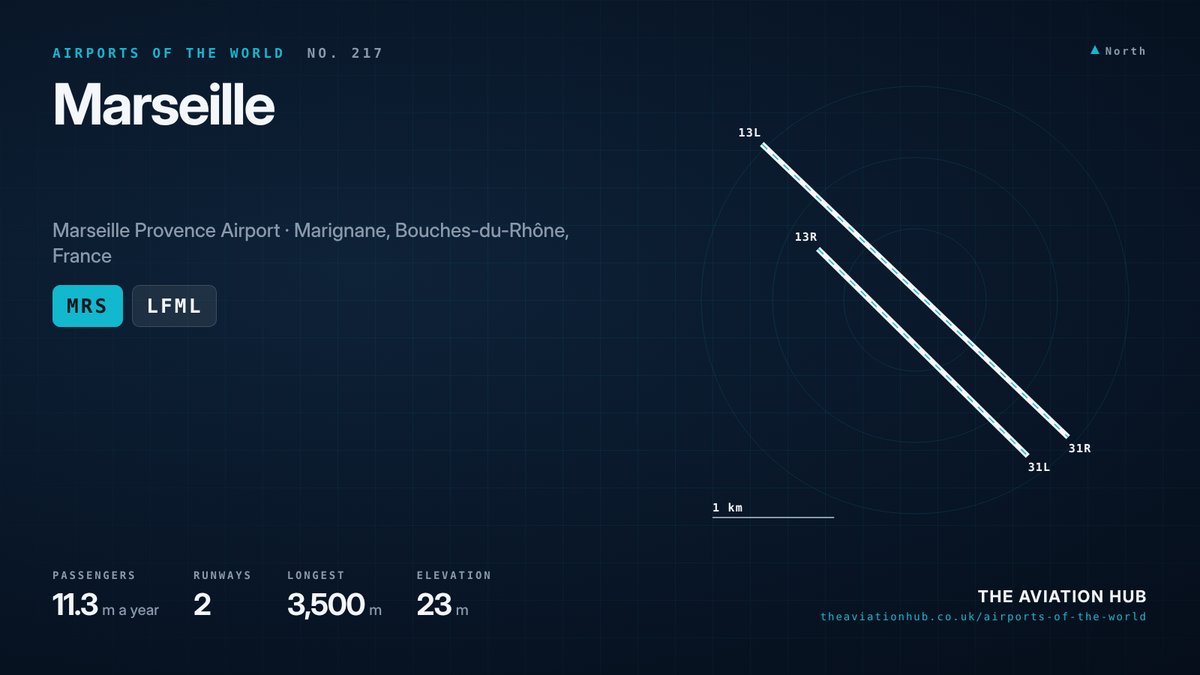
Marseille Provence Airport sits on the shore of the Etang de Berre at Marignane, serving France’s second city and the wider Provence region. Marseille Airport handled around 11.3 million passengers in its latest year, which places it fifth among French airports. It mixes Ryanair’s low cost network with Air France links to Paris and a strong North African market. Airbus Helicopters builds aircraft on the same site, and the field has a history stretching back more than a century.
Marseille Airport at a Glance
The IATA code is MRS and the ICAO code is LFML. The airport lies about 17 miles (27 km) north west of central Marseille, in the town of Marignane. Elevation is 74 ft (23 m). There are two parallel runways and two terminal areas, Terminal 1 and the low cost terminal MP2.
Passenger numbers reached about 10.8 million in 2023, up 18 per cent, and have grown to roughly 11.3 million since. Ryanair has an operating base and runs the largest network. Air France keeps a significant presence. The local Chamber of Commerce and Industry has managed the airport since 1934, now through a dedicated operating company. Flight times and parking are on the airport’s official website.
How Marseille’s Airport Came to Be
The airport opened on 22 October 1922. Its waterside position made it an important flying boat base in the 1920s and 1930s, and Pan American Clippers briefly used it as a terminal. Antoine de Saint Exupery once turned back to Marignane with a fuel leak, an episode he described in Wind, Sand and Stars.
For decades the field was known as Marseille Marignane. It grew into a major French regional airport after the war, with strong links to Algeria, Tunisia and Corsica. Aerospace industry followed, and the site now hosts the head office of Airbus Helicopters.
The airport made headlines on 26 December 1994. Air France Flight 8969, hijacked in Algiers by the Armed Islamic Group, landed at Marignane, and French special forces stormed the Airbus A300, killing all four hijackers. The MP2 low cost terminal opened in September 2006. A rebuilt Terminal 1 opened on 17 June 2024, with about 22,000 square metres of new space and 28,000 square metres renovated.
Runways at Marseille Airport
The main runway, 13L/31R, is 3,500 m (11,483 ft) long, 45 m wide and asphalt surfaced. It handles all heavy traffic, including the Boeing 787 and Airbus A330 on long haul and charter flights. The parallel 13R/31L is 2,370 m (7,776 ft), also 45 m wide and asphalt.
The Mistral shapes daily operations. This cold, strong north westerly wind can blow for days at a time, and it puts Runways 31R and 31L in use for much of the year. Arrivals then approach from the south east, while departures climb out over the Etang de Berre.
The shorter parallel takes smaller aircraft and provides a backup when the main runway is closed. In southerly and easterly winds, traffic swings onto the 13 direction, with approaches over the lagoon. Strong gusts and turbulence make Marseille Airport a demanding place to land on Mistral days.
Terminals and Airlines
Terminal 1 contains Halls A and B and handles most full service and international flights. The 2024 project added new space and modernised Halls A and B. MP2, a stripped down building opened in 2006, was designed for low cost carriers and turns aircraft quickly.
Ryanair is the largest airline at Marseille Airport, with routes across Europe and North Africa. Air France flies to Paris Charles de Gaulle and Lyon. Volotea, Transavia and Air Corsica add domestic and European routes.
International carriers include Lufthansa, British Airways, Turkish Airlines, Air Algerie, Tunisair and Royal Air Maroc. Air France and KLM give SkyTeam the strongest alliance presence.
Routes and Destinations
Paris is the core domestic market for Marseille Airport, although high speed TGV trains reach the capital in around three hours and compete hard. Corsica, Brittany, Nantes and Lille are also well served. In summer 2013 the airport offered 132 regular destinations, more than any French airport outside Paris.
North Africa is the strongest international market. Algiers, Oran, Constantine, Tunis, Djerba and Casablanca all see frequent flights, reflecting Marseille’s large North African communities. Ryanair adds Dublin, Madrid, Lisbon, Porto, Rome Fiumicino and Marrakech.
Long haul flying is growing. Air Transat flies to Montreal all year, Corsair serves Reunion and Mauritius, Shanghai Airlines links the city with Shanghai, and United Airlines plans seasonal service to Newark from 5 June 2027. Cargo is significant, with around 56,000 tonnes in 2023, the third highest total in France.
Getting to and from Marseille Airport
The quickest public link from Marseille Airport to the city is the express shuttle bus to Marseille Saint Charles station. Coaches run every 15 to 20 minutes for most of the day and take around 25 to 30 minutes, traffic permitting. Other coaches serve Aix en Provence and the Aix TGV station.
The rail option is Vitrolles Marseille Provence Airport station on the regional TER network, linked to the terminals by a short free shuttle bus. Trains reach Marseille Saint Charles in about 20 minutes, and this is usually the cheapest sensible option. Trains also run north west towards Miramas.
By road, the A7 motorway passes close by and connects with Marseille, Aix and Lyon. A taxi to central Marseille takes 25 to 40 minutes and costs from around 60 euros (about £50). Parking ranges from short stay areas outside Terminal 1 to cheaper long stay lots.
Spotting and Photography
Marseille Airport rewards enthusiasts with real variety. Ryanair and Volotea narrow bodies share the field with Air Algerie, Tunisair and long haul visitors, and Airbus Helicopters test flights add something few airports can offer.
The shores of the Etang de Berre and the roads around Marignane give good views of aircraft approaching and departing. On Mistral days the north western end of the field sees departures climbing over the water. Light is best in the morning from the north east side of the runways and in the afternoon from the south west.
Stay on public land, keep away from the perimeter fence and follow any instruction from the gendarmerie. Drones are banned near the airport.
What Comes Next
The rebuilt Terminal 1 has given the airport room to grow through the late 2020s. Long haul development is the priority, with United’s Newark route a significant signal of North American interest.
Environmental pressure is real. Noise over Marignane and Vitrolles, and air quality around the Etang de Berre, will limit how far traffic can expand. Better rail access to the terminals would help the airport’s environmental case.
Marseille Airport is heading for steady growth with a sharper international focus. Compare it with Nice and Lyon on the Airports of the World map.
Continue to follow The Aviation Hub for more analysis and insight.
Advertise with us Your brand, in front of an aviation audience Home page and in-article placements, sold directly, one advertiser per slot. From £250 a year. See the rates

