
Milan Linate Airport Guide: Metro Links and City Flying
Milan Linate Airport sits 4 miles from the city centre with its own metro station. Read about its runway, airlines, routes, history and spotting spots.
 By The Aviation Hub
6 min read
Updated October 20, 2026
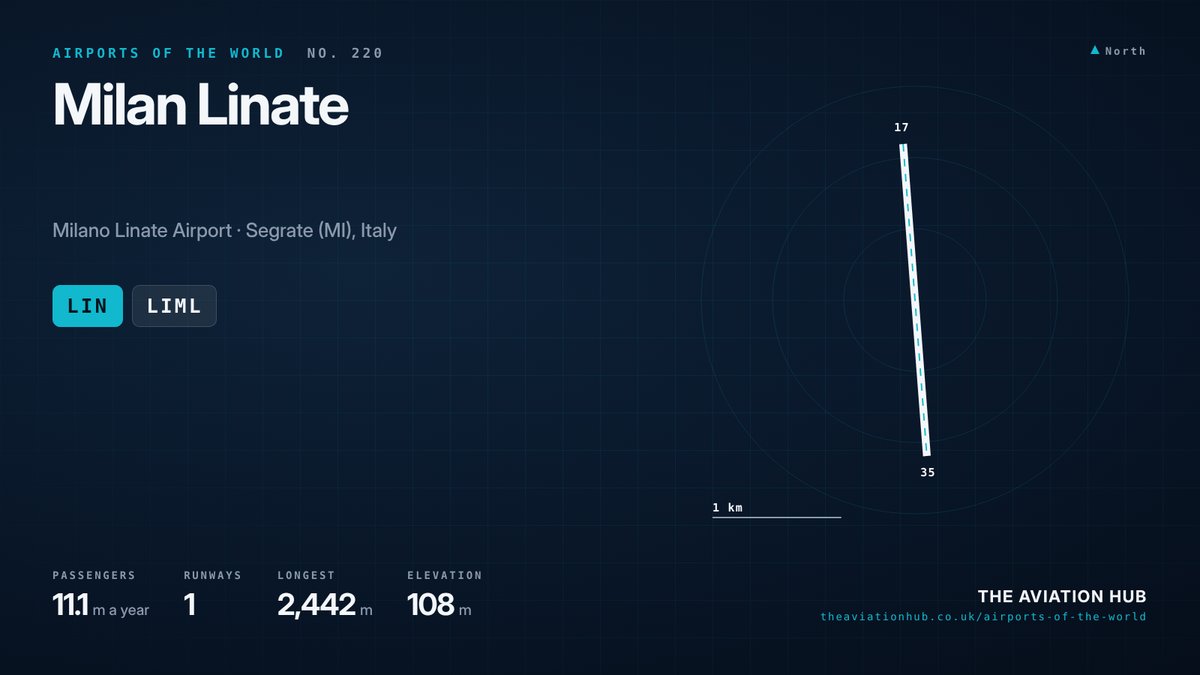
Linate is Milan’s city airport, a compact field on the eastern edge of the city that business travellers love for its speed. Milan Linate Airport handled around 11 million passengers in its latest year, almost all on domestic and European routes. Since 2022 the M4 metro line has put the terminal about a quarter of an hour from the centre. Malpensa takes the long haul flights, so Linate concentrates on short trips to Rome, the south of Italy and Europe’s main business capitals.
Milan Linate Airport at a Glance
The IATA code is LIN and the ICAO code is LIML. The airport lies about 4 miles (7 km) east of central Milan, straddling the municipalities of Segrate and Peschiera Borromeo. Elevation is 353 ft (108 m). There is one runway and one passenger terminal.
Traffic reached about 10.65 million passengers and 118,000 aircraft movements in 2024, and grew to roughly 11.1 million in the latest count. ITA Airways is the largest airline, and easyJet opened a base in 2025. SEA, which also runs Malpensa, operates the airport. Flight information and parking are on the airport’s official website.
A Short History of Linate
Milan’s first airfield was at Taliedo, but by the 1930s it was too small for commercial flying. A new airport was built in the late 1930s beside the Idroscalo, an artificial lake created for seaplanes. It takes its name from the nearby village of Linate. Its official title honours Enrico Forlanini, the Milanese aviation pioneer.
Milan Linate Airport was rebuilt in the 1950s and again in the 1980s, and for decades it was Milan’s main airport. That changed when Malpensa became the hub at the end of the 1990s. In 2001 capacity at Linate was cut, and flights were later restricted to domestic, European Union and United Kingdom routes.
The worst day came on 8 October 2001. In thick fog, SAS Flight 686, a McDonnell Douglas MD-87, collided on the runway with a business jet that had taken a wrong turn. The crash killed 118 people, including four on the ground, and remains the deadliest air disaster in Italian history. From July to October 2019 the airport closed for runway resurfacing and terminal upgrades.
Runways at Milan Linate Airport
All traffic uses Runway 17/35, an asphalt strip 2,442 m (8,012 ft) long and an unusually generous 60 m wide. It was renumbered from 18/36 in late 2023 to reflect the drift in magnetic variation. A short secondary strip once used by light aircraft now serves only as a taxiway.
The runway length suits the Airbus A320 family, Boeing 737 and Embraer regional jets that dominate the schedule. Wide body aircraft are rare. Winds in the Po Valley are usually light, so traffic flow and noise rules often decide the runway direction.
Fog is the main weather hazard in winter. The 2001 disaster led to sweeping changes in ground radar, taxiway signage and procedures at Milan Linate Airport. Capacity remains capped by government decree, limiting the number of movements each hour.
Terminals and Airlines
The single terminal at Milan Linate Airport spreads across three floors. Check in, baggage reclaim and a secondary bus gate area sit on the ground floor, with shops and restaurants on the first floor. Only five stands have jet bridges, so bus boarding is common.
ITA Airways, the successor to Alitalia in which Lufthansa has taken a major stake, holds the largest share of slots. The Lufthansa deal required ITA to release slots at Linate, and easyJet took them over. IAG and Air France KLM gained long haul remedies instead. easyJet now runs a base with domestic and European routes.
British Airways flies to London Heathrow and London City, Air France to Paris Charles de Gaulle and KLM to Amsterdam. Lufthansa serves Frankfurt and Munich, and Iberia flies to Madrid. Business aviation is busy too, with a dedicated terminal of its own.
Routes and Destinations
Rome Fiumicino remains the flagship route, despite high speed trains that link the two cities in around three hours. Naples, Catania, Palermo, Bari and Lamezia Terme are major domestic routes, where rail is slower and demand from southern Italians in Milan stays strong.
Internationally, London, Paris, Amsterdam, Frankfurt, Munich, Madrid and Brussels form the business core. easyJet’s arrival has added leisure routes within Europe and more competition on domestic trunks.
The rules keep Milan Linate Airport firmly short haul, as anything beyond the European Union and the United Kingdom must use Malpensa or Bergamo. Traffic is steady year round, with peaks around trade fairs such as Milan Design Week. Cargo is negligible.
Getting to and from Milan Linate Airport
Metro Line M4 is the best option. Trains run every few minutes from the station in front of the terminal and reach San Babila in the city centre in about 15 minutes. A standard urban ticket costs a little over 2 euros (under £2), making it the cheapest sensible option too.
Shuttle coaches link the airport with Milano Centrale in around 25 minutes, and an express bus runs to Lambrate station in about 10. Several ATM city and suburban buses also serve the terminal.
By road, the airport sits beside the A51 eastern ring road at exit 6. A taxi to the centre takes around 20 minutes and costs roughly 20 to 30 euros. Short and long stay car parks lie in front of the terminal.
Spotting and Photography
Milan Linate Airport is a good place to watch European flag carriers and business jets at close range. The Idroscalo park, on the lake east of the airport, gives views across the runway. Morning light from the east suits the Idroscalo side, while afternoon shooters should look for spots to the west.
The traffic mix is narrow body heavy, but the business aviation terminal brings Gulfstreams, Falcons and Bombardier jets in large numbers, especially during fashion and design weeks.
Stay on public paths, keep away from the perimeter fence and follow any instruction from the police. Drones are prohibited around the airport.
What Comes Next
The terminal upgrades that followed the 2019 closure have modernised the building, and the metro link has transformed access. The bigger questions are political. Any easing of the slot cap or route restrictions would change the balance between Linate and Malpensa.
easyJet’s base and Lufthansa’s growing role at ITA will reshape competition on Milan’s short haul routes over the next few years. Noise limits and the close proximity of homes rule out any new runway.
Milan Linate Airport is heading for a stable future as Milan’s convenient city airport, with growth limited by design. Compare it with Malpensa and Bergamo on the Airports of the World map.
Continue to follow The Aviation Hub for more analysis and insight.
Advertise with us Your brand, in front of an aviation audience Home page and in-article placements, sold directly, one advertiser per slot. From £250 a year. See the rates

