
Nagoya Chubu Airport Guide: Japan’s Island Airport
Nagoya Chubu Airport, known as Centrair, sits on an artificial island in Ise Bay. Runway, terminals, Dreamlifter operations, Sky Deck spotting and rail links.
 By The Aviation Hub
7 min read
Updated October 20, 2026
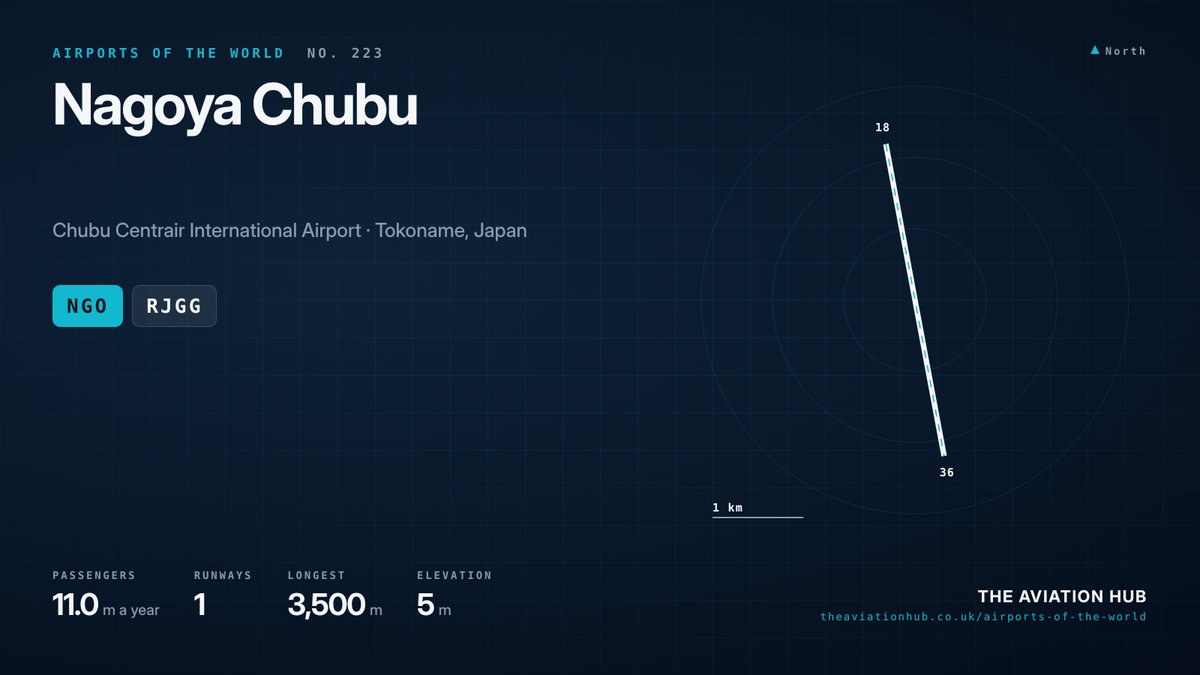
Chubu Centrair International Airport occupies an artificial island in Ise Bay off the town of Tokoname, about 22 miles (35 km) south of central Nagoya. It opened in 2005 as the main gateway to central Japan and its industrial heartland, home to Toyota and much of the country’s aerospace supply chain. Nagoya Chubu Airport handles around 11 million passengers a year and hosts the Boeing Dreamlifter flights that carry 787 wings to the United States. For spotters it has one of the best viewing decks in Asia.
Nagoya Chubu Airport at a Glance
The IATA code is NGO, inherited from the old Nagoya Airport at Komaki, and the ICAO code is RJGG. The island sits at 15 feet (5 m) above sea level and is linked to the mainland by a road and rail bridge. There is one runway and two passenger terminals. In the financial year to March 2025 the airport handled about 11.04 million passengers, 139,000 tonnes of cargo and roughly 95,000 aircraft movements.
ANA, Japan Airlines and Polar Air Cargo treat the airport as a focus city, and Jetstar Japan has an operating base. The operator is Central Japan International Airport Co Ltd, a company owned by the national government, local authorities and private investors including Toyota. Flight times, access guides and Sky Deck opening hours are on the airport’s official website.
A Short History of Centrair
Nagoya’s original airport at Komaki, north of the city, was hemmed in by housing and shared with the Japan Air Self Defense Force. By the 1990s it could not grow, and the region watched Kansai open its offshore airport near Osaka in 1994. Aichi prefecture wanted the same solution. Construction of the island began in August 2000 and the airport opened on 17 February 2005, in time for the Expo 2005 world fair held in the prefecture.
The name Centrair is a contraction of Central Japan International Airport, the English rendering used by the operating company. Almost all commercial flights moved from Komaki to Nagoya Chubu Airport on opening day, and the old field became a regional airport served by Fuji Dream Airlines. The project came in under budget, which was rare for Japanese public works of the era.
Two later developments shaped the airport. Boeing chose it in 2007 as the collection point for 787 sections built by Mitsubishi, Kawasaki and Subaru, bringing the Dreamlifter into daily service. Then in September 2019 the operator opened Terminal 2 for low cost airlines. Media reports have also linked the island’s construction to a yakuza front company supplying materials, though the charges against its executives were later dropped.
Runways at Nagoya Chubu Airport
There is one runway, 18/36, an asphalt strip of 3,500 metres (11,483 feet) and 60 metres wide. It runs north to south along the western edge of the island, with the terminals and aprons to its east. The length comfortably handles the Boeing 747-400 Dreamlifter, the 777-300ER and the Airbus A350-900 on long haul sectors to Europe and North America.
The wind decides which direction is in use at Nagoya Chubu Airport, and both approaches cross the open water of Ise Bay. Being surrounded by sea removes most noise constraints and allows 24 hour operations, which is a key advantage over Osaka Itami. The single strip still has spare capacity.
The exposed position has a downside. Typhoons and winter sea fog can disrupt the field, and strong crosswinds off the bay make some landings lively.
Terminals and Airlines
Terminal 1 is the original building and still handles most traffic. It is shaped like a letter T, with domestic flights on the north pier and international flights on the south pier. There are 13 domestic gates and 14 international gates. ANA and JAL dominate the domestic side with Boeing 737-800, 787-8 and Airbus A321neo aircraft on trunk routes.
The international pier brings in a mix of Asian full service carriers and a handful of long haul operators. Cathay Pacific, Korean Air, Asiana, China Airlines, Thai Airways, Singapore Airlines, Philippine Airlines, Vietnam Airlines and China Eastern all appear. Finnair serves Helsinki, the only regular link to Europe, and United Airlines flies to Guam. Delta dropped Detroit in 2023, leaving no scheduled route to the mainland United States.
Terminal 2 at Nagoya Chubu Airport opened in 2019 to serve the budget sector and has nine domestic and 11 international gates. Jetstar Japan leads the low cost airlines that operate from it. A free shuttle bus links the two terminals.
Routes and Destinations
Domestic traffic from Nagoya Chubu Airport clusters on Sapporo New Chitose, Fukuoka, Naha and Kagoshima. Tokyo is not a major air market because the shinkansen covers the journey in around 90 minutes. Seoul Incheon, Taipei Taoyuan, Shanghai Pudong, Hong Kong, Bangkok, Manila and Singapore are among the busiest international routes.
Honolulu is a strong leisure market served by JAL. The Helsinki service is the longest scheduled passenger route. Cargo is substantial, led by the Dreamlifter’s regular runs to Everett and Charleston and by Polar Air Cargo freighters. Toyota exports and aerospace components keep the freight apron busy through the night.
Seasonal patterns follow Japan’s holidays. Golden Week in late April, Obon in August and the New Year period push loads to their peaks. Winter brings extra Hokkaido capacity for skiers.
Getting to and from Nagoya Chubu Airport
Rail is the best way in. Central Japan International Airport station sits beside the terminals on the Meitetsu Airport Line. The μSky limited express reaches Meitetsu Nagoya in 28 minutes for 1,340 yen (roughly £7), and Meitetsu Nagoya sits beside JR Nagoya station for shinkansen connections. Slower express trains stop at Tokoname and the Chita peninsula towns.
Centrair Limousine buses serve central Nagoya, Sakae and the main hotels. A high speed bus runs to Kyoto via Mie prefecture for 3,000 yen, taking about two and a half hours. Drivers use the Chita Odan Road toll road over the bridge, with multi storey car parks facing Terminal 1. A taxi to central Nagoya costs well over 10,000 yen and takes 45 minutes, so few people bother.
A ferry crosses Ise Bay to Tsu in Mie prefecture in about 40 minutes. Bicycles are banned on the bridge, so cyclists take a Meitetsu local train one stop to Rinku Tokoname instead.
Spotting and Photography
The Sky Deck is the main attraction for spotters at Nagoya Chubu Airport. This outdoor observation deck runs the length of the Terminal 1 roof, about 300 metres end to end, and extends out between the two piers to within a short distance of the runway. It is free, open most of the day and faces west over the aprons and runway. Morning light is best, with the sun behind the photographer, and evenings bring sunsets over Ise Bay.
Flight of Dreams, a Seattle themed shopping and entertainment complex opened in 2018, houses the first Boeing 787 prototype, registration N787BA, under its roof. It is a draw in its own right. Dreamlifter movements are the prize for visiting spotters and happen several times a week, usually in daylight.
The Sky Deck has high glass panels and wire mesh, so bring a lens hood and shoot through the gaps. Mainland vantage points along the Tokoname shoreline give distant views of arrivals on runway 36. Respect the deck’s rules, keep tripods clear of walkways and do not block gate windows in the terminals.
What Comes Next
In December 2021 the governor of Aichi announced a second runway. A 3,290 metre parallel strip will be built east of the existing one, with a target completion of 2027, and a later 3,500 metre runway to the west will eventually replace the original. The transport ministry started preparatory work in 2024. The aim is to allow runway maintenance without closing the airport and to add capacity for cargo growth.
The airport has never recovered its pre pandemic international volumes in full, and Haneda’s expansion draws long haul demand away from central Japan. Nagoya Chubu Airport is nevertheless well placed, with a growing low cost sector, an unassailable cargo role and room on the island to build. Compare it with Japan’s other gateways on the Airports of the World map.
Continue to follow The Aviation Hub for more analysis and insight.
Advertise with us Your brand, in front of an aviation audience Home page and in-article placements, sold directly, one advertiser per slot. From £250 a year. See the rates

