
San Antonio Airport Guide: Texas’s Overlooked Gateway
San Antonio Airport sits just eight miles from downtown. Three runways, two terminals, Southwest's dominance, the busiest routes and the new Terminal C project.
 By The Aviation Hub
6 min read
Updated October 20, 2026
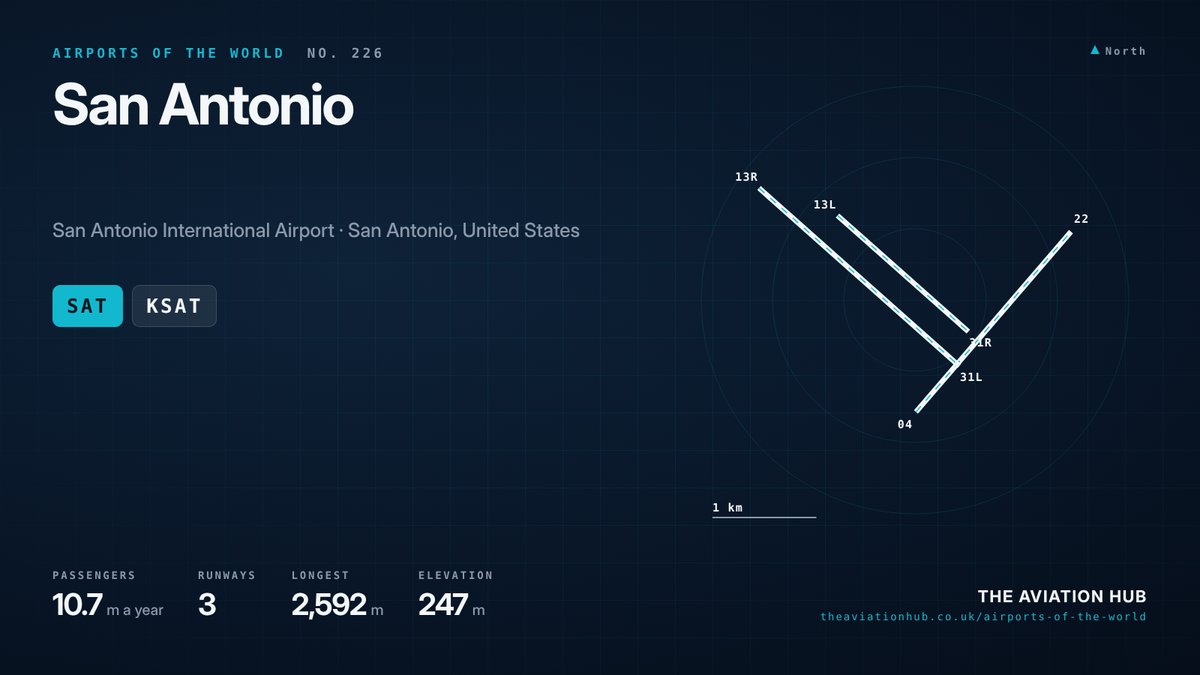
San Antonio International Airport sits about 8 miles (13 km) north of downtown, in the uptown district inside Loop 410. It serves the seventh largest city in the United States yet remains a mid sized airport, overshadowed by the giant hubs at Dallas Fort Worth and Houston. San Antonio Airport handled around 10.7 million passengers in 2025 and offers nonstop flights to roughly 45 destinations in the United States and Mexico. A new Terminal C, due in 2028, is the biggest investment in its history.
San Antonio Airport at a Glance
The IATA code is SAT and the ICAO code is KSAT. The field lies at 809 feet (247 m) on the limestone plateau north of the city, hemmed in by suburbs on every side. There are three runways and two terminals, A and B, with a third under construction. In 2025 the airport handled 10.74 million passengers, a dip of about 3 per cent on the previous year, and around 125,000 tonnes of cargo.
Southwest Airlines is the largest carrier with roughly 37 per cent of passengers, followed by American, Delta, United and Frontier. No airline runs a hub here. The City of San Antonio owns the airport and its Aviation Department operates it. Parking, flight status and construction updates are posted on the airport’s official website.
How San Antonio’s Airport Came to Be
The city bought 1,200 acres of undeveloped land north of its limits in 1941 for a municipal airport. War intervened. The north eastern section became Alamo Field, a United States Army Air Forces training base, and the civil project was not completed until after 1945. Braniff Airways was the first airline to serve the field, in 1943, and the city renamed it San Antonio International Airport in 1944.
Southwest Airlines began flying in June 1971 with Dallas, Houston and San Antonio as its three original destinations, which gave the airport a prominence it has never quite lost. Terminal 1, now Terminal A, opened in 1984 and remains the main building. The original Terminal 2 closed when Terminal B opened in November 2010, and it was demolished soon after.
San Antonio Airport has spent decades as the junior partner to its Texan neighbours. Dallas Fort Worth and Houston Intercontinental became global hubs while San Antonio stayed a point to point market. The military presence around the city, with Lackland and Randolph air force bases nearby, has shaped the airspace and the local economy far more than the civil airport.
Runways at San Antonio Airport
There are three runways. Runway 04/22 is concrete, 2,592 metres (8,505 feet) long and 46 metres wide. Runway 13R/31L is also concrete, 2,591 metres (8,502 feet) long and 46 metres wide. Runway 13L/31R is asphalt, 1,682 metres (5,519 feet) long and 30 metres wide, and serves general aviation and small turboprops.
The two main runways cross, so the airport cannot run them independently in the way a parallel layout allows. The prevailing south easterly winds favour runway 13R for much of the year, with north westerly winds behind cold fronts flipping operations to 31L. Approaches on 13R cross the northern suburbs, while 31L arrivals come in over the neighbourhoods to the south east. Both main runways can handle a Boeing 767 or Airbus A330, but their length limits heavy long haul departures in the Texas summer heat.
Terminals and Airlines
Terminal A at San Antonio Airport opened in 1984 and has 17 gates. It houses the customs and immigration facility, so every international flight uses it. Twelve of the 14 airlines serving the airport operate from Terminal A, including Southwest, Delta, Frontier, Alaska, Sun Country, Breeze, Air Canada, Aeromexico, Volaris and Viva. The building has been refurbished but shows its age.
Terminal B opened in 2010 for American and Continental, and United moved across in 2012. A 2023 extension took it to ten gates. The terminal is brighter and more spacious than its neighbour and connects by sky bridge to the consolidated rental car facility completed in 2018. A separate ground load facility for ultra low cost airlines such as Frontier began construction in October 2023.
Southwest’s Boeing 737-700, 737-800 and 737 MAX 8 fleet dominates the apron. American brings Airbus A321 and Boeing 737-800 jets from its Dallas and Charlotte hubs, Delta flies from Atlanta and Salt Lake City, and United connects Houston, Denver and Chicago.
Routes and Destinations
Dallas Fort Worth is the busiest route from San Antonio Airport, with about 516,000 passengers in 2025, followed by Atlanta, Denver, Las Vegas and Phoenix. Houston, Chicago, Los Angeles and Charlotte complete the leading markets. Southwest links the city to Dallas Love Field, Houston Hobby and a long list of leisure destinations such as Orlando, Nashville and Baltimore.
Mexico is the main international market, with Aeromexico, Volaris and Viva serving Mexico City, Guadalajara and Monterrey. Condor launched a seasonal Frankfurt service in 2024, the airport’s first nonstop flight to Europe, but withdrew it within months. There is no long haul service today. Cargo is modest, carried mainly by FedEx and UPS freighters serving the growing distribution economy along Interstate 35.
Getting to and from San Antonio Airport
San Antonio Airport has no rail link, and the city has no light rail at all. VIA Metropolitan Transit runs the Route 5 local bus to downtown via the North Star transit centre, which takes about 40 minutes and costs a couple of dollars. A weekday express, Route 7, links the airport with downtown and the Stone Oak park and ride. The bus is the cheapest option but few visitors use it.
US Highway 281 runs past the western edge of the field and reaches downtown in under 15 minutes in normal traffic. Loop 410 skirts the southern boundary. Taxis and ride hailing services pick up outside both terminals, with fares to downtown of around 25 to 35 dollars. Parking is plentiful, with short term and long term garages next to the terminals and cheaper economy lots served by shuttle buses.
The rental car facility is connected to Terminal B by a covered sky bridge and to Terminal A by a short walk. Hotels along Loop 410 run shuttles on request.
Spotting and Photography
San Antonio Airport is a comfortable airport for spotting because it sits among ordinary streets. The best known position is along Wetmore Road and the roads east of the field, which look across the runways. Morning light suits this side. The roads along the western perimeter near Highway 281 work better in the afternoon.
The traffic is almost entirely narrow body, but the mix of Southwest, American, Delta, United, Frontier and the Mexican carriers gives some variety. Military aircraft from Lackland and Randolph pass through on occasion, and the Airbus A330neo that Condor flew to Frankfurt drew crowds. Cold front days bring clear air and crisp light.
Stay on public pavements, keep away from fence lines near the cargo apron and do not block driveways on the residential streets. Airport police are used to spotters but respond quickly to anything that looks like loitering near the perimeter.
What Comes Next
Work began in 2023 on a programme scheduled for completion in 2028. The centrepiece is Terminal C, with up to 17 gates, six of them sized for wide body aircraft, and a central security checkpoint serving all terminals. Terminal A will be renovated, and the airfield and access roads upgraded. The wide body gates are a statement of intent for future European and Latin American flights.
The challenge is demand. Passenger numbers fell in 2025, Condor’s experiment failed and the Dallas and Houston hubs absorb most of the region’s connecting traffic. San Antonio Airport is heading for a modern terminal with capacity to spare, and the next decade will show whether the airlines fill it. See where it sits among North American airports on the Airports of the World map.
Continue to follow The Aviation Hub for more analysis and insight.
Advertise with us Your brand, in front of an aviation audience Home page and in-article placements, sold directly, one advertiser per slot. From £250 a year. See the rates

