
Marrakech Airport Guide: Menara, Low Cost Boom and the Atlas
Marrakech Airport has one long runway, a striking lattice terminal and a booming low cost network. Read about its history, routes, transport and spotting.
 By The Aviation Hub
6 min read
Updated October 20, 2026
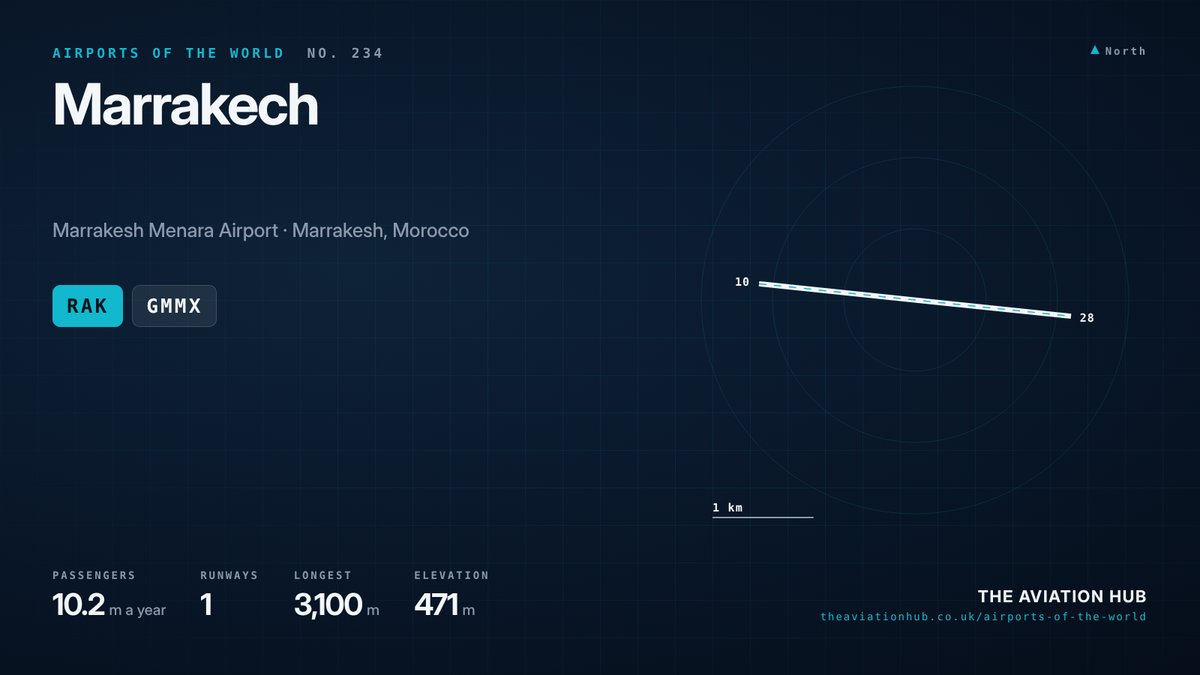
Marrakech Menara Airport lies on the south western edge of the city, barely 3 miles (5 km) from the medina and the Jemaa el Fna square. It is the main gateway for Morocco’s most visited city and for trips into the High Atlas. Marrakech Airport passed 10 million passengers for the first time around 2025, up from 6.3 million in 2019. Low cost airlines drive that growth, and the airport now handles far more traffic than its terminals were planned for.
Marrakech Airport at a Glance
The IATA code is RAK and the ICAO code is GMMX. The field sits 1,545 feet (471 m) above sea level on the Haouz plain, with the snow capped Atlas visible to the south on clear days. It has one runway and a single large terminal building that houses Terminals 1 and 2, plus a smaller Terminal 3. It handled about 9.3 million passengers in 2024, and traffic kept climbing through 2025.
Royal Air Maroc, the national carrier, flies from its Casablanca hub and on selected international routes. Ryanair and easyJet carry a large share of passengers, and Transavia, Jet2 and TUI are also prominent. The airport is run by ONDA, the national airports office. Flight information and terminal details are on the airport’s official website.
How Marrakech’s Airport Came to Be
The airfield takes its name from the Menara gardens, the olive groves and pavilion that sit just to the north east. During the Second World War the United States Army Air Forces’ Air Transport Command used it as a hub for cargo, transiting aircraft and personnel. It served as a stop on the trans African route between Cairo and Dakar.
After the war Marrakech became a slow burning tourist destination, popular with artists, designers and the jet set. The airport stayed modest until a major upgrade in the late 1980s. It reopened in August 1991 after around 8 million dollars was spent lengthening the runway and refurbishing the buildings.
Modern Marrakech Airport took shape in the 2000s, as Morocco opened its skies to European airlines under an open skies deal with the European Union. The terminal was rebuilt and extended in stages, finishing with a combined 42,000 square metres for Terminals 1 and 2 and a design capacity of around 9 million passengers. Its white geometric lattice facade, inspired by Islamic patterns, quickly became the airport’s calling card.
Runways at Marrakech Airport
There is one runway, 10/28, with an asphalt surface 3,100 metres (10,170 feet) long and 45 metres wide. It can handle aircraft up to the size of the Boeing 747, and the apron has room for about 14 Boeing 737s and four 747s at once. An ILS rated to Category II, backed by VOR, DME and NDB aids, guides arrivals in poor weather.
The single runway is the obvious constraint at Marrakech Airport. Every movement, from Airbus A320neo jets on short European hops to the occasional wide body, shares one strip of asphalt. The airfield sits at a moderate elevation and summer temperatures often pass 40C, which reduces climb performance and can limit payload on longer flights. The Royal Moroccan Air Force’s flying school also uses the field, adding trainers to the mix.
Terminals and Airlines
Terminals 1 and 2 share one building and handle almost every scheduled flight, with check in, security and gates spread across the two. Terminal 3, a smaller facility, supports peak operations. ONDA’s VIP service, the Salon Convives de Marque, is available here as at a handful of other Moroccan airports.
Ryanair and easyJet dominate the schedule with Boeing 737-800 and Airbus A320 family jets. Transavia and Volotea serve France, Jet2 and TUI carry British package holidaymakers, and Vueling, Wizz Air and Eurowings add Spain, Italy and Germany. Royal Air Maroc links Marrakech Airport with Casablanca and Paris. Other carriers add links to the Gulf and the wider Arab world.
Routes and Destinations
France is the largest market by a distance. Paris Orly and Charles de Gaulle lead, with Lyon, Marseille, Nantes, Bordeaux and Toulouse all well served. The United Kingdom follows, with London Gatwick, Stansted and Luton, Manchester, Bristol and Birmingham feeding a steady flow of city break and riad travellers. Spain, Italy, Belgium, Germany and the Netherlands complete the European network.
North American flights began in 2024, when Air Transat and United arrived, giving Marrakech Airport its first direct links across the Atlantic. Those transatlantic sectors, at well over 3,500 miles (5,600 km), are the longest on the network. Domestic flying is thin, because trains and roads link Marrakech with Casablanca, Rabat and Tangier.
The pattern is less seasonal than at beach airports. Spring and autumn are peaks, winter brings city breaks and Christmas sun, and only the fierce heat of July and August softens demand from Europe.
Getting to and from Marrakech Airport
There is no rail link. The airport bus, route 19, runs from the terminal to Jemaa el Fna and the hotels of Gueliz and Hivernage in about 20 to 30 minutes. It is the cheapest sensible option for travellers who are not staying deep inside the medina.
Taxis wait outside arrivals and the ride into the city takes 15 to 20 minutes. Fares are officially regulated but often negotiated, so agree a price before setting off, usually somewhere between 100 and 200 dirhams (roughly £8 to £16). Many riads send a driver to meet guests, which is the easiest choice for anyone heading into the narrow lanes of the medina. Car hire desks sit in the terminal, and the A7 motorway reaches Casablanca in about two and a half hours.
Spotting and Photography
Spotting at Marrakech Airport needs caution. Morocco treats airports as sensitive sites, the Air Force operates from the field, and photographing the perimeter can attract quick attention from police. The safest views are from inside the terminal, where windows overlook parts of the apron.
The setting is the attraction. On clear winter mornings the snow capped High Atlas forms a spectacular backdrop to aircraft on the runway. Traffic is mostly European narrow bodies, but Royal Air Maroc and the North American services add variety. Winter light is soft and the air is usually clear after rain.
Always ask permission if in doubt, never photograph military aircraft or installations, and stop immediately if asked by officials.
What Comes Next
Traffic has outgrown the terminals. Morocco is co hosting the 2030 FIFA World Cup with Spain and Portugal, and ONDA’s investment programme for the tournament is expected to bring substantial new terminal capacity to Marrakech. A high speed rail extension from Casablanca to Marrakech is also under construction, which will strengthen links with the rest of the country.
The single runway will remain the long term question. Marrakech Airport is heading for continued rapid growth, powered by low cost airlines and Morocco’s tourism ambitions, provided the new terminal space arrives in time. See how it compares with Casablanca, Agadir and Fes on the Airports of the World map.
Continue to follow The Aviation Hub for more analysis and insight.
Advertise with us Your brand, in front of an aviation audience Home page and in-article placements, sold directly, one advertiser per slot. From £250 a year. See the rates

