
Almaty Airport Guide: Central Asia’s Busiest Gateway
Almaty Airport is the busiest in Kazakhstan and Central Asia, the home of Air Astana and FlyArystan. Runways, terminals, routes and access explained.
 By The Aviation Hub
6 min read
Updated October 20, 2026
Almaty International Airport sits beneath the snow capped Tian Shan mountains on the northeastern edge of Kazakhstan’s largest city. Almaty Airport is the busiest in Central Asia, handling more than 11 million passengers in 2024, and it is the principal hub of Air Astana and its low cost offshoot FlyArystan. A new international terminal opened in 2024 under the ownership of TAV Airports, and a far larger investment programme is now under way. For anyone flying between Europe, China and the heart of Asia, this is the region’s key crossroads.
Almaty Airport at a Glance
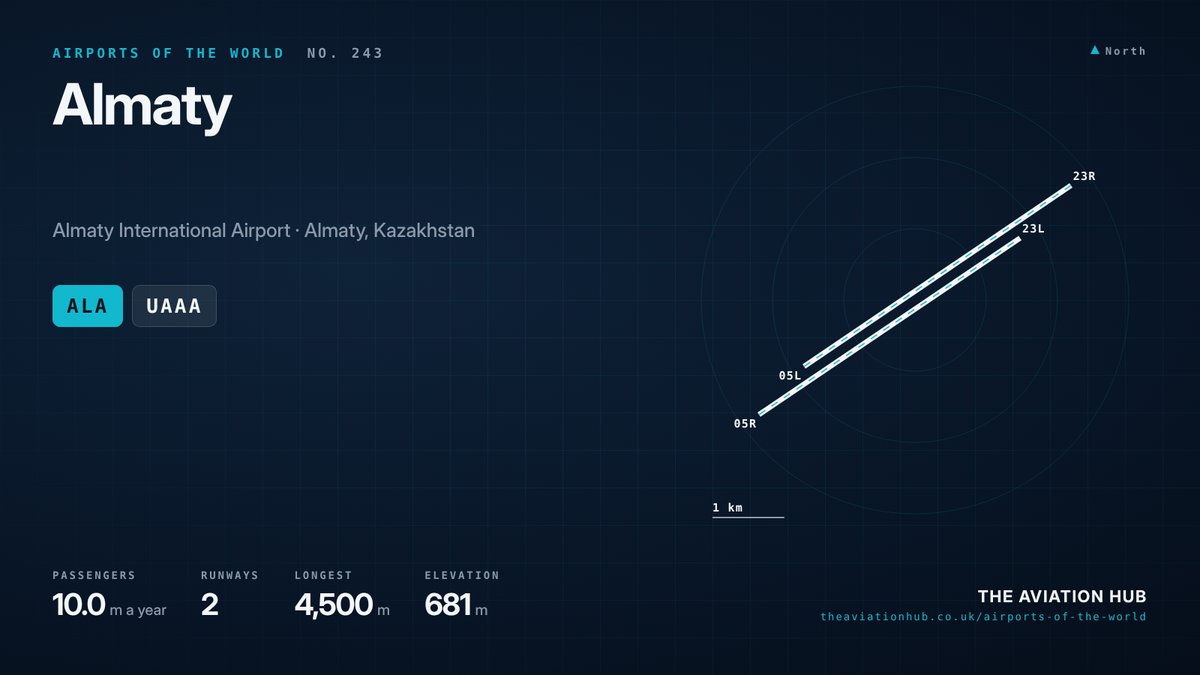
The IATA code is ALA and the ICAO code is UAAA. The airport lies about 9 miles (15 km) northeast of the city centre at an elevation of 681 metres (2,234 feet), with the mountains rising steeply to the south. Two parallel runways and two passenger terminals make up the main infrastructure, with Terminal 1 serving domestic flights and Terminal 2 handling international traffic.
Passenger numbers reached roughly 11.4 million in 2024, up almost a fifth on the previous year and well clear of the capital’s airport at Astana. Air Astana, FlyArystan, Qazaq Air and Sunday Airlines are based here, and SCAT Airlines treats it as a focus city. The airport is owned by TAV Airports, the Turkish group that is part of Groupe ADP. Current flight and facility details are published on the airport’s official website.
How Almaty’s Airport Came to Be
The airfield dates from 1935, when it opened for small civil and military aircraft serving what was then Alma Ata, the Soviet capital of Kazakhstan. A main terminal arrived in 1973 as jet traffic grew. The airport even saw supersonic service, with Aeroflot flying the Tupolev Tu-144 between Moscow and Alma Ata. Mail and freight flights began in 1975, and passengers followed from 1977 to 1978 on the type’s only scheduled passenger route.
Independence in 1991 brought a new commercial structure, and the company took the Almaty Airport name in 1994. The runway was rebuilt in 1998, which secured full international status, and a year later a fire that started in a kitchen gutted much of the old terminal. A replacement Terminal 1 opened in December 2003, designed by the architect Qaldybai Montahaev.
A second runway opened in 2008. The airport changed hands in 2021 when TAV Airports bought it, and the following January it was briefly seized by protesters during the unrest that swept Kazakhstan, halting all flights for several days. Terminal 2 opened on 1 June 2024 and moved all international flights out of the crowded 2003 building.
Runways at Almaty Airport
Almaty Airport has two parallel runways aligned northeast to southwest. Runway 05L/23R is 4,500 metres (14,764 feet) long and runway 05R/23L is 4,400 metres (14,436 feet). The lengths reflect the altitude and the hot summers, which thin the air and lengthen take off runs for heavy jets bound for Europe or East Asia.
The newer 05L/23R opened in September 2008 and carries a CAT III instrument landing certificate, which matters in a city where winter fog and smog from the valley can cut visibility badly. The two runways allow parallel operations, and runway reconstruction is part of the current investment plan.
Approaches from the southwest on runway 05 bring aircraft over the city’s northern suburbs, while runway 23 arrivals come in over the flat steppe to the northeast. The mountains to the south shape every procedure, and crews treat the field with respect. Two serious accidents since 2013, a SCAT Airlines CRJ-200 in 2013 and a Bek Air Fokker 100 in 2019, both happened in winter conditions close to Almaty Airport.
Terminals and Airlines
Terminal 1, the 2003 building, now handles domestic traffic. Air Astana and FlyArystan dominate it, with dense schedules to Astana, Shymkent, Aktau, Atyrau and the oil towns of the west. SCAT fills out the domestic board with Boeing 737 services.
Terminal 2 is the international building at Almaty Airport, opened in June 2024 with more than 53,000 square metres of floor space, 50 check in desks and 20 passport control booths backed by automated gates. Air Astana operates its Airbus A321LR and Boeing 767-300ER long haul fleet from here. Foreign carriers include Turkish Airlines, Qatar Airways, flydubai, Lufthansa, Aeroflot, China Southern, China Eastern and Uzbekistan Airways, together with a growing list of Chinese and Gulf low cost operators.
Routes and Destinations
Astana is the busiest route, with Air Astana and FlyArystan running a near shuttle service to the capital. Shymkent, Aktau and Atyrau are other important domestic links. Internationally, Istanbul, Dubai, Moscow and Tashkent are key routes, with Istanbul serving as a major gateway to Western Europe for connecting passengers.
Air Astana flies directly to London Heathrow, Frankfurt, Seoul, Beijing, Delhi and Bangkok, and plans to start flights to Tokyo Narita on 30 November 2026 after an earlier launch date slipped. A planned New York service has been postponed indefinitely. Chinese routes to Urumqi, Beijing and Shanghai have grown fast since visa free travel was introduced between the two countries. Winter brings ski traffic to the slopes above the city, while summer sees heavy demand to Turkey, Georgia and the Gulf.
Getting to and from Almaty Airport
There is no rail or metro link, so road is the only option. Almaty Airport is a 25 to 40 minute drive from the centre, depending on traffic, which can be heavy in the evening peak. Yandex Go is the standard ride hailing app and a trip to the centre costs around KZT 3,000 to 5,000 (roughly £5 to £8). Official taxis at the terminal charge more.
City bus routes 3 and 92 stop at both terminals and run into the centre for a small fare, which makes them the cheapest sensible option for anyone without heavy luggage. The journey takes about an hour. Two car parks serve the terminals, with short stay spaces in front of the buildings and a larger long stay area nearby.
Many hotels in the city centre and the ski resorts of Shymbulak and Medeu arrange transfers. Travellers heading to Bishkek in neighbouring Kyrgyzstan can take a shared taxi or coach from the city, a trip of roughly four hours by road.
Spotting and Photography
The mountain backdrop makes Almaty Airport one of the more photogenic airports in Asia. The best views are of aircraft landing on runway 23 with the peaks of the Zailiysky Alatau behind them, and the open ground to the northeast of the field along the approach path gives a clear line of sight. Morning light is best, before haze builds over the city in the afternoon.
Enthusiasts also watch from the roads south of the runways around the Turksib district, where departures on runway 23 climb out overhead. The international terminal has large windows airside but no public viewing deck. Winter brings crisp air and snow on the mountains, which is spectacular for photography but demands warm clothing and short sessions.
Kazakhstan’s security services take photography near airports seriously. Stay on public roads, do not photograph military areas or the perimeter fence at close range and carry identification. A courteous explanation usually settles any questions from police, but do not argue.
What Comes Next
TAV launched the Horizon investment project in 2025 with a budget of around US$1.5 to 1.7 billion. The first phase, due to run to 2028, covers runway reconstruction, new taxiways, terminal upgrades and a system to recycle deicing fluid, with a maintenance hangar planned later. The longer term plan talks of a third runway, a special economic zone around the field and a target of 40 million passengers by 2050.
The strategy makes sense. Kazakhstan sits on the overland routes between China and Europe, Air Astana is growing, and the country’s visa policy is drawing tourists and transit passengers. Almaty Airport is heading upwards, and the main constraint is how fast the terminals and runways can keep up with demand. See how it compares with other Asian hubs on the Airports of the World map.
Continue to follow The Aviation Hub for more analysis and insight.
Advertise with us Your brand, in front of an aviation audience Home page and in-article placements, sold directly, one advertiser per slot. From £250 a year. See the rates

