
Makassar Airport Guide: Gateway to Eastern Indonesia
Makassar Airport links Jakarta and Bali with eastern Indonesia. Our guide covers its runways, enlarged terminal, airlines, routes, transport and spotting.
 By The Aviation Hub
5 min read
Updated October 20, 2026
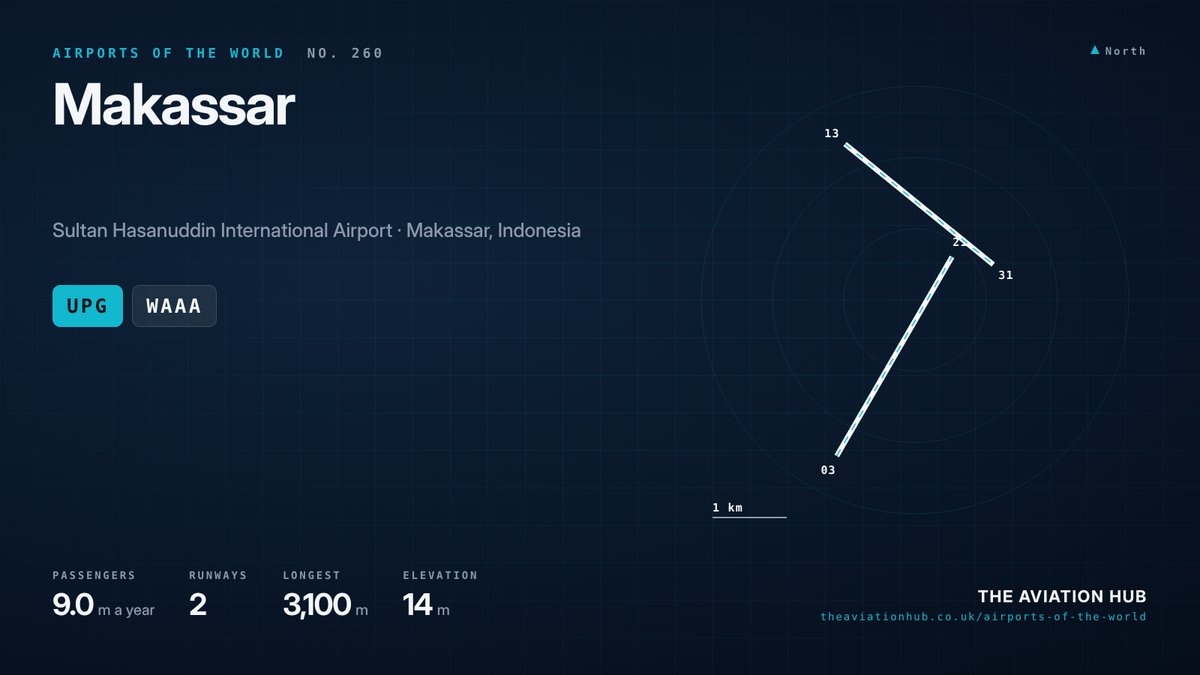
Sultan Hasanuddin International Airport sits on the coastal plain of South Sulawesi, northeast of the port city it serves. Makassar Airport handled close to 10 million passengers in 2024 and acts as the main stepping stone between western Indonesia and the islands further east, including Maluku and Papua. It shares its runways with a major Indonesian Air Force base, home to Sukhoi fighters.
Makassar Airport at a Glance
The IATA code is UPG, a legacy of the city’s former name of Ujung Pandang, and the ICAO code is WAAA. Makassar Airport lies in Maros Regency, about 12 miles (20 km) northeast of central Makassar by road, at an elevation of 14 metres (47 feet). It has two runways and one passenger terminal, enlarged in 2024.
Traffic reached about 9.7 million passengers in 2024, down almost 8 per cent on 2023, while cargo rose by around a fifth to more than 96,000 tonnes. Garuda Indonesia, Lion Air and Batik Air use the airport as a hub, and Citilink, Super Air Jet and Wings Air base aircraft here. The state owned InJourney Airports runs the airport, and flight details are on the airport’s official website.
A Short History of Makassar’s Airfield
The Dutch colonial government built the field, then called Kadieng Airfield, in 1935. It opened on 27 September 1937 with a KNILM Douglas DC-2 service to Singapore. During the Japanese occupation from 1942 it became Mandai Airfield and gained a concrete runway, with Allied prisoners of war doing much of the labour.
The Indonesian Air Force took control in 1950, and civil aviation management followed in 1955. In 1980 the airport was renamed after Sultan Hasanuddin, the 17th century ruler of Gowa who fought the Dutch East India Company and is honoured as a national hero. International status came in 1994, and Malaysia Airlines launched a regular route to Kuala Lumpur in 1995.
A new terminal opened in 2008, and the old building passed to the Air Force before a fire destroyed it in 2016. An expansion that roughly tripled the terminal to about 150,000 square metres opened on 26 June 2024.
Runways at Makassar Airport
Makassar Airport has two asphalt runways, both 45 metres wide, set at an angle to each other. The main runway, 03/21, is 3,100 metres (10,171 feet) long and handles most airline traffic, including wide bodies on Hajj charters. The secondary runway, 13/31, is 2,500 metres (8,202 feet) long.
The wind shifts with the monsoon, westerly from about November to March and easterly for much of the rest of the year, and runway use changes with it. Heavy tropical downpours can cut visibility quickly in the wet season.
Runway excursions have been a recurring theme. Several Lion Air McDonnell Douglas MD-82 incidents occurred between 2003 and 2007, and a Garuda A330 left the paved surface in 2020. In August 2026 an Air Force Sukhoi fighter overran the runway, a reminder that civil and military traffic share the same strip.
Terminals and Airlines
All passenger flights use the single terminal, which handles both domestic and international traffic after the 2024 expansion. The enlarged halls have eased the crowding that built up as traffic outgrew the 2008 building.
Lion Air Group airlines fly the largest share of departures. Lion Air uses Boeing 737-900ER and 737 MAX 8 jets, Batik Air flies Airbus A320 and 737 aircraft, and Wings Air operates ATR 72 turboprops to smaller airports across Sulawesi and eastern Indonesia. Super Air Jet adds low cost A320 capacity.
Garuda Indonesia and its low cost arm Citilink provide the main alternative, with Garuda’s Boeing 737-800 and Airbus A330 aircraft on trunk routes. Sriwijaya Air and FlyJaya also use Makassar Airport as a focus city.
Routes and Destinations
Jakarta is the dominant route from Makassar Airport by far, linking the city with the capital about 890 miles (1,430 km) away. Surabaya, Denpasar and Balikpapan are other busy routes, while Ambon, Jayapura, Sorong, Manado and Kendari draw heavy transfer traffic heading east.
International service is limited. Scheduled flights reach Singapore and Kuala Lumpur, and seasonal Hajj and Umrah flights carry pilgrims to Jeddah and Medina. At roughly 5,700 miles (9,200 km), the pilgrimage flights to Saudi Arabia are the longest from the airport.
Cargo grew strongly in 2024. Seafood, fresh produce and general freight move through the airport on passenger aircraft and dedicated freighters, linking Sulawesi’s economy with Java and beyond.
Getting to and from Makassar Airport
There is no rail link to the terminal. The quickest route into the city uses the toll road, about 12 miles (20 km) and around 15 to 30 minutes depending on traffic. The regular highway is slightly longer and often slower.
Taxis and ride hailing apps such as Grab and Gojek operate from the terminal. DAMRI runs a long distance bus to Tanjung Bira in the south of the province, and the Trans Sulsel bus network also serves the airport. Pete pete minibuses are the cheapest sensible option, with a journey into the city costing well under Rp 10,000 including transfers, though they take time.
Car parks sit in front of the terminal, and hotel transfers are widely available. Many visitors heading to Tana Toraja continue by road, a journey of eight hours or more.
Spotting and Photography
Makassar Airport offers an unusual mix. Lion Air Group jets dominate, but the Air Force base adds Sukhoi Su-27 and Su-30 fighters, C-130H Hercules transports and maritime patrol aircraft, and Hajj season brings wide bodies.
That military presence is a serious constraint. Photographing military aircraft or installations in Indonesia is prohibited, and enthusiasts near the perimeter with cameras are likely to be stopped. The terminal windows offer a safer view of airline traffic, but even there, keep lenses pointed at civil aircraft only.
Follow all local rules, keep away from fences and military gates, and never fly drones near the airfield. Morning light before the afternoon storms is usually best.
What Comes Next
The long term master plan sets out further phases. Phase II aims for capacity of 21 million passengers a year with 47 aircraft stands, Phase III targets 30.8 million by 2034, and Phase IV 40 million by 2044. Delivery dates have already slipped, and traffic fell in 2024.
Even so, Makassar Airport is well placed as the transfer point for eastern Indonesia, where air travel is often the only practical way to move between islands. The verdict is an airport with room to grow and a clear role, provided demand recovers. Compare it with other Indonesian airports on the Airports of the World map.
Continue to follow The Aviation Hub for more analysis and insight.
Advertise with us Your brand, in front of an aviation audience Home page and in-article placements, sold directly, one advertiser per slot. From £250 a year. See the rates

