
Lijiang Airport Guide: High Altitude Gateway to Yunnan
Lijiang Airport sits at 2,243 metres beneath the Jade Dragon Snow Mountain. Read about its runway, airlines, routes, bus links and spotting in northwest Yunnan.
 By The Aviation Hub
6 min read
Updated October 20, 2026
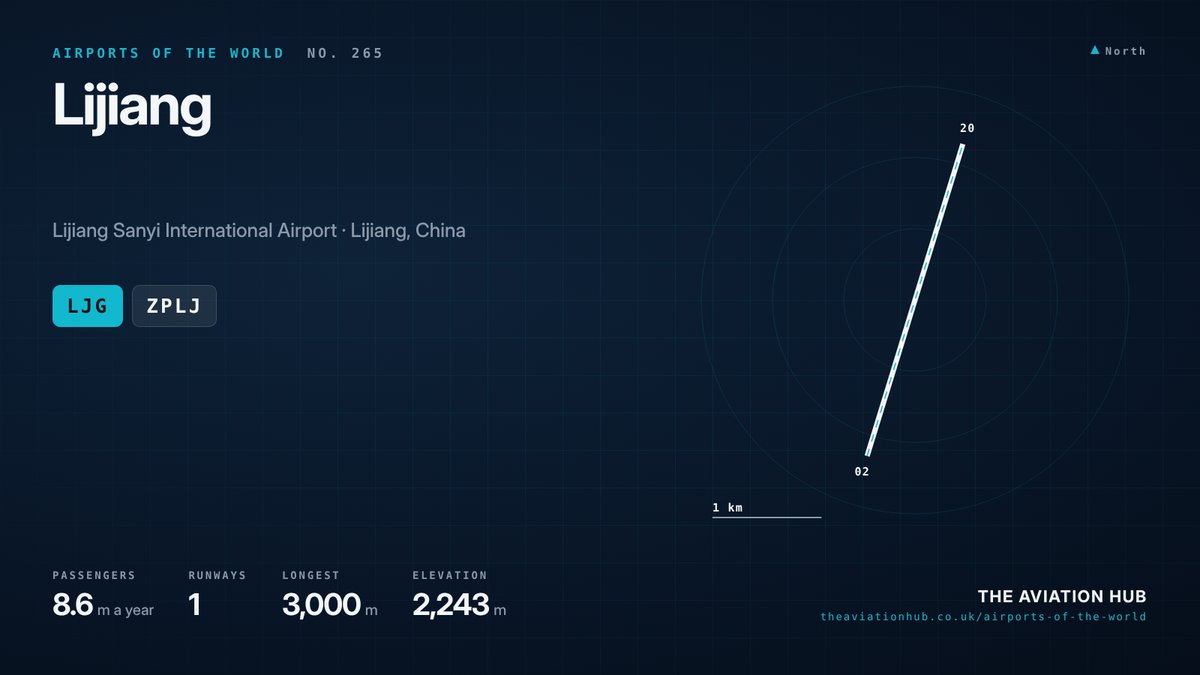
Lijiang Sanyi International Airport is the busiest tourist airport in northwest Yunnan, serving the UNESCO listed old town of Lijiang and the mountain country that rises towards Tibet. It sits high on a plateau at 2,243 metres, which makes it one of the higher airports in this series and shapes everything from runway length to aircraft performance. Lijiang Airport handles more than eight and a half million passengers a year, almost all of them Chinese tourists heading for the old town, Tiger Leaping Gorge and Shangri La.
Lijiang Airport at a Glance
The IATA code is LJG and the ICAO code ZPLJ. The field lies about 16 miles (25 km) south of the Lijiang city centre near the village of Sanyi, from which it takes its name. Elevation is 2,243 metres (7,359 feet), which puts it in the thin air category where engines produce less thrust and take off runs stretch. There is one runway and one passenger terminal with domestic and international sections.
Traffic reached roughly 8.6 million passengers in 2025, with around 62,500 aircraft movements and about 17,000 tonnes of cargo. No airline calls the field a hub, and China Eastern’s Yunnan subsidiary, Lucky Air and Kunming Airlines are among the main operators. Sichuan Airlines, Air China, China Southern and Hainan Airlines add trunk routes. Lijiang Airport is run by Yunnan Airport Group, the provincial company that also operates Kunming. Flight listings are on the airport’s official website.
How Lijiang’s Airport Came to Be
Lijiang was a remote trading town on the old tea horse road until the 1990s, a long road journey from Kunming. The provincial government saw an airport as the way to open the Naxi heartland to visitors, and construction began in 1992 on a stretch of level ground south of the town. The field was completed in April 1995 and opened to traffic that July with a 2,500 metre runway and a small terminal.
Two events transformed it. The 1996 earthquake that damaged the old town brought reconstruction money and attention, and the 1997 UNESCO listing made Lijiang a national destination. The 1999 World Horticultural Exposition in Kunming pushed annual throughput past half a million for the first time and triggered the first expansion.
A second and much larger programme in 2007 extended the runway by 500 metres and added a 33,300 square metre domestic terminal designed for 4.5 million passengers. Traffic outgrew that figure within a few years. In March 2012 the airport was declared a national port open to foreign aircraft, the third in Yunnan after Kunming and Xishuangbanna, and gained the international title.
Runways at Lijiang Airport
Lijiang Airport has one asphalt runway, 02/20, measuring 3,000 metres (9,843 feet) long and 45 metres wide, with turning pads at both ends. The length matters because of the altitude. At 2,243 metres the air is roughly a quarter thinner than at sea level, so a Boeing 737-800 or Airbus A320 needs far more runway and climbs away more slowly than it would at Kunming. Airlines operate with weight restrictions on hot afternoons.
The runway sits in a valley aligned roughly north to south between ridges, with the Jade Dragon Snow Mountain rising to more than 5,500 metres well to the north. Arrivals on runway 20 approach from the north, down the valley from the Lijiang side, while runway 02 brings aircraft in from the south. Mountains on both sides make terrain the main concern for crews. Afternoon thermals and valley winds make summer arrivals bumpy.
Terminals and Airlines
The 2007 domestic terminal, with 33,300 square metres of floor space, handles almost all of the traffic. Domestic flights make up the great majority of movements. International services are few and come and go with demand, mostly to Southeast Asia.
China Eastern is the largest carrier through its Yunnan arm, giving SkyTeam the strongest alliance presence, with Xiamen Air reinforcing it. Air China and Shenzhen Airlines represent Star Alliance. Lucky Air, a Hainan group subsidiary based at Kunming, flies a dense network of tourist routes. Sichuan Airlines, China Southern and other carriers add more capacity.
Routes and Destinations
Kunming is a key route from Lijiang Airport, with many flights a day taking under an hour. Other main routes run to Chengdu, Chongqing, Guangzhou, Shenzhen, Shanghai and Beijing, the cities that supply most of the tourists. Hangzhou, Nanjing, Wuhan, Xi’an and Changsha fill out the trunk routes, and smaller cities get seasonal services.
Tourism drives sharp seasonal swings. Summer holidays, the October National Day week and Chinese New Year bring extra flights and larger aircraft. International flights are irregular, and Ruili Airlines added a route to Ho Chi Minh City in 2024. Flights to Beijing take about three and a half hours. Cargo is small, at about 17,000 tonnes a year.
Getting to and from Lijiang Airport
There is no rail link to the terminal. Lijiang railway station, on the line from Kunming and Dali, lies on the southern edge of the city about 20 minutes from the airport by taxi. High speed trains from Kunming take about three hours and compete with the flights. Airport buses run between the terminal and the Blue Sky Hotel near the old town for 20 yuan (roughly £2), taking about 40 minutes, and depart after each arriving wave.
Taxis from Lijiang Airport to the old town cost around 80 to 100 yuan and take 30 to 40 minutes on the expressway. Ride hailing through Didi is usually cheaper, and hotels in the old town arrange private transfers for a fixed price. The airport expressway joins the main road south to Dali. Parking is in surface lots in front of the terminal, cheap by the hour and modest by the day.
Spotting and Photography
Lijiang Airport is a civil field and photography is more relaxed than at the military shared airports along the coast, though Chinese security staff still take an interest in long lenses. The best public views are from the terminal windows, which look across the apron to the runway and the mountains beyond. The northern approach, with aircraft descending past the snow peaks, is the signature shot.
Clear winter mornings give the sharpest light and the best view of the Jade Dragon Snow Mountain behind aircraft arriving from the north on runway 20. Summer brings haze and afternoon cloud. The traffic is mostly 737-800s, A320neos and A321neos in China Eastern, Lucky Air, Sichuan Airlines and Air China colours. Stay on public roads and footpaths, do not approach the fence and be polite with any officer who asks about your camera.
What Comes Next
The terminal was designed for 4.5 million passengers and now handles nearly twice that. A third phase expansion, with a new terminal and more aircraft stands, is in its final stage. Several new stands are already in use, and the project is due to open in 2027.
Competition from the high speed railway to Kunming and the Dali line is real, but the long distance tourist traffic from eastern China will keep the flights full. Expect steady growth at Lijiang Airport, sharper seasonal peaks and a gradual increase in international charters as Yunnan courts Southeast Asian visitors. Compare Lijiang with the other high altitude fields in this series on our Airports of the World map.
Continue to follow The Aviation Hub for more analysis and insight.
Advertise with us Your brand, in front of an aviation audience Home page and in-article placements, sold directly, one advertiser per slot. From £250 a year. See the rates

