
Adelaide Airport Guide: South Australia’s Coastal Gateway
Adelaide Airport handles more than nine million passengers a year. Explore its runways, terminal, airlines, JetBus links and the Project Flight upgrade.
 By The Aviation Hub
6 min read
Updated October 20, 2026
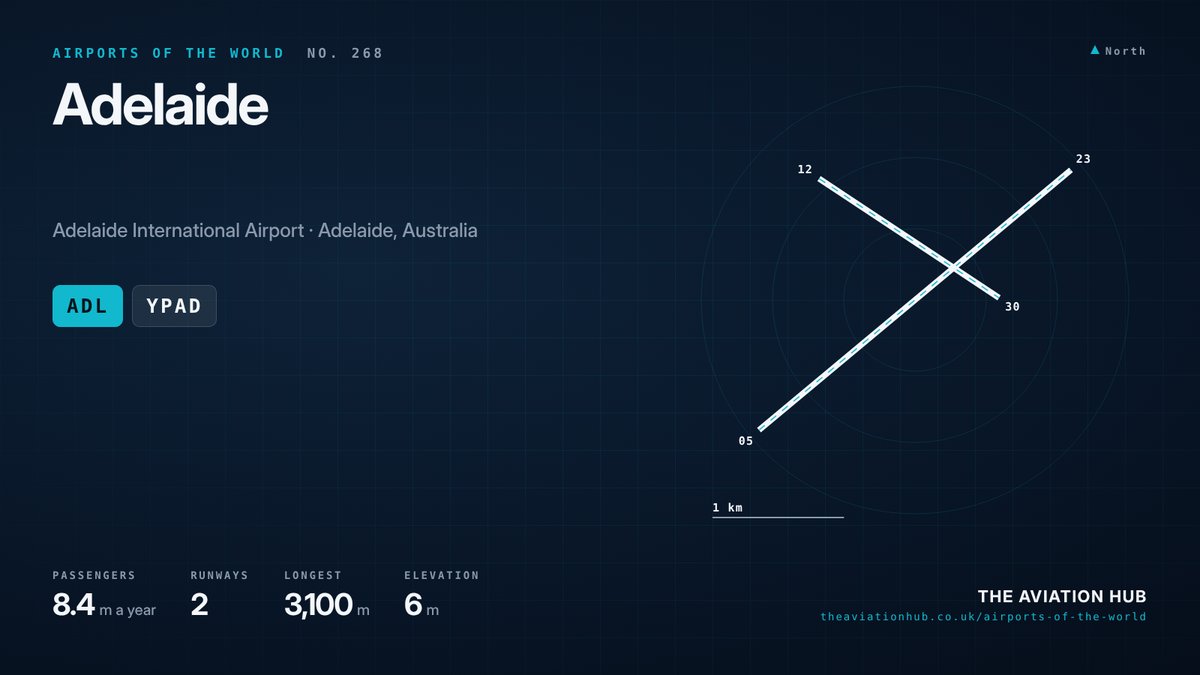
Adelaide Airport sits on the coastal plain between the city and the beaches of Gulf St Vincent, close enough to the centre that a taxi ride rarely takes more than 20 minutes. It is the main gateway to South Australia and handled a record of more than nine million passengers in the year to June 2026. One modern terminal serves both domestic and international flights, and a new wave of long haul links now reaches China and the United States.
Adelaide Airport at a Glance
The codes are ADL for IATA and YPAD for ICAO. The airport lies in its own suburb, named Adelaide Airport, beside West Beach and about 4 miles (6 km) west of the central business district. Elevation is just 6 metres (20 feet). There are two runways and a single combined terminal, known as T1, which handles every scheduled passenger flight.
Traffic reached roughly 9.15 million passengers in the 2025 to 2026 financial year, including a record 1.24 million international travellers. Qantas treats the field as a focus city and Virgin Australia as a hub, while Jetstar, QantasLink, Rex, Alliance Airlines and the Royal Flying Doctor Service all base aircraft here. Adelaide Airport Limited has run the site under a long term federal lease since May 1998. Its largest shareholder is the pension fund UniSuper, with 51 per cent. Flight information is on the airport’s official website.
How Adelaide’s Airport Came to Be
Adelaide’s first airfield opened at Albert Park, now Hendon, in 1921. Parafield in the northern suburbs took over later in the decade, but by the end of the Second World War it was clearly too small for the airliners to come. Work on a new site at West Beach began in 1947, the first flights arrived in 1954 and regular airline services started on 16 February 1955.
The early facilities were modest. A hangar annexe served as the first passenger terminal, and the domestic buildings that followed were long regarded as makeshift for a state capital. International flights arrived in the early 1980s with a separate terminal. In 1998 the main runway was extended by 570 metres to 3.1 km, and privatisation followed in the same year.
The turning point came on 8 October 2005, when the combined terminal opened. Domestic flights moved across on 17 February 2006, ending decades of split operations. The building has since been extended to add gates, lounges and a larger security area as demand has grown.
Runways at Adelaide Airport
Adelaide Airport has two asphalt runways that cross near the terminal. The main runway, 05/23, measures 3,100 metres (10,171 feet) by 45 metres and handles almost all jet traffic, from Airbus A320s to Boeing 777s. The secondary runway, 12/30, is 1,652 metres (5,420 feet) long and 45 metres wide, and it is mainly used by turboprops, general aviation and light jets when crosswinds make 05/23 uncomfortable.
Arrivals on runway 23 come in from the north east over the western suburbs, while arrivals on runway 05 approach from the coast. Summer sea breezes off the gulf often favour runway 23 in the afternoon. A curfew limits most operations between 11pm and 6am, which shapes the timing of international departures.
The airport has also experimented with its surroundings. A trial planted lucerne on land beside the runway and irrigated it with recycled water, aiming to cut temperatures nearby by around 3°C on warm days. Cooler air helps aircraft performance during heatwaves.
Terminals and Airlines
T1 at Adelaide Airport handles every airline on one site, with domestic and international gates under one roof. Qantas, Jetstar and QantasLink form the largest group, alongside Virgin Australia and Rex. Qantas runs a Qantas Club complex, Virgin and Rex have domestic lounges, and Plaza Premium operates the international lounge.
The international line up is broad for a city of 1.4 million people. Singapore Airlines, Qatar Airways, Emirates, Malaysia Airlines, Cathay Pacific, Air New Zealand and China Southern have all served the field, and United and China Eastern joined more recently. Jetstar and Indonesia AirAsia carry leisure traffic to Bali. Alliance Airlines and National Jet Express fly charters to mining sites across the outback.
Routes and Destinations
Melbourne is the busiest route, carrying about 2.41 million passengers in the 2025 to 2026 year. Sydney follows with 1.90 million and Brisbane with roughly 910,000. Perth, Canberra, the Gold Coast, Darwin and Alice Springs complete the core domestic network, and Rex and QantasLink serve regional centres such as Port Lincoln, Whyalla and Kangaroo Island.
Singapore is the top international route from Adelaide Airport, with around 321,000 passengers, followed by Denpasar with 286,000 and Kuala Lumpur with 165,000. Gulf carriers provide one stop links to Europe. United’s San Francisco service, launched in December 2025, is the longest route at roughly 8,100 miles (13,000 km), and China Eastern began flying to Shanghai on 20 June 2026. Bali is the staple leisure route, busiest in the southern winter.
Getting to and from Adelaide Airport
There is no rail link. Plans for a train line have been shelved, so buses do the work. Adelaide Metro runs JetBus routes J1 and J2 between the terminal and the city centre, Glenelg, Harbour Town and Tea Tree Plaza, while J7 and J8 serve West Lakes and Marion. A standard Metrocard fare makes the JetBus the cheapest sensible option, and the ride to the city takes around 30 minutes.
Taxis and ride hailing services collect from the forecourt outside T1. The run to the centre takes 15 to 20 minutes outside peak hours and typically costs around A$25 to A$35 (roughly £12 to £17). Drivers reach the terminal from Sir Donald Bradman Drive. The airport offers short stay, long stay and multi level parking within walking distance of the terminal, and the major car rental firms operate beside the terminal.
Spotting and Photography
The roads around the perimeter of Adelaide Airport do most of the work. Tapleys Hill Road runs along the western boundary beside the Harbour Town outlet centre, and Sir Donald Bradman Drive borders the north. Both give views across the field, with the right spot depending on which runway is active. In the southern hemisphere the sun sits to the north, so positions on the northern side tend to have it behind the camera.
Inside the terminal, the departure areas give clear views of the apron. A short walk from the terminal, the Vickers Vimy flown by Ross and Keith Smith from England to Australia in 1919 is preserved in a museum inside the long term car park and is worth a visit. Traffic includes Singapore Airlines Airbus A350-900s, Emirates Boeing 777-300ERs, Qantas and Virgin 737-800s and Rex Saab 340s. Stay on public land, keep clear of fences and follow any direction from airport security or police.
What Comes Next
Adelaide Airport Limited announced a A$600 million programme called Project Flight in August 2025. It adds terminal extensions, five more gates with aerobridges and extra parking, with completion expected by June 2028. A longer term 2050 Network Vision sets a goal of direct links to 39 cities around the world.
The curfew and a city of modest size will cap ambitions, but the new long haul routes show that airlines see real demand. Adelaide Airport looks set to keep growing steadily, with international traffic leading the way. See how it compares with other Australian gateways on our Airports of the World map.
Continue to follow The Aviation Hub for more analysis and insight.
Advertise with us Your brand, in front of an aviation audience Home page and in-article placements, sold directly, one advertiser per slot. From £250 a year. See the rates

