
Keflavik Airport Guide: Iceland’s Transatlantic Crossroads
Keflavik Airport links Europe and North America via Icelandair's hub. Explore its wartime origins, runways, terminal, routes and coaches to Reykjavik.
 By The Aviation Hub
6 min read
Updated October 20, 2026
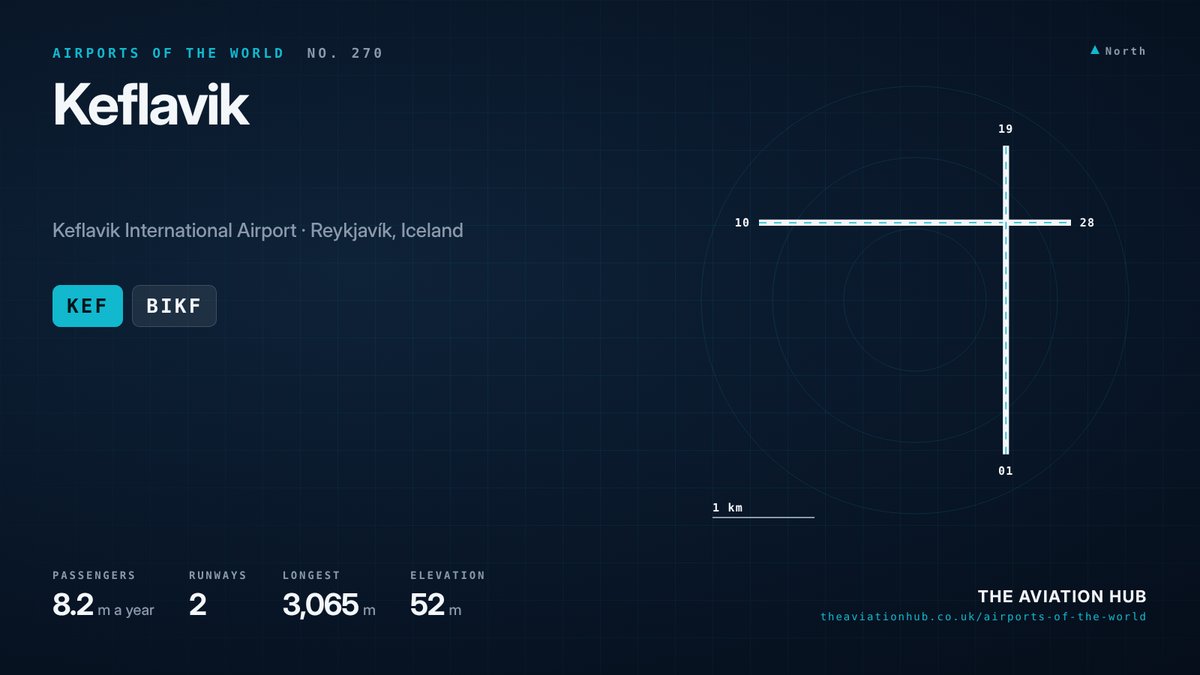
Keflavik Airport sits on a windswept lava plain at the tip of the Reykjanes peninsula, roughly 31 miles (50 km) southwest of Reykjavik. It handles almost every international flight to and from Iceland, and more than eight million passengers passed through in 2025. Icelandair built its business here on a simple idea: a mid Atlantic hub where flights from Europe and North America meet and swap passengers. The result is a small country’s airport with a genuinely global reach.
Keflavik Airport at a Glance
The codes are KEF for IATA and BIKF for ICAO. The airport lies beside the town of Keflavik, now part of the municipality of Reykjanesbaer, at an elevation of 52 metres (171 feet). There are two crossing runways and one terminal, the Leif Erikson Air Terminal, known locally as Leifsstod. Domestic flights do not use the field; they operate from Reykjavik Airport in the capital.
Traffic reached about 8.16 million passengers in 2025, a slight fall on 2024 and still below the record of 9.8 million set in 2018. Icelandair is the dominant carrier and runs its hub from Keflavik Airport, with around 27 airlines serving the field in 2025. The state owned company Isavia operates the site. Live departures and parking prices are on the airport’s official website.
A Short History of Meeks Field
The airport is a product of the Second World War. American forces arrived during the Allied occupation of Iceland and needed a base for aircraft crossing the North Atlantic. Patterson Field opened in 1942, and Meeks Field followed on 23 March 1943 on the site still used today. Both were named after young American pilots who died in Iceland. Patterson closed after the war, and the town of Keflavik eventually gave the surviving field its name.
The Cold War kept the Americans in place. Naval Air Station Keflavik hosted fighters and maritime patrol aircraft watching Soviet traffic in the gap between Greenland, Iceland and the UK. Civil flights shared the runways, and protests against the military presence in the 1960s and 1970s changed little. The US Navy finally left in 2006, and the former base housing has since been redeveloped.
The civil side grew separately. The Leif Erikson terminal opened in April 1987, giving airline passengers their own building away from the base. A South Building added in 2001 allowed Iceland to join the Schengen area, and the North Building was enlarged in 2007. A tourism boom after the 2010 eruption of Eyjafjallajokull put the island on the map and filled the terminal.
Runways at Keflavik Airport
Keflavik Airport has two asphalt runways, both 60 metres wide. Runway 10/28 measures 3,065 metres (10,056 feet), and runway 01/19 is 3,054 metres (10,020 feet). The generous width is a legacy of the military years. Both were built large enough to take NASA’s Space Shuttle and the Antonov An-225.
The crossing layout matters because the weather is fierce. Deep Atlantic lows bring gales from almost any direction, and having two long runways at right angles lets controllers keep crosswinds within limits for most of the year. Snow and ice are part of the winter routine. A Primera Air Boeing 737-800 slid off an icy runway in 2017, and an Icelandair Boeing 757-200 suffered a main gear collapse on landing in 2020.
The airfield also serves as a diversion point for twin engine jets crossing the North Atlantic under ETOPS rules. Isavia added a 1.2 km taxiway in 2023.
Terminals and Airlines
All passenger flights use the single terminal at Keflavik Airport. It has 13 gates with jet bridges and 17 remote stands, divided into A, C and D gates, with the D gates handling non Schengen departures such as the United States, Canada and the UK. A 2023 to 2025 expansion of the eastern wing added about 30 per cent more floor space, four jet bridges and a food hall.
Icelandair dominates, timing its waves so that North American arrivals connect with European departures and the reverse. The field lost two home carriers in quick succession, as WOW air collapsed in March 2019 and Play ceased flying on 29 September 2025. British Airways, Delta, United, Lufthansa, SAS, easyJet and Wizz Air are among the foreign airlines, and Icelandair Cargo, DHL and Amerijet carry freight.
Routes and Destinations
Copenhagen was the busiest route from Keflavik Airport in 2024, with about 556,000 passengers. Amsterdam followed with roughly 370,000, then Paris Charles de Gaulle, Boston and London Heathrow, each around 350,000. Oslo, New York JFK, Frankfurt, Manchester and Washington Dulles complete the top ten, which captures the hub model neatly: Scandinavia, the big European capitals and the American East Coast.
Icelandair also serves Greenland and the Faroe Islands, alongside dozens of cities across Europe and North America. Summer is the peak, when tourist demand and seasonal transatlantic routes both swell. Winter traffic leans on Northern Lights breaks from the UK and Europe. Cargo is significant for a small country, with fresh fish loaded into the holds of passenger aircraft bound for Europe and North America.
Getting to and from Keflavik Airport
There is no rail link. A high speed line was proposed in 2014 and its route remains safeguarded, but nothing has been built. Road access is via Route 41, a 31 mile (50 km) dual carriageway to the capital, and the drive takes around 45 minutes in good conditions.
Most visitors take a coach. Flybus and Airport Express both run to Reykjavik with connections to hotels, timed around flight arrivals, for around ISK 4,000 to 5,000 (roughly £25 to £30). The cheapest sensible option is Strætó route 55, which links Keflavik and central Reykjavik from a stop a few hundred metres from the terminal, though it runs less often. Taxis are expensive, often well over ISK 20,000 (roughly £120). Rental cars are popular, and parking sits beside the terminal.
Spotting and Photography
Open lava fields surround Keflavik Airport, so sightlines are long and obstructions few. The Asbru area to the east, the former base housing, gives views across parts of the airfield, and minor roads around the perimeter offer angles on both runways. Which one is active depends entirely on the wind, so check the forecast before setting out.
Timing is everything at a wave hub. North American arrivals land early in the morning, European departures follow, and the afternoon brings the reverse bank. Icelandair Boeing 757s, 767s, 737 MAX jets and new Airbus A321LRs fill the stands, and NATO aircraft still pass through. Summer light lasts almost all night, while winter offers only a few hours of daylight. Stay on public roads, keep clear of fences and respect any restricted military areas.
What Comes Next
Isavia’s masterplan aims for 15 million passengers a year. It includes new terminal piers, a third runway and an airport city on surrounding land. Volcanic activity on the Reykjanes peninsula since 2021 has been a reminder of the risks, though eruptions near Grindavik have so far left flights largely unaffected.
The collapse of Play leaves Icelandair stronger at home but more exposed to any downturn. With tourism steady and the transatlantic hub model proven, Keflavik Airport looks set for gradual growth rather than another boom. Compare it with other North Atlantic gateways on our Airports of the World map.
Continue to follow The Aviation Hub for more analysis and insight.
Advertise with us Your brand, in front of an aviation audience Home page and in-article placements, sold directly, one advertiser per slot. From £250 a year. See the rates

