
Mashhad Airport Guide: Iran’s Pilgrim Gateway in the East
Mashhad Airport serves millions of pilgrims to the Imam Reza shrine. Explore its runways, three terminals, Iranian airlines, routes and ground transport.
 By The Aviation Hub
6 min read
Updated October 20, 2026
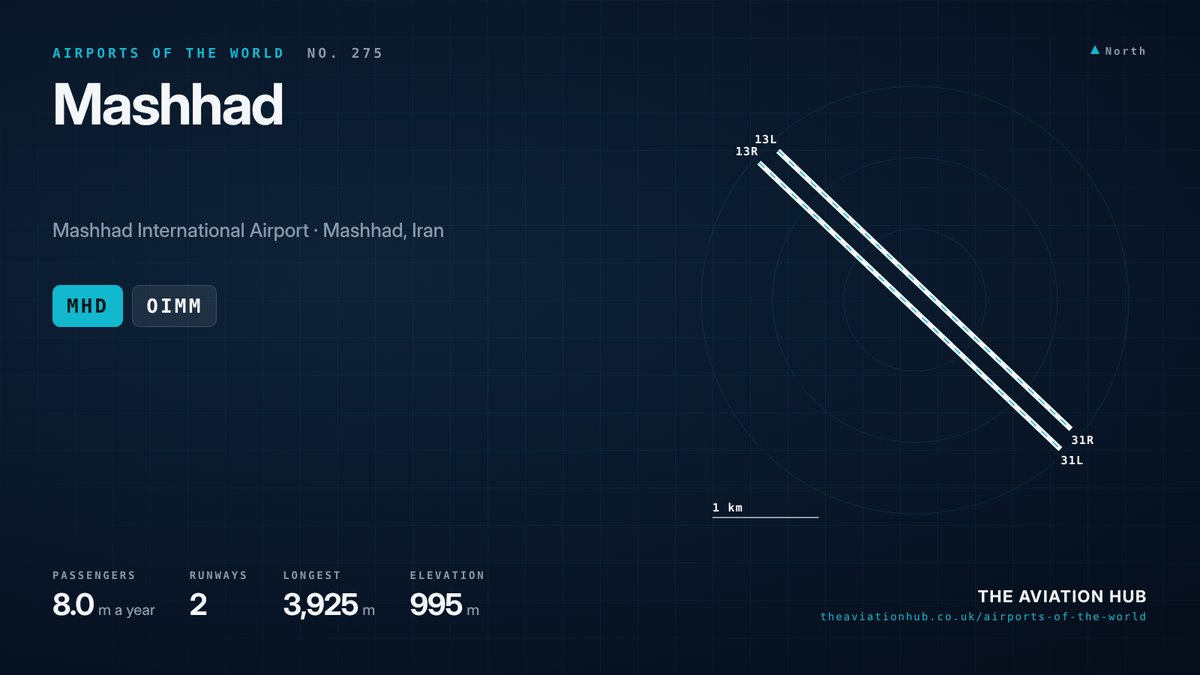
Mashhad Airport serves Iran’s second largest city and the shrine of Imam Reza, which draws millions of pilgrims every year. It sits on the south eastern edge of the city in Razavi Khorasan province, close to the borders with Afghanistan and Turkmenistan. The airport passed ten million passengers in 2016 and has since handled roughly eight to ten million a year, making it one of the busiest in the country. Pilgrims, domestic travellers and Hajj flights keep its long runways busy around the clock.
Mashhad Airport at a Glance
The codes are MHD for IATA and OIMM for ICAO. The airport lies a short drive south east of the city centre and the shrine, at an elevation of 995 metres (3,263 feet). It has two long parallel runways and three terminals: Terminal 1 for domestic flights, Terminal 2 for international services and Terminal 3 for Hajj traffic. Its official name honours Shahid Hasheminejad, a cleric killed in 1981.
Traffic peaked at about 10.5 million passengers in 2017, which made it the second busiest airport in Iran after Tehran Mehrabad. Recent totals are thought to be lower, at around eight million, as sanctions and fleet problems have hit Iranian airlines. Mashhad Airport is also a joint civil and military site, with an air force base on the field. Iran Air, Mahan Air, Iran Aseman Airlines and many smaller Iranian carriers fly here. Schedules are on the airport’s official website.
How Mashhad’s Airport Came to Be
Mashhad has long been a pilgrimage centre, and air services grew to meet that demand as Iran’s domestic network developed in the twentieth century. The airport began as a modest field serving Tehran and the eastern provinces, then expanded as pilgrim traffic and the city’s population grew. Its military role developed alongside, giving the air force a base close to Iran’s eastern frontier.
The field has seen dramatic episodes. In 1988 hijackers diverted Kuwait Airways Flight 422 to Mashhad during a long standoff. In 2006 Iran Air Tours Flight 945, a Tupolev Tu-154, burst a tyre on landing and caught fire, killing 28 of the 147 people on board. In 2009 an Aria Air Ilyushin Il-62 came to grief on landing, and 16 people died.
Growth accelerated in the 2000s and 2010s. Passenger numbers rose from about six million in 2010 to more than ten million by 2016, an increase of 17 per cent in that year alone. Separate domestic, international and Hajj terminals took shape to handle the different flows.
Runways at Mashhad Airport
Mashhad Airport has two parallel asphalt runways, both 45 metres wide. Runway 13R/31L measures 3,925 metres (12,877 feet), and runway 13L/31R is 3,811 metres (12,503 feet). That is exceptional length for a regional city, and it reflects both the military role and the demands of the elevation, which reduces engine and wing performance on hot summer days.
The runways run north west to south east. The long strips allow fully loaded wide body aircraft to depart for Hajj flights to Saudi Arabia in summer heat. Winter can bring fog, and in 2010 a Taban Air flight made an emergency landing in poor visibility, leaving 42 people with minor injuries. In 2016 a Zagros Airlines McDonnell Douglas MD-83 skidded off the runway on landing and was written off.
The military side has drawn attention in recent years. During the June 2025 conflict between Iran and Israel, Israeli aircraft reportedly struck an aerial refuelling aircraft parked at the airport.
Terminals and Airlines
Terminal 1 handles the domestic network, the largest share of traffic at Mashhad Airport. Iran Air, Mahan Air, Iran Aseman, Iran Airtour, Taban Air, Qeshm Air, Kish Air, Caspian Airlines and Zagros Airlines are among the operators. Many fly ageing fleets of Airbus A300s, Fokker 100s, MD-80 series jets and older Boeing types, kept flying despite sanctions on spare parts.
Terminal 2 handles international flights, including pilgrim traffic from Iraq and the Gulf states. Terminal 3 opens for the Hajj season, sending pilgrims to Jeddah and Medina. Facilities are functional rather than lavish. In 2018 hackers broke into the arrival and departure screens and posted anti government messages, an unusual security lapse.
Routes and Destinations
Tehran Mehrabad is the dominant route from Mashhad Airport, one of the busiest domestic links in Iran, with frequent shuttles through the day. Isfahan, Shiraz, Tabriz, Ahvaz, Kish Island and many smaller provincial cities follow. In total the airport serves around 57 destinations, about 30 of them within Iran.
The other 27 or so are spread across Central Asia, the Middle East, East Asia and Europe. Iraqi cities such as Baghdad and Najaf generate heavy pilgrim traffic in both directions, and Gulf links to Dubai and Doha matter for business and transfers. Demand peaks around religious occasions and during the Nowruz new year holiday. Cargo is substantial for a regional airport, at more than 80,000 tonnes a year in the mid 2010s.
Getting to and from Mashhad Airport
The city’s light rail network is the cheapest sensible option. Line 1 of the Mashhad Urban Railway serves the airport and runs through the city centre, with the shrine area a short walk or taxi ride from central stations. Fares are low by any standard, and the journey takes around half an hour.
Taxis wait outside both main terminals and are the most common choice for pilgrims with luggage. A trip to the shrine area typically takes 20 to 30 minutes, depending on traffic, which can be intense during religious festivals. Agree the fare or use the official airport taxi desk. Ride hailing apps such as Snapp also operate in the city. Parking is available beside the terminals.
Spotting and Photography
Spotting at Mashhad Airport is not advisable. Iran treats airfields, especially those with a military presence, as highly sensitive, and photographing aircraft or installations can lead to detention. Foreign visitors face particular risk, and even innocent pictures from a terminal window can draw questions.
For enthusiasts, the interest lies in the fleet. Few places still see Airbus A300s, Fokker 100s and older Boeing and McDonnell Douglas jets in such numbers. The safest way to enjoy them is from a passenger seat, without a camera pointed outside. Keep well away from fences, never photograph military aircraft and follow every instruction from security staff.
What Comes Next
The future depends on factors beyond the airport’s control. Sanctions limit access to new aircraft and spare parts, and regional conflict has disrupted Iranian airspace. Demand, however, is enormous, with pilgrim numbers rising and the city continuing to grow. Plans to expand terminal capacity have been discussed, but funding and politics will decide the timing.
If Iranian airlines can renew their fleets, Mashhad Airport could quickly return to its 2017 peak and beyond. Until then it will remain a vital pilgrim hub running on old aircraft and long runways. See where it sits among Middle Eastern airports on our Airports of the World map.
Continue to follow The Aviation Hub for more analysis and insight.
Advertise with us Your brand, in front of an aviation audience Home page and in-article placements, sold directly, one advertiser per slot. From £250 a year. See the rates

